


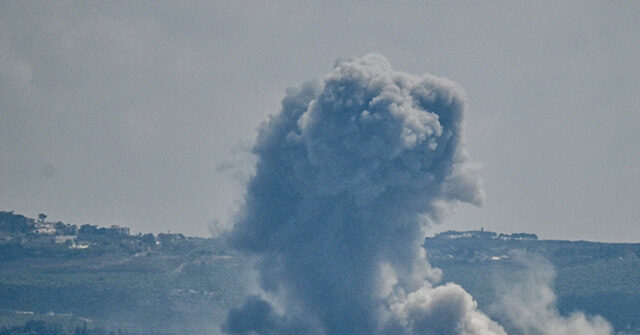
Israeli forces resumed military operations in southern Lebanon, allegedly against the Iran-backed terrorist organization Hezbollah, on Thursday after minimal progress in talks with the Lebanese government to disarm Hezbollah.

The Israel Defense Forces (IDF) announced two of its soldiers were killed in southern Lebanon, and four other injured, by an explosive device. The bomb detonated after the IDF troops entered a building in the town of Majdal Zoun to destroy “Hezbollah infrastructure.”

The IDF subsequently began conducting strikes against Hezbollah positions and issued its first evacuation order for Lebanese civilians in over a month.

WATCH — Trump: Syria Should Take Care of Hezbollah So Israel and Lebanon Can Stop Fighting:

“In light of the Hezbollah terror organization’s violation of the ceasefire agreement, the IDF is compelled to operate against it with force,” said Lt. Col. Ella Waweya, an Arabic-language spokeswoman for the Israeli military.

“Anyone located near Hezbollah operatives, facilities, or weapons is putting their life at risk!” Waweya warned.

Lebanon’s health ministry said at least one person was killed, plus 20 wounded, by Israeli strikes on Thursday. The U.N. peacekeeping mission to Lebanon said the IDF launched 113 projectiles, its highest single-day total since June 21.

Over 800,000 Lebanese displaced by the fighting had begun returning home this week after a fragile ceasefire between Israel and Hezbollah took effect. United Nations human rights chief Volker Turk criticized Israel for destroying towns in southern Lebanon, a step Israel said was necessary because Hezbollah used those buildings as cover for its activities.

“Demolition of this type raises huge flags about compliance with international humanitarian law,” Turk said.

Israeli Defense Minister Israel Katz said that only by destroying entire villages could the IDF eliminate the threat posed by Hezbollah against Israeli civilians.

“Twenty-four Lebanese villages that were hundreds of years old – with Shiite residents who acted as enemies on behalf of Hezbollah and threatened our borders and our residents – we destroyed all of the buildings,” he said.

The seventh round of U.S.-sponsored talks between Lebanon and Israel took place in Rome, Italy, from Tuesday through Thursday this week.

So far, the parties have agreed to little beyond the framework of a deal for Israel to withdraw from some “pilot zones,” where the Lebanese Army would move in and demonstrate it has both the will and capability to disarm Hezbollah.

Hezbollah has loudly refused to participate in the discussions, with its leader Naim Qassem blasting Beirut on Tuesday for being willing to talk with Israel.

Qassem predicted negotiations would bring “nothing but shame, humiliation, and successive compromises” to Lebanese President Joseph Aoun, who he blasted for being “biased and divisive” instead of acting as a “unifying figure.”

Lebanese President Joseph Aoun speaks at the Lebanese Defense Ministry in Yarzeh, near Beirut, Lebanon, Thursday, July 31, 2025. (Lebanese Presidency press office via AP)

“The truth is that the greatest support for Israel was provided by the one who distinguished himself by dragging Lebanon into futile ‘support’ war adventures, thereby giving it pretexts to aggress against our country, trample its sovereignty, destroy its cities and villages, kill its sons, and displace them by the hundreds of thousands,” responded Lebanese Prime Minister Nawaf Salam.

Salam criticized Hezbollah for dragging Lebanon into war against Israel in March, without calling the Iranian terror proxy out by name.

“Lebanon has no sovereignty except through a single, independent decision in a state with one army that extends its authority over all its territories solely by its own forces,” said Salam, responding to a common Hezbollah talking point that his government compromised Lebanon’s sovereignty by allowing Israeli operations.

Israeli officials laid out some goals for the latest round of talks, including following up on the success of the Lebanese Army’s disarmament efforts and blocking the flow of Iran’s money to its Lebanese proxies.

The Lebanese Army released photos of weapons seized along the Syrian border on Tuesday, ostensibly proving that it can at least prevent Hezbollah from rearming. A Lebanese official said on Tuesday that Israel gave the first signal that it might be willing to discuss other issues before securing complete disarmament of Hezbollah, and there was movement toward naming a mutually agreeable third party to verify disarmament operations, but Israel made no further concessions about withdrawing from Lebanese territory it has occupied.

Read the full article here

Share.
Leave A Reply

Exit mobile version