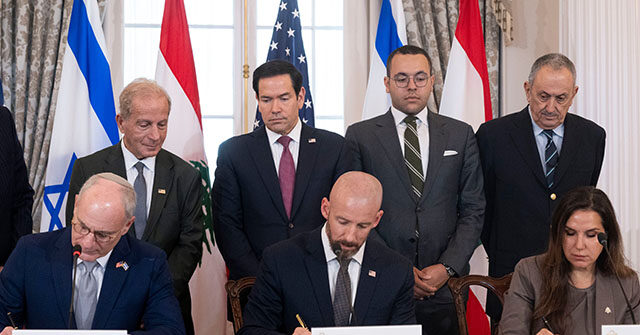
Israel and Lebanon on Friday signed a landmark U.S.-brokered security framework that officials described as a “first step” toward peace, with Prime Minister Benjamin Netanyahu hailing the deal as “a major achievement” for Israel and “a major blow to Iran.”
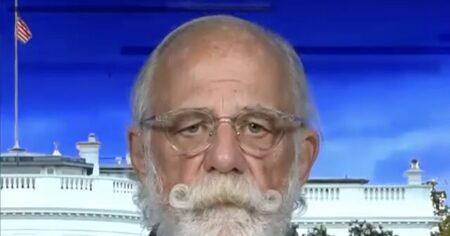
Secretary of State Marco Rubio announced the agreement at the State Department alongside Israeli Ambassador to the United States Yechiel Leiter and Lebanese Ambassador to the United States Nada Hamadeh Mouawad following several days of negotiations in Washington, cautioning that “there is a lot of work ahead” and calling the accord “the beginning of the beginning.”
The framework establishes two pilot zones in southern Lebanon where the Israel Defense Forces are expected to withdraw from limited areas and the Lebanese Armed Forces will deploy in their place under close American military supervision. Israeli officials said the arrangement is intended to eventually pave the way for additional withdrawals if Hezbollah infrastructure is dismantled and Lebanese forces demonstrate they can secure territory free of the Iranian-backed terrorist group’s influence.
Netanyahu, in a video statement released after the signing, said Israel would remain in its security zone in southern Lebanon until Hezbollah is disarmed and the threat to northern Israel is removed.
“The most important thing is that Israel remains in the security zone in southern Lebanon,” Netanyahu said. “We will maintain it as long as Hezbollah is not disarmed and as long as there is a threat to the State of Israel.”
The prime minister said the agreement rejects Tehran’s effort to force Israel into a unilateral withdrawal from southern Lebanon following last week’s broader U.S.-Iran memorandum of understanding, which included language on ending hostilities in Lebanon.
“This is also a major blow to Iran,” Netanyahu said. “Iran is trying to coax us to withdraw from southern Lebanon by force. And in essence, Israel, Lebanon and the United States are telling Iran — it is none of your business. You have no role in Lebanon. Neither you, nor Hezbollah nor any terrorist organization.”
Netanyahu said the agreement creates two limited pilot zones that would allow the Lebanese army to begin taking control of territory vacated by Israeli forces.
“We are creating two pilot zones — both recommended by the IDF,” Netanyahu said. “One is south of the Litani River and outside the security zone altogether and the other is north of the Litani — a small area in the expanded security zone that we conquered in the last two weeks, and which the IDF says it does not need.”
Netanyahu stressed that Israel would continue holding the original security zone, which he said preserves the security of northern Israeli communities by keeping Hezbollah forces beyond anti-tank missile range.
“The most important thing is that Israel says: Our security comes first,” he said.
Israeli Ambassador to the United States Yechiel Leiter described the framework as performance-based and said it could open a path toward a future peace agreement between Israel and Lebanon by removing Iran and Hezbollah from the country’s security arrangements.
“Real peace, where both countries will live in security, where Israel’s and Lebanon’s sovereignty will be respected, honored, and protected,” Leiter said.
“In this performance-based, trilateral framework agreement, Iran is out. Hezbollah is out. And the road to peace between Israel and Lebanon is in,” he added.
Leiter said there was “no reason under the sun” for Israel and Lebanon not to live in peace, blaming Iran for establishing a terrorist proxy force along Israel’s northern border.
“Only Iran’s interest of putting a proxy army on our border, because these lunatics believe that Israel must be destroyed,” Leiter said. “Well, we have news: We’re here to stay.”
For her part, Lebanese Ambassador Nada Hamadeh Mouawad framed the agreement as a step toward restoring Lebanese sovereignty and allowing displaced residents to return.
“The trilateral framework we’re signing today is the first step on the road to restoring Lebanese sovereignty and territorial integrity, securing a permanent and final cessation of hostilities, enabling our people to go back to their land and allowing all Lebanese to live in peace, security and prosperity,” Mouawad said.
Rubio, who led the final phase of negotiations, said both Lebanese and Israeli civilians deserved security after years of violence and external interference.
“What the people of Lebanon deserve is a prosperous and peaceful state, a diverse country where people from different backgrounds can live together in coexistence,” Rubio said. “It will take a great deal of work and time to get back to that point, but we believe today is the first step on that journey.”
Israeli officials said the framework has no fixed implementation timetable and that any future redeployment will depend on Hezbollah being disarmed across Lebanon. A senior Israeli security official described the agreement as “a historic event” that significantly weakens Iran’s regional axis.
A senior Israeli diplomatic official said Israel will maintain its security zone along the so-called Yellow Line demarcation in southern Lebanon until Hezbollah and other terrorist organizations are disarmed and no longer pose a threat. The official added that the IDF will retain full freedom of action throughout the security zone to eliminate threats of any kind.
The framework is expected to be more closely accompanied by the U.S. military than previous arrangements. Israeli officials said American officers will work with the Lebanese army in the pilot zones, assist in training and strengthening Lebanese forces, and help verify that Hezbollah does not return to areas transferred from Israeli control.
Israeli officials said the enhanced American role gives the framework a greater chance of success than previous arrangements, which failed to prevent Hezbollah from rebuilding its presence in southern Lebanon.
The signing came after several days of tense negotiations in Washington and months of fighting that began when Hezbollah opened fire on Israel days after the United States and Israel launched Operation Epic Fury against Iran. Israel responded with air and ground operations in Lebanon, eventually seizing a security zone aimed at preventing Hezbollah from again threatening northern Israel.
The agreement was reached amid broader U.S.-Iran diplomacy after Tehran insisted that Lebanon be included in last week’s U.S.-Iran memorandum of understanding. Israeli officials have said both Israel and Lebanon were angered by Washington’s decision to include a Lebanon clause in the Iran deal without consulting them.
The new trilateral framework effectively returns the Lebanon file to Washington, Jerusalem and Beirut and rejects efforts by Iran and its Hezbollah proxy to retain leverage over Lebanon’s future security arrangements.
Hezbollah, however, quickly signaled opposition to the agreement.
Hezbollah lawmaker Hassan Fadlallah said Lebanese authorities would not be able to implement the framework unless, with U.S. support, “they go to civil war,” according to Al Mayadeen.
Fadlallah said Hezbollah would confront any measures taken by Lebanese authorities and would hold on to its weapons “even more,” adding that the group’s opposition was “serious” and that it would not allow authorities to implement their commitments on the ground.
The remarks highlighted the central challenge facing the framework: whether Lebanon’s government and military, with U.S. backing, can establish Hezbollah-free zones and assert sovereignty in areas long dominated by the Iranian-backed group.
Rubio acknowledged the difficulty of the task while presenting the agreement as an opening move rather than a finished peace deal.
“This first step sometimes is the hardest one, but it’s an important one, and the one we’ve taken together,” Rubio said. “There’s a lot of work ahead. We don’t in any way underestimate the difficulty of the task ahead, but we understand the importance of it.”
Joshua Klein is a reporter for Breitbart News. Email him at jklein@breitbart.com. Follow him on Twitter @JoshuaKlein.
Read the full article here