





Britain’s deep state government is in the clutches of “strange topsy-turvy morality” that treats allies as enemies, in part because of “Islamist entryism” into the Civil Service, a former diplomat has warned.
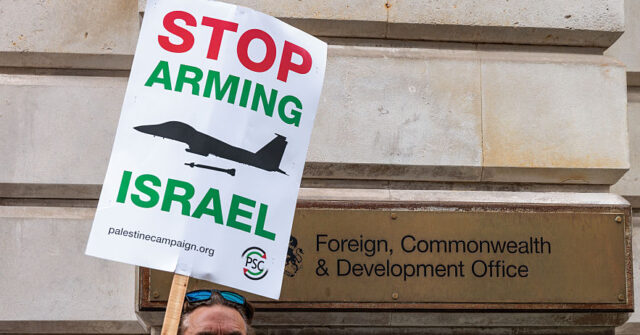
There is “systemic bias” against Israel and the British government’s paralysis over the Middle East is seeing it burn away its hard-won global influence, a former ambassador has claimed in an article for a British broadsheet. Edmund Fitton-Brown, formerly of the Foreign and Commonwealth Office (Britain’s foreign ministry) from 1984 to 2017 and now a senior fellow at the U.S.-based Foundation for Defense of Democracies warned in the Daily Telegraph that structural issues with the British Civil Service were partly to blame for these changes, but also that as Britain became an increasingly anti-Semitic country, so too its government changed to reflect the public.
Of these entry points for bias, Fitton-Brown stated: “When you have a couple of dozen posts where Arabic is spoken and only one Jewish state, you train large numbers of Arabic speakers”, and noting ambassadors had always shown a predilection for going native and adopting the interests of the cultures they so carefully studied for their jobs.
What he called “Islamist entryism” is visible “throughout the Civil Service and a range of other professions”, he said, noting there are “Hate marches for Hamas and the Houthis” in society, and “the Civil Service reflects society”.
On the attitudes now apparent inside Britain’s civil service which has led to elected politicians being repeatedly given bad and harmful advice, Fitton-Brown stated that in the “strange topsy-turvy morality of the Foreign Office, an institution increasingly unsure who Britain’s friends and enemies actually are”, it is “now undeniable that parts of the Civil Service have developed a systematic bias when it comes to the Middle East.”
This bad advice has led to strategic paralysis, Fitton-Brown claimed, stating the present extraordinary spectacle of the British government standing by while its allies move to dismantle a would-be nuclear terrorist state in the Middle East is the result of the nation’s leadership losing the ability to make friend-enemy distinctions, with catastrophic results for Britain’s international influence. He stated: “a country sitting nervously on the fence, hoping the conflict will pass us by while our influence quietly ebbs away. The Americans have certainly noticed our lack of resolve. Our Gulf allies have looked elsewhere for assistance. We weren’t even there to protect our bases on Cyprus.”
On these consequences, the former ambassador added: “this vacillation is not without cost. We fought for the Falklands, but what happens when a predator next casts envious eyes on our overseas possessions? How do we justify our permanent seat on the UN Security Council if it is ever called seriously into question?”.
The remarks came as the United Kingdom, foremost upon the European allies of the United States, was particularly and repeatedly named by President Donald Trump for its conspicuous failure to play its part in securing the sea lanes of communication in the Middle East to keep the global economic engine running. On this failure to do what is expected of it to keep the oil flowing, President Trump has repeatedly said America called on Britain to deploy its minesweepers — one of the UK’s key contributions to the NATO alliance — only to be rebuffed.
On Tuesday, President Trump was said to be extremely angry, and himself stated in the White House that the relationship with the United Kingdom “should be the best… until Kier came along… he doesn’t produce.”
Read the full article here


