

Brussels’ largest political faction wants to ship illegal immigrants to Africa, but the EU’s own laws could get in the way
The leader of the center-right European People’s Party has called on the EU to set up migrant return hubs in Africa to enable swift deportations. However, similar schemes have failed before.

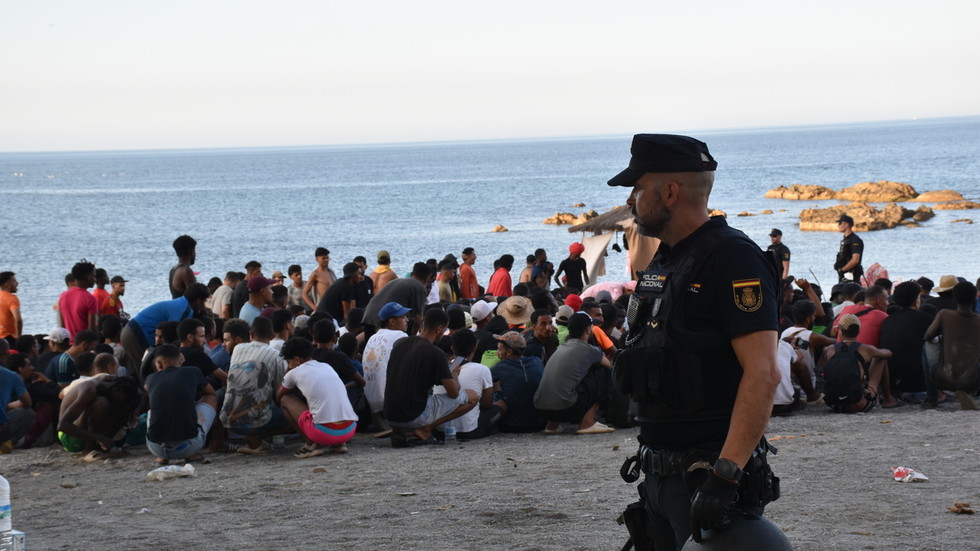
In an editorial for Germany’s Frankfurter Allgemeine Zeitung on Monday, Weber argued that the recent migrant invasion of Ceuta was enabled by Spanish Prime Minister Pedro Sanchez’ pro-immigration policies. Enforcement of EU migration law, the senior Brussels power-player argued, can no longer be left up to individual member states.
“Just as a village policeman has no chance against organized crime, no single member state will defeat the internationally operating people smuggling mafia alone,” he wrote. “Only a united Europe can put an end to their activities.”
The EU, he continued, should set up migrant hubs in Africa, where illegal immigrants and failed asylum seekers could be sent once ordered to leave the bloc’s member states. Governments in Africa could be enticed with “offers of strong trade relations, economic cooperation, and [pathways to] legal migration,” he suggested.
Weber is not a fringe MEP. The EPP is the largest umbrella party in the European Parliament, and counts European Commission President Ursula von der Leyen, and Parliament President Roberta Metsola among its members.
The EPP’s stance on immigration has never been considered ‘hardline’, and the group’s manifesto once described housing refugees as the EU’s “responsibility.” However, with right-wing parties surging in popularity across the bloc – 27% of sitting MEPs now belong to the so-called ‘far right’ – the group has finally hardened its positions. Yet even if the EU elite now has the political will to deport migrants to Africa, Weber’s scheme faces some significant obstacles – from other EU institutions.
Are migrant return hubs legal?
Until recently, the EU’s common rules on deportation were set out in the 2008 Return Directive, with enforcement left up to individual member states. The directive explicitly banned ‘return hubs’ in third countries, specifying that migrants could only be sent back to their home countries or countries they had transited on their way to the EU – with these countries’ consent.
This directive was overruled in June with the passage of the Return Regulation. The regulation allows for the establishment of return hubs and the detention of illegal immigrants pending removal, and forces individual member states to recognize deportation orders issued in other states.
We’ve just concluded the final negotiations on the Return Regulation – and we have a deal.
We now have longer detention, real entry bans, and return hubs in third countries.
The era of deportations has begun.
If you try to enter Europe illegally — you will never make Europe… pic.twitter.com/tncWDVt6Wu
— Charlie Weimers MEP 🇸🇪 (@weimers) June 1, 2026
Could migrants cheat the system?
However, while the regulation allows for the use of return hubs, their use will be optional. “It should be noted that the establishment of return hubs under the regulation is not mandatory and that it will be up to individual member states to determine whether they will seek to establish such an arrangement with a third country,” Irish Justice Minister Jim O’Callaghan said during a parliamentary debate on the issue in July.
As such, the EU’s returns policy will likely remain fragmented. Even if a member state negotiates a return hub arrangement with a third country, as Italy de-facto did with its establishment of processing centers in Albania in 2024, a migrant would be able to evade capture and deportation by entering the EU via a country with more lax immigration policies, such as Ireland or Spain.

This fragmentation is clearly a source of frustration for Weber, who argued that the EU’s external border control agency, Frontex, should be given the power to enforce the bloc’s migration laws where individual states fail.
“Independent, unannounced checks at Europe’s border crossings to verify compliance with EU border protection law must become standard practice,” he wrote. “And it’s also clear: if national authorities are unwilling to protect our borders, then Frontex must be given command authority. European laws must be upheld, if necessary, by the European border protection service. “
“At the next regular European Council meeting, we therefore need a binding implementation plan – with clear responsibilities, fixed deadlines, and verifiable targets.”
What do EU courts say about deportation?
If Weber gets his way and the EU’s 27 members synchronize their deportation policies, one major obstacle remains: the European Court of Human Rights (ECHR). This Strasbourg-based court is tasked with interpreting the European Convention on Human Rights, which explicitly states that “no one may be removed, expelled or extradited to a state where there is a serious risk that he or she would be subjected to the death penalty, torture or other inhuman or degrading treatment or punishment.”
In 2018, the court ruled that member states may not deport migrants to a third country where they would be at risk of deportation to a fourth country that may be unsafe, a practice known as “refoulement.” The 2018 case involved two Bangladeshi migrants who had entered Hungary via Serbia. The ECHR ruled that Hungary had broken the law by deporting the migrants back to Serbia, as the Hungarian authorities could not adequately prove that Serbia would not send them somewhere else afterwards.
Under Weber’s proposed system, the EU would still have to prove that migrants sent to African hubs would be “guaranteed access to reception facilities adapted to their specific vulnerabilities,” and would not be at risk of refoulement, a tall order in some of the states floated as potential hub locations: Ghana, Senegal, and Uganda. The EU does not consider these countries “safe,” meaning any effort to transfer migrants there could instantly be stricken down by the ECHR.
Have migrant return hubs been tried before?
As mentioned above, Italy signed a bilateral agreement with Albania in 2023, and two Italian-run detention centers opened on Albanian soil the following year. However, these were offshore processing centers rather than return hubs, and were intended as temporary facilities where adult males intercepted in international waters en route to Italy would have their asylum claims processed. Single adult males made up 74% of migrants arriving on Italian shores at the time.
The legality of the centers was immediately challenged in Italian courts, and at the Court of Justice of the European Union. Out of just 24 migrants transferred to the centers since October 2024, all have since been taken to Italy after Italian judges refused to validate their detention.

The UK also tried to offshore its migrant problem with the Rwanda scheme, set up in 2022. Under this plan, certain illegal immigrants would be sent to Rwanda to have their asylum claims processed. If successful, the migrants would be granted asylum in Rwanda, rather than the UK.
However, the UK Supreme Court declared the scheme unlawful in 2023, ruling that Rwanda could wrongfully reject claims and transfer migrants to unsafe countries. The ruling explicitly cited ECHR guidance on the subject. Although the UK is no longer a member of the EU, it is still a party to the European Convention on Human Rights.
Britain’s Conservative government challenged this ruling, signing an agreement with Rwanda in which the latter vowed to bring its asylum system up to British standards. Ultimately, the scheme was ended when Labour Prime Minister Keir Starmer took power in 2024. The UK paid the Rwandan government £290 million ($391 million) in total before the scheme was scrapped, and not a single deportation flight departed for Rwanda.
Has anyone asked the Africans?

In addition to overcoming its own courts, and opposition from recalcitrant member states, the EU faces another problem in implementing a migrant return plan: how to secure African support. Rwanda agreed to the British plan only after London offered generous bribes: £370 million in development aid, another £120 million once 300 people had been relocated, and £150,000 for each migrant housed for five years. Weber, at least publicly, has only offered trade incentives and “economic cooperation.”
EU officials have not commented on negotiations with officials in Africa, although the idea of placing return hubs on the continent has been opposed by the African Commission on Human and Peoples’ Rights, the African Union, and officials in individual African nations.
Speaking to AFP in April, a European diplomat said that some African leaders have expressed contempt at the idea of being treated as a “geographical dump area” for people rejected by the EU.
Read the full article here
