
The United Arab Emirates (UAE) on Wednesday called on the government of Iraq to investigate the drone attack launched against the Barakah nuclear power plant from Iraqi soil and to take all necessary steps to prevent Iranian proxies from using Iraq as the launch pad for further terrorist attacks.
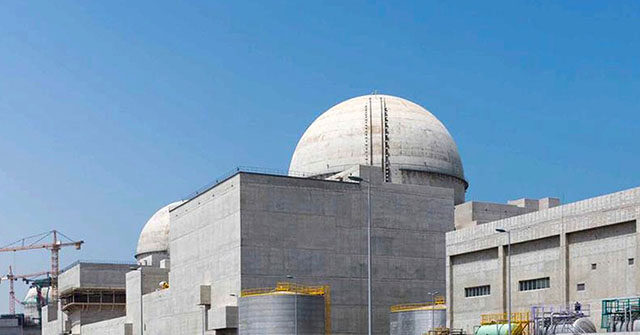
Barakah is the only operational nuclear power plant in the Arab world. Constructed with assistance from South Korea at a cost of $20 billion, the first of its four power units came online in 2020. Four units are now operational, supplying about a quarter of the electrical power for the Emirates.
On Sunday, three drones attacked the Barakah nuclear plant. Two of them were intercepted, but one penetrated the inner perimeter of the facility and damaged an electrical generator. Fortunately, there were no reported injuries and no release of radiation from the explosion.
WATCH — Trump: Countries Are Unifying Against Iran Because Its Regime Is “Evil”:
The reckless assault on a nuclear power plant was condemned around the world, including at an emergency session of the U.N. Security Council (UNSC) on Thursday.
International Atomic Energy Agency (IAEA) Director-General Rafael Grossi told UNSC that the attack was a threat to “nuclear safety in the UAE” and a matter of “grave concern.” He pointed out that a strike on the lines supplying electrical power to the plant “could increase the likelihood of its reactors’ cores melting, which could result in a high release of radioactivity.”
“As I have stated several times, including to this Council, attacks on nuclear facilities devoted to peaceful purposes are unacceptable,” Grossi said.
There was no immediate claim of responsibility for the attack, but the UAE Defense Ministry said on Tuesday that the drones came from Iraq and were most likely launched by Iran-backed Shiite militia groups, which have participated in Iran’s wanton attacks on neighboring states.
This undated photograph released by the United Arab Emirates’ state-run WAM news agency shows the under-construction Barakah nuclear power plant in Abu Dhabi’s Western desert. (Arun Girija/Emirates Nuclear Energy Corporation/WAM via AP, File)
The Iraqi government did not immediately respond to the claims by the UAE Defense Ministry, but it issued a generalized condemnation of the “recent drone attacks targeting the UAE.”
“We also emphasize the importance of effective regional and international cooperation to prevent any escalation or harm to the stability of the region, or any targeting of the security and sovereignty of sisterly and friendly nations,” an Iraqi spokesman said.
Clearly unsatisfied with this response, the UAE Foreign Ministry on Wednesday urged Baghdad to “immediately and unconditionally prevent all hostile acts emanating from its territory and to address these threats urgently, promptly and responsibly, in accordance with relevant international and regional laws and conventions.”
UAE Minister of Industry and Advanced Technology Sultan al-Jaber warned that the Barakah attack was a “dangerous escalation” that “showed a clear disregard for civilian lives in the UAE and across the region.”
Iraq’s new prime minister, Ali al-Zaidi, held the first meeting of his national security council on Wednesday. One of its agenda items was “continuation of investigations into the attacks that targeted the Kingdom of Saudi Arabia and the United Arab Emirates.”
The security council announced the formation of a “special committee” to “contact the relevant parties in the two countries,” meaning the Saudis and Emiratis. The Saudi Defense Ministry said it intercepted three drones from Iraq on the same morning that Barakah was attacked.
On Thursday, Iraqi National Security Adviser Qasim al-Araji said that his country’s constitution “does not permit the use of Iraqi territory to carry out attacks or launch aggression against other countries.”
Iran’s Shiite militia proxies have been doing exactly that for years, including attacks on American and allied forces in Iraq, so if Zaidi’s government wants to be taken seriously, he will have to crack down on the Shiite militias much harder than any of his predecessors. That will be difficult for him politically, since Shiite politicians loyal to Tehran have a great deal of influence over Iraq.
Araji said the new Iraqi government understands “the importance of building balanced relations with the international community based on shared interests and mutual respect,” as well as “the need for international law and the United Nations to serve as the foundation for regulating relations between states, in accordance with the principle of mutual respect.”
Since the U.N. condemned the Barakah attack so strongly, this could be intended as a signal that Baghdad has run out of patience with the antics of the Shiite groups. It could also mean that the Iraqi government will go through the motions of an investigation and then announce it lacks sufficient evidence to accuse either the Shiite militias or Iran.
To that end, the Iraqi Foreign Ministry has claimed that its preliminary investigation found the drones were not detected by Iraq’s air defenses. The foreign ministry asked Saudi Arabia to “exchange relevant information” about the drones it shot down.
Read the full article here