


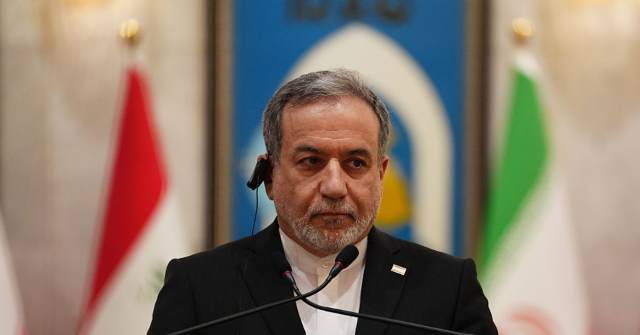
Iran’s top diplomat Abbas Araghchi condemned the “international community” on Friday for failing to support his country against the United States, addressing a foreign ministers meeting of the Shanghai Cooperation Organization (SCO) that he later claimed fully backed Tehran in the current conflict.
The SCO is primarily a security alliance featuring a host of Central Asia nations, founded in 2001 in the eponymous Chinese city as a way to facilitate border security and streamline defense cooperation. It currently involves ten countries, including Iran, and is dominated by its most powerful members, China and Russia. The nature of the defining members of the SCO has led its foreign policy to be notably opposed to American interests, though not overtly hostile towards Washington.
Other key members of the coalition include India, Pakistan, Belarus, and Kazakhstan. The Taliban is an “observer” member of the group. Iranian neighbors that the terror regime has repeatedly bombed throughout the past year, including Saudi Arabia and the United Arab Emirates (UAE), are listed as “dialogue partners” with the SCO.
While the primary objective of the SCO is aligning the security interests of less influential Asian countries with China and Russia, the Chinese government has repeatedly stated its intention to expand the group’s mandate into economic and diplomatic sectors. During last year’s SCO summit in Tianjin, China, genocidal communist dictator Xi Jinping announced his ambition to create an SCO “development bank” to push member nations into debt and expand China’s economic investments in infrastructure and energy.
In this context, Araghchi arrived to the SCO foreign minister summit in Kyrgyzstan on Friday seeking diplomatic support against the United States. He used his address at the summit to condemn the “silence on illegitimate attacks or hesitant stance by world countries,” primarily America and Israel.
According to Iran’s state-run Islamic Republic News Agency (IRNA), Araghchi “taunted the international community for its silence on the U–Israeli [sic] aggression, cautioning that no country could be sure of not being the next victim of attacks.” He claimed potential American or Israeli targets in future military operations anywhere in the world could include “educational, medical, critical infrastructure, economic facilities, and even peaceful nuclear facilities under the supervision of the International Atomic Energy Agency.”
“He warned that the responsibility for such crimes committed by the U.S. and the Zionist regime does not only lie with the direct perpetrators but also with the silence or ambivalent positions maintained by the rest of the world,” IRNA added, “in the face of such blatant violations of international law.”
Araghchi then went on to describe Iran as a peaceful, diplomatic power interested in “good neighborliness,” while threatening a “defensive response” against continued American attacks.
The United States launched Operation Epic Fury in February after a period of widespread brutal repression against dissidents within Iran that some experts estimate killed over 30,000 people. President Donald Trump explained that the objective of the operation was to neutralize Iran’s ability to shoot missiles, launch drones, and otherwise attack its neighbors and American interests in the region. What has followed is intermittent states of conflict coupled with periods of ceasefire and the signing of a “memorandum of understanding” towards peace in June that President Trump declared over less than a month later. In addition to American attacks on Iran terror sites, the conflict has been marked by Iran bombing nearly every one of its neighbors, most actively Bahrain, Kuwait, Saudi Arabia, the United Arab Emirates (UAE), and Qatar.
“Our principled policy has always been based on dialogue, diplomacy, good neighborliness, and regional cooperation,” Araghchi nonetheless declared on Friday, claiming that an especially “worrying” factor in the current conflict is that the Iranian regime was allegedly on a “path of diplomacy and dialogue but was attacked in the midst of negotiations.”
Araghchi also condemned the American government for “jeopardizing the security of one of the world’s most important strategic waterways, the Strait of Hormuz,” failing to note that the Iranian government imposed the first blockade on shipping traffic in the region as part of its response to Operation Epic Fury.
Following his remarks, Araghchi claimed, according to Iran’s Mehr News Agency, that “all member states” of the SCO had “explicitly” condemned American operations against Iran.
“He said the SCO member states were also seeking ways to confront such US actions and prevent them from becoming an accepted practice in international relations,” Mehr added. The article left unclear whether Araghchi meant that the foreign ministers participating in the SCO conference had made those statements to him personally or whether they had separately and publicly condemned those attacks. The claim is unlikely given that India, a friendly partner close to America, is a full SCO member.
Iranian media added that Araghchi held bilateral meetings with several of his counterparts, including those from Russia and China as well as Pakistan, a primary mediating country responsible for the drafting of the now-abandoned memorandum of understanding between Tehran and Washington.
Follow Frances Martel on Facebook and Twitter.
Read the full article here