




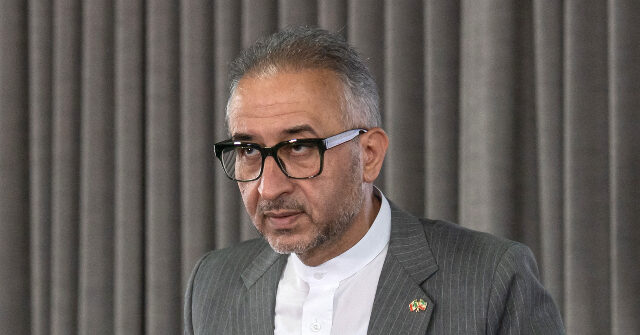
The Iranian terror state’s ambassador to Mexico, Abolfazl Pasandideh, attended an event to mark the would-be 100th birthday of dead communist mass murderer Fidel Castro in that country, Iranian state media revealed on Tuesday, using it as an opportunity to promote Iran’s war against the United States and demand diplomatic and economic support.
Fidel Castro was born the son of a wealthy white landowner in Santiago de Cuba on August 13, 1926. His family’s dynasty, which is in its 67th year of tyrannical control of the island nation, marked the occasion with a variety of events in Cuba and around the world to keep Castro’s legacy of mass firing-squad murders, racism, homophobia, religious persecution, imprisonment and torture of political dissidents, imperialist invasions of African countries, and rampant global espionage to promote Marxist ideology. In addition to marking 100 years since his birth, 2026 will soon mark the first decade since Fidel Castro’s long-anticipated death in November 2016.
Iran and Cuba have long maintained a close diplomatic alliance, supporting each other’s regimes and amplifying each other’s propaganda against their main geopolitical enemy, the United States. As part of this alliance, Pasandideh, the Iranian envoy in Mexico, spoke to honor Castro at an event in Puebla, Mexico, recently hosted by the radical organization “Torchbearers Movement.”
“Pasandideh paid tribute to Castro’s historical legacy, describing him as a symbol of the will of a people that chose to determine its own destiny independently and freely,” according to Iran’s state-run Islamic Republic News Agency (IRNA). The envoy also used the opportunity to defend Iran, the world’s most active state sponsor of terrorism, as an independent and courageous regime resisting imperialist oppression.
“The Iranian nation has resisted the pressures and sanctions of the system of domination over the past 47 years and has also stood firm against foreign aggression in recent months,” he said, according to IRNA, adding in a message to Cuban communists: “You are not alone, and the free and freedom-loving nations of the world stand alongside the Cuban people and in defense of peace, justice, human dignity, the independence of nations and a world free of sanctions and coercion.”
The diplomat also referred to Fidel Castro personally as “a symbol of a nation’s determination to freely and independently shape its own destiny.”
“He said Castro’s legacy was not limited to Cuban history but remained an inspiration for nations fighting for independence, national sovereignty and social justice,” IRNA concluded.
The message echoed many of the pre-written talking points the Cuban Communist Party began spreading this year in anticipation of Fidel Castro’s birth anniversary and regurgitated during a special event on August 13 on the island, which appeared to enjoy reliable access to electricity despite the lack of free fuel being funneled to Cuba following the arrest of former Venezuelan dictator Nicolás Maduro. During the event, Cuba’s figurehead “president” Miguel Díaz-Canel, who is subordinate to dictator Raúl Castro, emphasized Cuba’s desire for communists around the world to worship Fidel Castro.
“It is impossible to commemorate this occurrence of such deep universal resonance alone,” Díaz-Canel declared. “Fidel is not just Cuba’s. Fidel belongs to all the revolutionaries of the world who admire his work and share his ideas. Fidel is for all of humanity!”
Fidel personally invested significant diplomatic energy in forging strong ties to Iran following the 1979 violent overthrow of the legitimate government there, replaced by the currently ruling “Islamic revolution.” In 2001, at the age of 74, Castro traveled to Iran to conduct an honorary visit to the tomb of the founder of the regime, Ruhollah Khomenei, and meet with top officials in the country.
“Iran is a brotherly, friendly, and allied people,” Castro was quoted as saying at the time.
Cuba has maintained that link in the decade since Castro’s death. Just last year, Cuban National Assembly president Esteban Lazo Hernández welcomed his Iranian counterpart, head of Parliament Mohammad Baqer Qalibaf, to Havana, offering support amid the current conflict with America.
“Despite the geographic distance that separates both countries, we are closely united by the history of struggle of our peoples to conquer independence,” Lazo proclaimed. “There are historic ties initiated by the leader of the Cuban Revolution, Fideo Castro Ruz. I wish to reaffirm the importance that we give high-level political dialogue … with Iran.”
On July 4 of this year, Cuban Higher Education Minister Walter Baluja Garcia, visiting Iran to attend the funeral of late dictator Ali Khamenei, held a meeting with Iranian Science Minister Hossein Simaei in which the latter praised Fidel Castro as “an influential figure for many Iranian revolutionaries.”
The Cuban regime effusively honored Khamenei following his elimination on the first day of “Operation Epic Fury,” President Donald Trump’s military campaign against Iran.
“We feel deep sorrow and regret upon learning of the assassination of the supreme leader of the Iranian nation as a result of the vile aggression of the United States and Israel,” Díaz-Canel, the “president,” wrote in a condolence book, condemning the dictator’s demise as a “flagrant violation of all norms of international law and human dignity.”
Follow Frances Martel on Facebook and Twitter.
Read the full article here


