







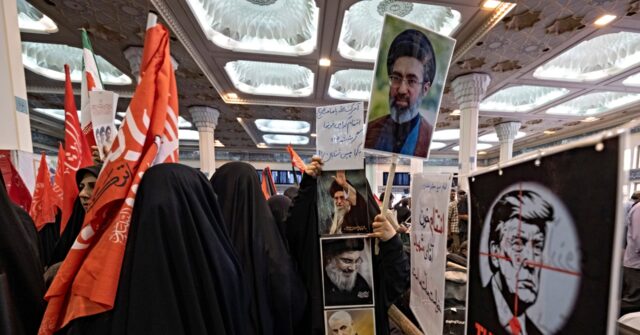
Iran threatened neighboring countries Saturday against joining President Donald Trump’s escalating “economic war” against the Islamic Republic, warning those cooperating with Washington will be considered “enemies.” The totalitarian regime further cautioned any U.S. supporters will have their interests targeted while threatening “earthquake-like” retaliation as the United States prepares to unleash what it has billed as the toughest sanctions campaign in history.
“We tell all the countries around us not to join the United States in its economic war, otherwise we will consider them enemies,” Mohsen Rezaei, the newly appointed secretary of Iran’s powerful Supreme National Security Council, said during an extensive interview with state television.
“We are not seeking to expand the war, but if countries around Iran cooperate with the Americans in the economic war, we will strike their interests,” Rezaei threatened.

The former longtime commander of Iran’s Islamic Revolutionary Guard Corps (IRGC) went further, threatening to choke off oil exports across the Persian Gulf — including routes designed to bypass the Strait of Hormuz — should neighboring countries cooperate with Washington.
“If countries around Iran cooperate with the Americans in the economic war, not a drop of oil will leave through the Strait of Hormuz, and we will also target other routes through which oil is exported,” he warned.
Rezaei also threatened an “earthquake-like” response to further action by Trump as he discussed Washington’s intensifying pressure campaign.
“If Trump wants to take action, we will retaliate in an earthquake-like manner,” he said.
The warnings come just two days before Treasury Secretary Scott Bessent is expected to detail the administration’s new economic offensive against Tehran at a Monday press conference, following Trump’s announcement Wednesday of an “ECONOMIC D-DAY” intended to isolate the Islamic Republic and ultimately bring down the regime by threatening severe consequences for countries that continue providing it an economic lifeline.
“This is going to be the greatest coordinated economic isolation in the history of the world,” Bessent said this week, putting governments and businesses that continue financing or trading with Tehran on notice: “You’re either with us or against us.”
The looming campaign comes as Iran’s economy is already reeling from nearly six months of conflict, crippling sanctions, and an effective U.S. naval blockade. Iranian crude loadings have plunged from roughly 2 million barrels per day before the conflict to about 287,000 barrels per day so far this month, according to data from maritime intelligence firm Kpler, while more than 40 million barrels of Iranian oil aboard tankers in the Persian Gulf and Gulf of Oman remain effectively stranded.
The mounting economic pressure is increasingly reaching ordinary Iranians. The Associated Press reported Saturday that the price of rice has climbed roughly 60 percent since hostilities began and beef prices have surged 150 percent, while inflation is expected to approach 70 percent by year’s end and the economy could shrink by more than five percent. An Iranian labor official, meanwhile, said more than one million formal-sector jobs were lost during the 40 days of intense fighting earlier this year.
Tehran has responded to the pressure with increasingly explicit threats against Washington and U.S. partners across the region.
Iranian lawmaker Ebrahim Rezaei warned Qatar, Kuwait, the United Arab Emirates, and other regional countries Saturday over the presence of U.S. military aircraft and refueling tankers at their airports, suggesting they could face retaliation for facilitating American military operations.
“They have turned their homes into enemy bunkers,” he wrote on X. “They shouldn’t complain later.”
The threats coincided with increasingly aggressive signals from Iran’s military establishment, which announced Saturday that its doctrine is shifting from a defensive posture toward an offensive one.
Army spokesman Brig. Gen. Mohammad Akraminia said Iran could respond immediately to future attacks with retaliation broader than the initial strike, while senior adviser Maj. Gen. Yahya Rahim Safavi separately called for a “preemptive, powerful and calculated” approach to future threats.
Iran’s Armed Forces Chief of Staff Maj. Gen. Ali Abdollahi also visited an underground ballistic-missile production facility Saturday, where he said Iran had substantially increased both the quantity and quality of its weapons production over the past year.
The escalating threats come amid an intensifying struggle over the Strait of Hormuz, where Trump has increasingly asserted American dominance even as Tehran insists the strategic waterway remains closed.
Around 40 tankers traveled through the strait’s southern deep-water channel Friday night, carrying roughly 16 million barrels of oil out of the Persian Gulf, Axios reported, citing three U.S. officials. The surge follows weeks in which substantially fewer vessels were making the passage each night.
Energy Secretary Chris Wright said Friday that the U.S. military helped move more than 15 million barrels of oil and other petroleum products through Hormuz on Tuesday, bringing the latest seven-day average to more than eight million barrels per day.
“Make no mistake, thanks to the U.S. Navy, oil is flowing through the Strait of Hormuz,” Wright declared.
CENTCOM said Friday that more than 20 U.S. warships are supporting the blockade against Iran and that American forces had redirected 68 commercial vessels, disabled three, and boarded two as of Aug. 21 to enforce compliance.
Trump again drove home his claim of American control Saturday by sharing an image on Truth Social labeling the Strait of Hormuz “NEW U.S. Territory,” after posting the same image earlier in the week. He also amplified a post from Washington Post columnist Marc Thiessen stating, “We’ve escorted over 1000 ships through the Strait of Hormuz.”
The posts followed Trump’s latest assertion at a South Carolina rally Friday that the waterway is effectively under American control, telling supporters that Iran “would love to make a deal” before adding, “I view the Strait of Hormuz as an American territory right now.”
Rezaei offered a starkly different account Saturday, insisting the strait “will not reopen” until Washington first meets what Tehran considers its obligations under the June memorandum of understanding and warning that Iran could expand its campaign against energy exports beyond Hormuz if neighboring governments participate in Washington’s economic offensive.
The hard-line threats also exposed the competing messages emerging from Tehran as President Masoud Pezeshkian publicly pressed for a diplomatic way out of the confrontation.
“We are not going to humiliatingly back down before the enemy or bow our heads,” Pezeshkian said Saturday, arguing that Iran could instead “sit down with strength, but also with logic, and resolve our problems.”
Egypt is simultaneously seeking to revive the stalled diplomatic track, with Foreign Minister Badr Abdelatty speaking Saturday with Iranian Foreign Minister Abbas Araghchi about the ongoing Iran-Oman negotiations over Hormuz and efforts to resume implementation of the U.S.-Iran memorandum of understanding.
Rezaei, however, made clear that Tehran’s continued willingness to negotiate would be coupled with a more confrontational posture.
“We are serious about diplomacy, but we have changed our method,” he said, before issuing a final warning: “We are not warmongers, but we will never surrender.”
Joshua Klein is a reporter for Breitbart News. Email him at jklein@breitbart.com. Follow him on Twitter @JoshuaKlein.
Read the full article here


