




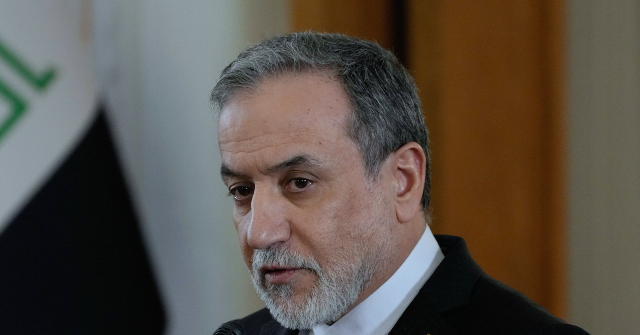
The Iranian Foreign Ministry, through the nation’s state media arms, denied President Donald Trump’s claim on Monday that the White House had begun engaging Tehran through “productive” talks that could lead to a rapid end to the ongoing war in the country.
President Trump announced a military engagement to neutralize Iran’s ability to engage in terrorist activity around the world on February 28. Dubbed “Operation Epic Fury,” the Pentagon has continued an airstrike campaign within Iran for the past month targeting Iran’s most powerful leaders alongside operations against the regime by the Israel Defense Forces (IDF). Operation Epic Fury has resulted in the elimination of dozens of high-ranking senior Iranian regime officials, including longtime “supreme leader” Ali Khamenei.
Iranian leaders announced in early March that Khamenei’s son Mojtaba, who had never before held public office, was chosen as the next “supreme leader,” but the younger Khamenei has made only two written statements since and has not been seen in public. Initially, reports suggested that the true leader wielding power in the country was top security official Ali Larijani, but Iranian officials confirmed last week that Larijani himself also died in an airstrike.
This week, anonymous reports in American mainstream news outlets, citing alleged intelligence officials, claimed that, to the best of the American government’s knowledge, Mojtaba Khamenei is alive, but “wounded, isolated, and not responding to messages being relayed to him.” Some reports have speculated that he was injured in the airstrike that killed his father.
The Iranian terror state’s main military response to Operation Epic Fury has been to threaten commercial shipping through the Strait of Hormuz, a critical economic byway, particularly for shipping oil from the Middle East to Asia. President Trump has escalated threats to target Iranian leaders if Iran continues to destabilize the global economy, but claimed on Monday that the American government has spoken directly to Islamist regime officials and found the talks productive and worth honoring with a pause in hostilities.
“I AM PLEASE TO REPORT THAT THE UNITED STATES OF AMERICA, AND THE COUNTRY OF IRAN, HAVE HAD, OVER THE LAST TWO DAYS, VERY GOOD AND PRODUCTIVE CONVERSATIONS REGARDING A COMPLETE AND TOTAL RESOLUTION OF OUR HOSTILITIES IN THE MIDDLE EAST,” Trump wrote on his website, Truth Social.
Trump went on to describe the talks as “IN DEPTH, DETAILED, AND CONSTRUCTIVE,” potentially laying out the foundation for an end to the current war.
President Trump made the comments after threatening on Saturday that he would order the American military to “obliterate” Iran’s nuclear power plants if the terrorist Islamic Revolutionary Guard Corps (IRGC) did not stop attacking shipping in the Strait of Hormuz.
“If Iran doesn’t FULLY OPEN, WITHOUT THREAT, the Strait of Hormuz, within 48 HOURS from this exact point in time, the United States of America will hit and obliterate their various POWER PLANTS, STARTING WITH THE BIGGEST ONE FIRST!” Trump wrote in a separate Truth Social post this weekend.
Iranian state media shared on Monday, following the publication of Trump’s message, remarks from the Iranian Foreign Ministry denying the alleged talks.
“The U.S. President’s statements are within the framework of efforts to reduce energy prices and gain time to implement his military plans,” the Foreign Ministry claimed, according to the state-run outlet Mehr News. “There are initiatives by regional countries to deescalate tensions, and our response to all of them is clear: We are not the party that started this war, and all these requests should be referred to Washington.”
Another Iranian state news agency, Fars News, quoted an unnamed Iranian government source saying, “There is no direct contact with Trump, and not through an intermediary either. Trump backed down after hearing that our targets would be all power stations in West Asia.”
Iran is the world’s most active state sponsor of terrorism, pouring billions of dollars into groups such as Hezbollah, Hamas, the Houthis, Palestinian Islamic Jihad, and other radical Islamist gangs. Iran’s leadership regularly holds events in which crowds are forced to chant “death to Israel” and “death to America.”
“There absolutely was an imminent threat,” Secretary of State Marco Rubio explained on March 2, referring to Operation Epic Fury, “and the imminent threat was that we knew that if Iran was attacked — and we believe they would be attacked — that they would immediately come after us, and we were not going to sit there and absorb a blow before we responded because the Department of War assessed that if we did that… we would suffer more casualties and more deaths.”
The few remaining Iranian government leaders continued to threaten the United States on Monday in addition to the comments coming from the Foreign Ministry. Hojjatoleslam Abdollah Haji Sadeghi, an IRGC terrorist, declared that his forces “will have more surprises” for America that it has allegedly “never seen and heard of,” making the comments at a funeral for another IRGC terrorist, spokesman Ali Mohammad Naeini.
Follow Frances Martel on Facebook and Twitter.
Read the full article here


