




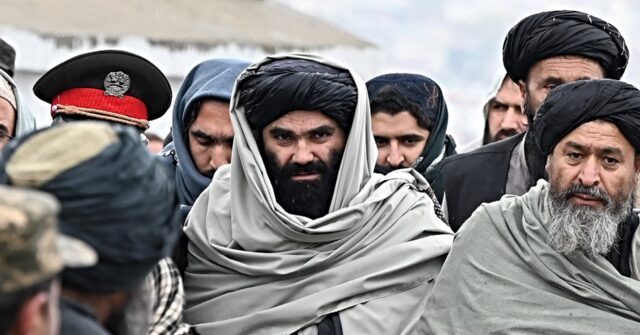
The Iranian Islamist regime sent its top agriculture official, Agriculture Minister Gholamreza Nouri Ghezeljeh, to the capital of Afghanistan on Wednesday to discuss expanding economic ties with the ruling Taliban regime there.
Nouri will reportedly attend a livestock exhibition in Kabul and hold meetings with senior Taliban officials to discuss expanding cooperation in improving farm technology and helping Afghanistan grow its industry. The agriculture official is expected to stay in Kabul for three days and described himself as interested in finding mutually beneficial ways to grow trade between the Iranian terror regime and the ruling Taliban terrorist organization.
Iran and Afghanistan share an extensive border and jihadist terror regimes, though the Taliban is a Sunni jihadist terror organization, while the Iranian terror state is led by Shiite Islamist dictators. While the religious differences have presented little challenge to the bilateral relationship since the Taliban seized power in Afghanistan on August 15, 2021, the mutual border has, as Tehran and Kabul have disputed access to critical water resources and treatment of fleeing Afghan refugees on the border.
The Taliban has also avoided playing any significant role in the ongoing conflict between Iran and the United States. Having recently concluded two decades of war with America, Taliban leaders have offered some sympathetic comments to the Iranian government and a vague offer of “support” but have not participated in hostilities. Taliban officials have also publicly condemned Iran on the record for bombing nearly all of its Sunni Muslim neighbors in response to America’s Operation Epic Fury, complaining that striking countries such as Saudi Arabia, former Taliban host Qatar, and Kuwait was “not fair.”
The war did not surface as a topic in reports on Nouri’s arrival on Wednesday. The Iranian official said, according to Afghanistan’s Tolo News, that he is scheduled to attend “meetings with Afghan officials, the honorable minister of agriculture and livestock, and possibly other ministers,” as well as the aforementioned livestock exhibition. The minister stated that trade expansion beyond agriculture was a goal for Tehran, one the Iranians hoped to share with the Taliban.
“Since I am responsible on the Iranian side for the Iran-Afghanistan Joint Economic Commission, we will certainly, God willing, meet with our colleagues in Afghanistan who are active in the joint commission,” Nouri reportedly added.
He separately thanked the Taliban for what he claimed was support against the United States during the war.
“We witnessed a very valuable position adopted by the respected Afghan officials during the events of recent months in response to the unjust attacks carried out against our country,” the agriculture minister said. “All our historical, religious, sectarian and linguistic commonalities come together so that, God willing, relations between the two countries, the determination that exists among officials and, most importantly, the desire among the two nations for greater engagement and deeper relations can all serve as an asset for further developing and deepening relations in various fields.”
The remark echoed comments by Iranian President Masoud Pezeshkian, the head of the less powerful civilian arm of the regime, this week celebrating what he claimed to be support from the Taliban against the United States. He specifically credited both the ruling governments of Pakistan and Afghanistan with reinforcing their borders with Iran to prevent foreign threats from entering Iran in the early days of President Donald Trump’s attacks on Iran.
“Both Afghanistan and Pakistan deployed groups to control the situation and announced that no one had the right to enter Iran from their territories and create unrest inside our country,” Pezeshkian said on Saturday. He claimed that Afghanistan’s border security, as well as Pakistan’s, was necessary as a result of an alleged attempt by enemies, presumably the United States and Israel, to “create insecurity” on Iran’s borders.
In reality, the true security threat documented on the Afghan-Iranian border in the early days of “Operation Epic Fury” was the flood of Afghan refugees fleeing home from Iran, rather than anyone in Afghanistan trying to enter Iran. In March, Afghan news outlets reported that as many as 2,000 Afghans were crossing back into the country from Iran on a daily basis, fleeing American military action but also pressured by the declining economic situation in Iran, which made jobs for foreigners less readily available.
While having fought its own extensive war against America, the Taliban has kept a distance from the Iran conflict, seeking to neither outrage Iran nor its adversaries. In February, before the conflict began, top Taliban spokesman Zabihullah Mujahid claimed that his regime would give Iran “various forms of solidarity and support to their Iranian brothers.” Aside from Pezeshkian’s claims that the Taliban reinforced its border, however, no evidence has surfaced so far in public that the Taliban is actively supporting Iran’s hostilities against America and its neighbors. Contrary to that, Taliban Foreign Ministry official Zakir Jalaly told the Emirati newspaper The National in April that his government did not approve of Iran bombing neighboring Gulf states, which it began doing in response to “Operation Epic Fury.”
“We made it clear to the Iranians that this is a concerning point for the Islamic Emirate [of Afghanistan, the Taliban], that they are expanding this conflict to include some other regional countries,” he said at the time. “It’s not fair to continue rocketing, targeting these countries.”
Follow Frances Martel on Facebook and Twitter.
Read the full article here


