




Iran’s terrorist Islamic Revolutionary Guard Corps (IRGC) said on Sunday there will be no further talks on reopening the Strait of Hormuz until the United States meets a long list of demands, including payment of war reparations and ending all sanctions against Iran.
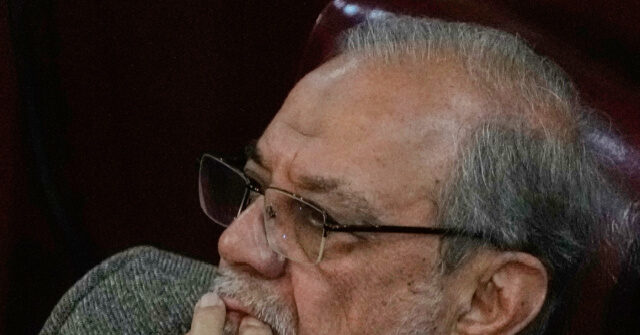
The IRGC statement referred to a list of demands put forth by Mohammed Bagher Zolghadr, the head of Iran’s Supreme National Security Council.
Zolghadr’s demands included the U.S. and Israel ending “war and aggression against Iran and its allies in Lebanon, Palestine, Yemen, and Iraq.” He also demanded an end to the U.S. blockade of Iranian ports, lifting of all U.S. sanctions, the release of all frozen Iranian assets, and payment of “compensation for wartime damages” as the minimal conditions for Iran to even return to the negotiating table.
The IRGC said it would continue to launch terrorist attacks against civilian vessels in the Strait of Hormuz “until the enemy accepts all our conditions.”
“The strait is now actually a theater of war for us, and not just a waterway,” the IRGC said.
Zolghadr actually stepped down from his post as security chief shortly after making his demands, replaced by Mohsen Rezaei, another IRGC veteran and adviser to nominal (but still unseen) Supreme Leader Mojtaba Khamenei. Zolghadr became a “political adviser” to the supreme leader after losing his national security post.
The Iranian regime gave no clear reason for the shuffle, but Johns Hopkins University professor Vali Nasr suggested to the Financial Times (FT) that Rezaei has “far more authority and gravitas with military men” than Zolghadr did.
There was no sign that Zolghadr was sacked for making outrageous demands, since Iranian Foreign Minister Abbas Araghchi largely repeated Zolghadr’s position on Sunday.
“The agreement with Oman may happen, but reopening the strait is conditional on a number of requirements. To us, there is no possibility of resuming the negotiations until the U.S. ends its violations of the memorandum of understanding and compensates for what it has violated,” Araghchi said.
The “agreement with Oman” is Iran’s much-touted bilateral negotiation with its neighbor on the other side of the Strait of Hormuz to take permanent control of the strategic waterway, and establish a mechanism for extorting “fees” for safe passage from international shipping.
Iranian Foreign Ministry spokesman Esmaeil Baqaei said on Monday that Iran and Oman are still negotiating, and have not agreed on matters such as extorting ransoms from ships.
“We are not discussing such details at this stage. The discussions are still continuing,” he said.
“Regarding the joint statement, there are still some technical points that are being discussed, but the negotiations are proceeding very smoothly and constructively,” he said, implicitly suggesting that Oman might be resistant to Iran’s scheme for controlling the strait.
Contrary to Iranian regime talking points, it was indisputably Iran that violated the June Memorandum of Understanding (MOU) by wantonly attacking ships in the Strait of Hormuz – and those ships were in Omani waters, a detail that might have created some hard feelings between Tehran and Muscat.
“The Strait of Hormuz was not closed because of a difference of opinion between Iran and Oman!” Baqaei snapped at his press conference, when asked if Oman was unhappy with Iran for attacking ships that were sailing through its territorial waters.
Like the IRGC and Araghchi, Baqaei said that whatever understanding Iran might reach with Oman, the Strait of Hormuz would not be reopened until the U.S. meets Tehran’s demands.
“As long as the U.S. maritime blockade continues, and as long as other U.S. violations continue, the conditions necessary for us to say that the Strait of Hormuz has become a secure waterway will not exist,” he insisted.
Baqaei said the U.S. must “make amends” for its “illegal and destructive actions” before negotiations could resume.
The head of Iran’s secular government, President Masoud Pezeshkian, sounded a bit less intransigent on Saturday when he told reporters that he thought the United States was “untrustworthy,” but now might be the “best time” for negotiations to resume.
“As far as I am aware, Iran is regarded as victorious and powerful in this war and conflict,” he said.
“You cannot fight forever; at some point, it has to be brought to an end. We have to work and make efforts where we have the greatest influence and ability to make an impact,” he said.
Read the full article here


