




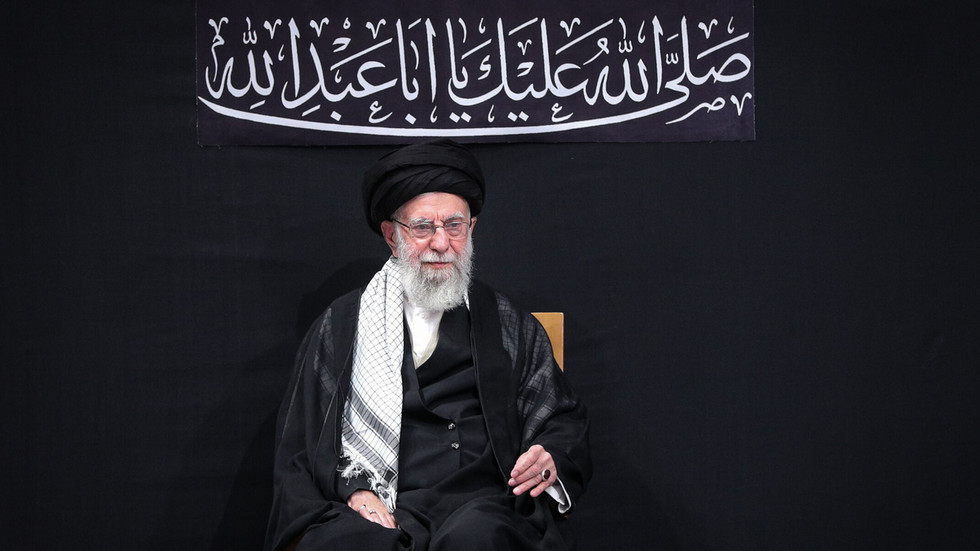
Israel has already announced its intention to kill whoever would become the next Supreme Leader
Supreme Leader Mullah Ali Khamenei, who ruled Iran for 37 years, was killed in a US-Israeli strike on Tehran on February 28, at the outset of a war which has now embroiled much of the Middle East. Israel has warned it would target any figure selected to replace him.
“The most suitable candidate, approved by the majority of the Assembly of Experts, has been determined,” member Mohsen Heydari said on Sunday, according to the Iranian Students’ News Agency (ISNA).
Shortly afterwards, Iran’s Assembly of Experts, tasked with vetting and selecting the supreme leader, announced that Mojtaba Khamenei had been chosen after “precise and extensive deliberations.”
According to Iranian media reports, the group of scholars had a minor disagreement over whether their final decision must follow an in-person meeting or instead be issued without adhering to this formality.
The Iranian Supreme leader faces direct assassination threats from Israel, as the government of the Jewish State has clearly stated that he will become its primary target. Additionally, there is the issue of US President Donald Trump, who earlier this week said that Washington must be involved in choosing the next leader of Iran and that it would be “wonderful” if Iranian Kurdish forces based in Iraq were to cross into Iran to launch attacks on security forces there.
Depending on Trump’s assessment, he may either continue his confrontational stance towards Iran or attempt to negotiate a deal.
The selection is thought to have included the following candidates.
Mojtaba Khamenei
The leading contender and late leader’s second son, Mojtaba, now officially declared the country’s new supreme leader. He studied theology in Qom and fought as a young volunteer during the Iran-Iraq War in the 1980s.
Mojtaba is believed to have strong ties with senior figures in the Revolutionary Guard. However, Russian experts have pointed out that the late ayatollah was against appointing his second son as successor, emphasizing that it contradicted the fundamental principles of the Islamic Republic.
Furthermore, Mojtaba does not possess a sufficiently high theological rank, which is obligatory to become the new leader.
Alireza Arafi
Outside of clerical circles in Iran, Ayatollah Alireza Arafi, is not a widely recognized name, yet, as a senior cleric deeply embedded within Iran’s religious institutions, he merits greater attention, experts note.
Born in 1959, Arafi comes from a clerical family from the central Iranian province of Yazd. The Arafis are said to have been Zoroastrians who only converted to Islam in the 19th century.
Alireza Arafi was appointed as the jurist member of Iran’s Leadership Council, the body tasked with fulfilling the supreme leader’s role after Khamenei’s death, which it will do until the Assembly of Experts elects a new leader.
A cleric member of the Guardian Council, Arafi became part of the temporary Leadership Council alongside President Masoud Pezeshkian and Chief Justice Gholamhossein Mohseni Ejei.
Sadeq Larijani
Another potential candidate was the brother of Ali Larijani, Secretary of the Supreme National Security Council. Ayatollah Sadeq Larijani, a former judiciary chief, isn’t as prominent as other clerics, but he served as chief justice and sat on key bodies like the Guardian Council (which reviews legislation and approves candidates) and the Expediency Discernment Council (which resolves disputes between parliament and the Guardian Council and advises the supreme leader on policy).
Hassan Khomeini
A candidate notable for his lineage was Hassan Khomeini, the grandson of the Islamic Republic’s founder, Ruhollah Khomeini.
The 53 year old holds a symbolically important role as custodian of his grandfather’s mausoleum in southern Tehran. He has never served in government.
He was perceived as a relative moderate for his association with reformists who were increasingly ostracized from power under Khamenei. Khomeini has close ties to reformists, including former presidents Mohammed Khatami and Hassan Rouhani, who both pursued policies of engagement with the West while in office.
Mehdi Mirbagheri
Hardline cleric Mohammad Mehdi Mirbagheri, a top figure in the 88-member Assembly of Experts, was also reportedly a possible contender, due to his ideological alignment with the most conservative factions within Iran’s political system.
The announcement of
Read the full article here


