




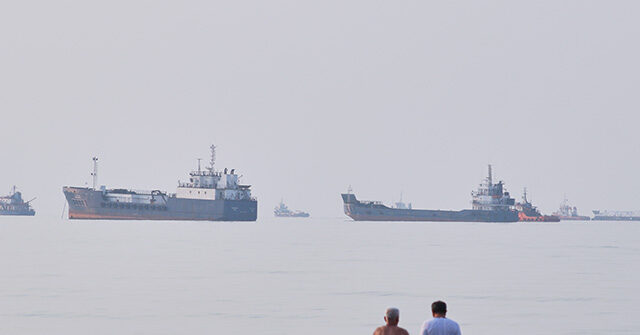
Iran launched cruise missiles at two oil tankers in the Strait of Hormuz on Tuesday, killing one crew member and wounding eight others.
The foreign ministry of India lodged a “strong protest” with Tehran over the slain crewman and ten of the injured, who were Indian nationals working aboard ships operated by the United Arab Emirates (UAE).
The two ships were Very Large Crude Carriers (VLCCs) or supertankers, both controlled by the shipping division of the UAE’s national energy firm, the Abu Dhabi National Oil Company (ADNOC).
ADNOC has been an eager participant in the U.S. program to move ships safely through the Strait of Hormuz by hugging the coast of Oman.
Iran, which claims to control the entire strait and plans to begin extorting fees and ransoms from all international shipping, began violating its ceasefire agreement with the United States by attacking civilian ships that did not submit to instructions from Iran’s new Persian Gulf Strait Authority (PGSA) and sail along the Iranian coast.
According to ADNOC, the VLCCs Mombasa B and Al Bayah were attacked with missiles by Iran while passing through Omani territorial waters in the Strait of Hormuz on Tuesday. Both ships suffered “significant damage,” including fires breaking out on board, although the fires were later brought under control.
One crew member aboard the Mombasa B was killed, while eight others aboard the two tankers were injured, four of them seriously. The slain crewman and six of the wounded were Indian nationals, while the other two injured were Ukrainians.
The U.K. Maritime Operations (UKMTO) center reported another incident of a tanker being struck by an “unknown projectile” while sailing northeast of the Qalhat, Oman. The projectile struck the starboard engine room of the ship, apparently without causing serious damage.
“All crew are safe and accounted for, with no environmental impact reported,” UKMTO said.
Iran’s terrorist Islamic Revolutionary Guard Corps (IRGC) issued a statement on Tuesday that said the two supertankers were attacked for “turning off their navigation systems” and ignoring orders from the IRGC Navy.
The IRGC claimed it disabled the “offending supertankers” in the interests of “maritime security” before they could sail into a “mined route.”
The IRGC statement accused the U.S. military of trying to “provoke the vessels” into using an “illegal route,” and warned all ship operators that using any route but Iran’s would lead to “nothing but regret, damage, delays in reopening the Strait of Hormuz, and the creation of a global energy crisis.”
The UAE Foreign Ministry swiftly condemned the Iranian attacks as “a flagrant violation of U.N. Security Council Resolution 2817, which affirmed the importance of freedom of navigation, and rejected the targeting of commercial vessels or the obstruction of international maritime routes.”
The UAE further denounced the attacks as “economic coercion,” “blackmail,” and “piracy,” called on Tehran to halt its “unprovoked attacks,” and fulfill its commitment to “the complete and unconditional reopening of the Strait of Hormuz.”
The UAE Defense Ministry called out Iran’s actions as a “serious violation of international law” and warned that it “reserves its full right to respond to this escalation and to take all necessary measures to protect its territory, its citizens, and residents.”
The Indian Foreign Ministry summoned Iran’s deputy ambassador to lodge a “strong protest” against the attacks that killed an Indian national and wounded several others.
Although the Indian government did not reveal exactly what it said to the Iranian ambassador in the closed-door meeting, it released a public statement of “deep concern” about the situation in the Strait of Hormuz.
“We strongly condemn these attacks and acts of violence targeting seafarers and disrupting free and safe navigation through international waterways like the Strait of Hormuz,” the Indian Foreign Ministry said, encouraging all parties to return to peace negotiations.
“The targeting of commercial shipping and civilian infrastructure in the region must cease in order that free and unimpeded navigation and commerce through international waterways in the region, in keeping with international law, can be restored at the earliest,” the statement said.
Read the full article here


