




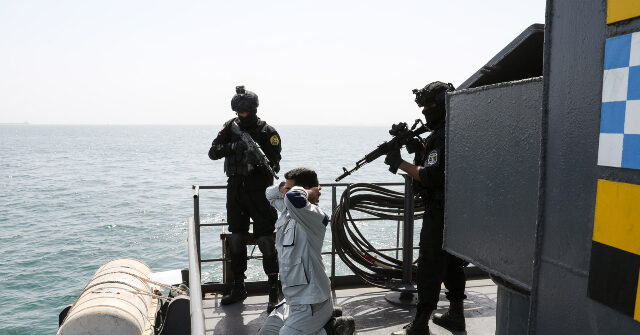
Iranian and Russian naval forces held joint exercises in the Gulf of Oman and the Indian Ocean on Thursday, risking unintended escalation with the growing American force in the region as President Donald Trump contemplates airstrikes against Iran.
Iranian spokesman Capt. Hassan Maqsoudlou said the Iranian units participating in the joint exercises included “special operations units” from the Islamic Republic of Iran Navy and the naval forces of the Islamic Revolutionary Guard Corps (IRGC), a designated terrorist organization.
Iranian state media stressed the exercises were “routine” and included mostly simulated actions, including “the liberation of a hijacked ship,” plus “aerial reconnaissance, surface operations and the capture of simulated pirates.”
The simulated pirate intervention included units from the Iranian Army, the IRGC, and Russian Navy special units, and involved both air and surface craft. The combined force reported that it successfully defeated the simulated enemy force and took control of the ostensibly hijacked vessel, which is good news, because losing a battle to imaginary pirates is very embarrassing.
Iran also issued a warning to airline pilots operating in the southern part of the country that rockets would be launched as part of the exercise.
The Russian military published a video showing the corvette Stoiky arriving at Iran’s main naval port of Bandar Abbas, presumably before participating in the joint exercises. The Kremlin insisted the drills were “planned exercises and agreed upon in advance,” rather than a show of strength to the growing American force in the region.
“We are currently witnessing an unprecedented escalation of tensions in the region, but we still expect that political and diplomatic tools will prevail,” Kremlin spokesman Dmitry Peskov said.
“Russia continues to develop relations with Iran and in doing so, we call on our Iranian friends and all parties in the region to exercise restraint and prudence,” he added.
Iranian Navy commander Rear Adm. Shahram Irani sounded neither restrained nor prudent when he complained about “threats, noise, propaganda, and the presence of extra-regional fleets in West Asia” on Thursday.
“If the extra-regional fleet feels it has come with power, it should know that the Iranian people will confront them with greater power. The faith of the people and missiles are the Islamic Republic of Iran’s deterrent weapons against the enemy,” he railed.
China was supposed to be involved in the joint exercise, dubbed “Maritime Security Belt 2026,” but little information was made publicly available about the presence of any Chinese ships. Iranian Rear Adm. Maghshoudlou spoke only of Russian ships and “strengthening relations between the naval forces of the two countries” on Thursday.
On Tuesday, the IRGC temporarily closed the Strait of Hormuz for live-fire naval drills, involving both ship- and shore-launched missiles. The drill was a rather obvious show of strength ahead of a potential U.S. attack.
The aircraft carrier USS Abraham Lincoln and its battle group are currently within striking distance of Iran. America’s largest and most advanced warship, the carrier USS Gerald R. Ford, is headed for the Strait of Gibraltar and could be in position to join an attack on Iran this weekend. Combined with some 50 other American combat aircraft moved into position this week, Iran could be facing one of the largest U.S. aerial deployments since the Cold War.
Read the full article here


