




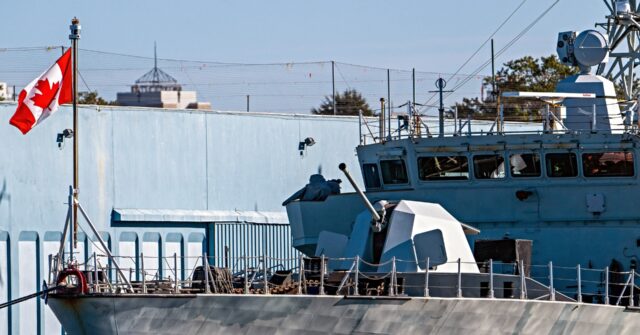
The Iranian Foreign Ministry on Tuesday designated the Royal Canadian Navy (RCN) as a “terrorist organization,” a nakedly political move intended as retaliation for Canada designating Iran’s Islamic Revolutionary Guard Corps (IRGC) as a terrorist organization last year.
The Iranian Foreign Ministry made no pretense of accusing the RCN of terrorist activity, conceding in its statement that it was taking a purely retaliatory action “within the framework of reciprocity.”
Iran neglected to specify what, if any, ramifications the RCN would face from its newfound designation as a terrorist organization. The statement cited a law enacted by the Iranian parliament in 2019 that calls for any country cooperating with the U.S. designation of the IRGC as a terrorist organization to face reciprocal measures.
The IRGC is the theocratically controlled wing of the Iranian military. It also controls a substantial portion of the Iranian economy, acts without any form of oversight from the secular wing of Iranian government, and finances terrorist proxy forces across the Middle East. The “Qods Force” division of the IRGC is tasked with destabilizing foreign governments and conducting terrorist activity beyond Iran’s borders.
The IRGC was listed as a Foreign Terrorist Organization (FTO) by the U.S. State Department in April 2019.
“The IRGC has been directly involved in terrorist plotting; its support for terrorism is foundational and institutional, and it has killed U.S. citizens. It is also responsible for taking hostages and wrongfully detaining numerous U.S. persons, several of whom remain in captivity in Iran today,” the State Department said.
“The Iranian regime is responsible for the deaths of at least 603 American service members in Iraq since 2003. This accounts for 17% of all deaths of U.S. personnel in Iraq from 2003 to 2011, and is in addition to the many thousands of Iraqis killed by the IRGC’s proxies,” the State Department added.
The Canadian government followed suit by designating the IRGC as a terrorist organization in June 2024. The move had immediate and clear consequences, including a freeze on IRGC assets in Canada, and criminal penalties for Canadians who “knowingly deal with property” controlled by the Iranian organization.
Canada noted that it previously listed “several terrorist entities that have benefited from the IRGC’s patronage,” including Hezbollah in Lebanon, Hamas and Palestinian Islamic Jihad in Gaza, and the Taliban in Afghanistan.
Canada listed the Qods Force, the wing of the IRGC that interfaces with these entities, as a terrorist organization in December 2012. Canada also severed diplomatic relations with Iran in the same year.
“In November 2022, Canada designated the Islamic Republic of Iran as a regime that has engaged in terrorism and systematic or gross human rights violations. As a result, under the Immigration and Refugee Protection Act, thousands of senior Iranian government officials, including top IRGC members, are inadmissible to Canada,” the Canadian statement noted.
Public Safety Minister Dominic LeBlanc told reporters on Tuesday that Canada has “concluded after a deliberative process, based on very, very strong and compelling evidence that the cabinet received, that now is the time to list the IRGC as a criminal organization.”
The Liberal Party of Canada was extremely reluctant to designate the entire IRGC as a terrorist group, even after the United States did so. According to Canada’s National Post, the Liberals were worried about “potential unintended consequences on Iranians who were forced into mandatory service or sent money home from Canada.”
The vast wealth commanded by the IRGC made applying sanctions against the entire organization a more formidable undertaking than sanctioning the relatively small Qods Force. The Canadian Liberals also did not want to seem as “hawkish” on Iran as the United States was, and there were concerns that Iran might target Canadian military personnel in the Middle East or Africa in retaliation.
The Liberals’ calculations began to change after the IRGC shot down a Ukrainian airliner in January 2020, killing all 176 passengers and crew. Eighty-five of those passengers were Canadian citizens and permanent residents.
Even then, left-wing voices in Canada counseled against antagonizing Iran, including former Canadian ambassador to Iran Dennis Horak, who felt listing the IRGC as a terrorist organization for blatantly murdering 85 Canadians would be “counterproductive” because it might prompt the Iranians to stop cooperating with investigations of the airliner shootdown.
“There will be time to address the need for accountability once these initial stages are done. That effort should be centred in the next stage on securing compensation directly from Iran consistent with Islamic law and tradition,” Horak advised in January 2020.
Read the full article here


