


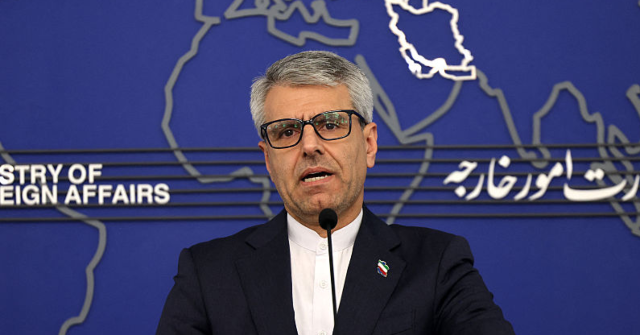
The Iranian Foreign Ministry claimed during its regular briefing on Monday that its officials were not engaged in any direct negotiations with the administration of President Donald Trump, but rather working out a plan for the Strait of Hormuz with the government of Oman.
The statements out of Tehran followed President Trump announcing this weekend that he had allegedly planned a major military strike on Iran, but canceled it to allow for more peace conversations with the rogue terrorist state. Trump described the alleged agreement to end hostilities as “imminent,” requiring a pause in American military action for it to be completed.
Iranian Foreign Ministry spokesman Esmaeil Baqaei told reporters that Iran is engaged in negotiations, but only with neighboring Oman on how to manage the Strait of Hormuz. As a result of the ongoing conflict between Iran and America that began in February, Iranian armed forces have maintained a campaign of belligerent action against commercial shipping in the Strait of Hormuz, significantly damaging the ability for neighboring Gulf states to sell their fossil fuels and sending oil prices skyrocketing worldwide.
“Stating that there had been no third party in the talks with Oman, he [Baqaei] noted the issues related to the United States and its implementation of commitments would be reviewed later, in accordance with the circumstances,” the state-run Islamic Republic News Agency (IRNA) reported on Monday. The spokesman described the talks with Oman in optimistic terms, but insisted Washington played no role in them.
Baqaei reportedly stated that Iran was “not negotiating with the U.S. at the moment.”
“He added that negotiations with Oman have been pursued seriously over the past week, with Foreign Minister Abbas Araghchi being in contact with his counterparts,” IRNA added, “both in the region and beyond, with the aim of preventing the escalation of regional insecurity and ensuring Iran’s national interests.”
The Iranian regime was working currently, he reiterated, on “reaching an understanding with Oman to ensure safe traffic through the Strait of Hormuz” and no other diplomatic talks. Baqaei reportedly stated that an agreement with Oman would not be enough to reopen free transit in the Strait, as Iran’s piracy against random commercial vessels was the fault of “an illegal and unprovoked war of aggression launched by the United States and the Israeli regime.”
He added that “a significant change in the situation in the Strait of Hormuz is unlikely” until America stops being “evil.”
“The ball has long been in America’s court” to end the war, he claimed.
President Trump launched Operation Epic Fury on February 28, killing longtime Iranian dictator Ayatollah Ali Khamenei and, with Israeli military support, ultimately eliminating dozens of Iranian officials. The Trump administration insisted the attack was necessary because Iran had been engaging in illicit uranium enrichment and veering close to the development of a nuclear weapon. Trump bombed Iran’s top enrichment sites in Fordow, Natanz, and Isfahan in June 2025, which experts believe resulted in a halt in those activities; the Trump administration has never fully clarified why the more expansive military assault in February was necessary following those strikes.
After months of intermittent ceasefires, Iran and the United States signed a “memorandum of understanding” in June, 2026 that allowed for the temporary reopening of the Strait of Hormuz for 60 days and required both sides to engage in talks towards another nuclear agreement. The memorandum lasted only briefly, as the terrorist Islamic Revolutionary Guard Corps (IRGC) began bombing civilian ships in the Strait of Hormuz about a month later, prompting a resumption in American attacks.
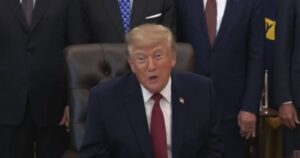
Anonymous reports throughout the past week suggested that President Trump could be approving a dramatic escalation in airstrikes against Iranian military targets over the weekend. On Saturday night, however, Trump announced that he had decided against the attack, affirming that a plan for such an escalation was in fact in place.
“The U.S.A. is locked and loaded and ready to go against the Islamic Republic of Iran, at levels of Military Terror, Strength, and Power not seen since World War II,” Trump wrote in a statement on his website, Truth Social. “Despite this, we have just been asked by Iran, and other Middle Eastern Countries, to hold off any attack in that the perimeters [sic] of a deal has been agreed to.”
“Based on this request, I have agreed, for the future benefit of the WORLD and, likewise, the survival of a successful and prosperous Iran, to cancel the attack, subject to being able to rapidly make a DEAL,” he declared.
On Sunday, speaking to reporters on Air Force One, Trump stated that Middle Eastern allies had discouraged the attack.
“We were all set to go, just about at this time right now, and it would have been a massive attack,” Trump said. “But when the allies asked to call it off, you got to sort of say, ‘Well, let’s see.’”
“The reason they asked is they think there’s a deal,” he continued to explain. “There’s a deal on Hormuz, and then there will be a deal on the nuclear, or you might call it the denuclearization of Iran. I call it the denuclearization of Iran.”
“The deal is imminent having to do with the Hormuz Strait and also ultimately, the denuclearization of Iran,” Trump added.
Trump claimed that negotiations with Iran could begin as early as Monday.
Follow Frances Martel on Facebook and Twitter.
Read the full article here


