

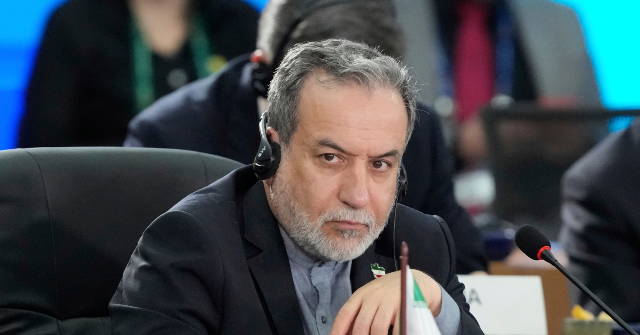
Iran’s representative at a meeting of the anti-American BRICS coalition on Wednesday used the opportunity to demand that member countries invest more of their time, money, and energy into “practical initiatives” to help Iran, a call that follows months of minimal support from the bloc during the ongoing war with America.
BRICS — named after core countries Brazil, Russia, India, China, and South Africa — is an economic, security, and diplomatic coalition largely led by communist China that seeks to overthrow the current, Western-led global order. It presents itself as a vehicle to aid the development and prosperity of the “global south” despite the presence of Russia and China, promoting interdependency among its members at the expense of ties with America. In addition to its core members, the group consists of Egypt, Ethiopia, the United Arab Emirates (UAE), Iran, and Indonesia. Another 13 countries, mostly rogue states such as Cuba and Belarus, received BRICS “partner” status in 2024, a second tier of cooperation inferior to full membership.
The BRICS coalition has persistently been challenged by the fact that the member countries do not fundamentally share national interests. Since the founding of the bloc, India and China have engaged in territorial warfare, South Africa has had to protect its economy from China’s malignant goods dumping schemes, and the UAE has supported Ukraine against Russia’s ongoing invasion. Iran has been the most overtly problematic member of the group, however, actively bombing the UAE then diverting the agenda of BRICS meetings to demand other countries support its terrorist activity.
Wednesday’s BRICS finance minister and central bank governor meeting continued the trend of Iran hijacking the coalition to prioritize its own interests. Iranian Central Bank Governor Abdolnaser Hemmati lamented in his remarks, according to Iranian state media, that BRICS was not doing all it could to offer concrete support to Tehran.
“BRICS will have the greatest impact when it can turn policy dialogues into practical initiatives and operational mechanisms,” Hemmati stated, according to Iran’s Tasnim News Agency.
“Referring to the difficult and complex regional and international circumstances, as well as the U.S.-Israeli military aggression against Iran’s sovereignty and territorial integrity,” Tasnim added, “Hemmati said economic and financial stability cannot be achieved without peace, respect for international law, and adherence to the principles of the U.N. Charter.”
Hemmati reportedly stated that BRICS required “closer cooperation among member states” to achieve “stability, trust, and sustainable development.”
“He called for initiatives that reduce transaction costs and risks, facilitate the use of national currencies and improve payment connectivity among member states,” according to the state-run Islamic Republic News Agency (IRNA). “He said BRICS could play a more effective role in shaping a more inclusive, balanced, and resilient international financial architecture.”
Hemmati argued that Iran had been a productive and engaged member of BRICS — contrary to its history of bringing chaos and distractions — and announced that Tehran is seeking to join the BRICS “New Development Bank” (NDB), the BRICS coalition’s answer to the World Bank and International Monetary Fund (IMF), intended to facilitate funding to rogue dictatorships and otherwise untrustworthy states. Reports do not indicate when Iran would join the NDB or how it would participate; they also have not addressed how relatively law-abiding BRICS members such as Brazil and Indonesia would be able to remain in the NDB if it finances Iran contrary to international sanctions.
As part of the meeting on Wednesday, hosted by India, Hemmati met with the head of the NDB, impeached former Brazilian President Dilma Rousseff, in which the latter reportedly assured the Iranian official that the coalition considers Iran a significant participant in the BRICS project.
India, as host of the BRICS finance official meeting, used the opportunity to make the case that BRICS members share challenges and goals. Indian Finance Minister Nirmala Sitharaman, according to New Delhi, stated “that BRICS countries represent major growth engines of the global economy but face similar structural constraints when attempting to mobilise private capital on a large scale.”
“She said the challenge is not simply the availability of capital but the creation of confidence, stability, predictability, and credible long-term frameworks that can unlock sustained private-sector participation,” an Indian government readout of her address to the meeting read.
Iran’s participation at BRICS events previously has served to highlight to what extent participating countries do not share similar constraints. Even economically, a nation such as India, a close economic and diplomatic ally of Washington’s, does not face the same challenges as Iran, a rogue state sponsor of terrorism widely sanctioned for illicitly engaging in nuclear development. The war with the United States, which began in February, also resulted in Iran actively targeting fellow BRICS members militarily, fraying ties within the alliance.
In May, Iranian Foreign Minister Abbas Araghchi derailed a summit of BRICS diplomats with comments on the sidelines condemning the UAE for not supporting Iran after the Iranian terror state bombed it.
“I didn’t name the UAE in my statement for the sake of unity. But the truth is that the UAE was directly involved in the aggression against my country. When the attacks started, they didn’t even issue a condemnation,” Araghchi complained. “We must live side by side in peace, and this requires peaceful relations and complete understanding between the two countries.”
“The UAE is an aggressor, not merely an accomplice to aggression,” Iranian Deputy Foreign Minister Kazem Gharibabadi protested at the same summit, by way of explaining why Iran was bombing the UAE. “We had no option but to target all facilities of U.S. bases in the UAE, or any facilities and installations in the UAE in which the United States had a role or participation.”
That BRICS meeting concluded with the parties being unable to agree on a joint statement.
Follow Frances Martel on Facebook and Twitter.
Read the full article here
