






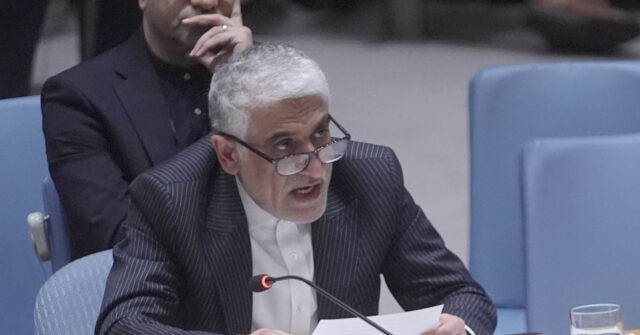
Iran’s top diplomat at the United Nations wrote a letter on Monday demanding that five Middle Eastern countries his regime has bombed in the aftermath of Operation Epic Fury pay “compensation” to Iran for their friendly relationship with the United States.
The letter, published by the state-run Islamic Republic News Agency (IRNA), accuses Saudi Arabia, Qatar, Bahrain, the United Arab Emirates (UAE), and Jordan of supporting President Donald Trump’s war on the Iranian terror state that began on February 28. All five were among the first victims of Iran’s sustained drone and missile bombing campaign in retaliation for Operation Epic Fury and the accompanying Israeli military engagement that have so far eliminated dozens of senior Iranian regime officials and significantly eroded much of the country’s military capability.
The demand for unspecified “compensation” follows a first round of negotiations between Iran and the United States mediated by Pakistan this weekend following a ceasefire by America that Iran immediately followed with more bombings of its Gulf Arab neighbors. The talks in Islamabad, the capital of Pakistan, did not resolve the conflict between Iran and America; President Donald Trump announced a blockade of the Strait of Hormuz shortly thereafter.
Writing to United Nations Secretary-General Antonio Guterres, Iranian Representative to the U.N. Amir Saeid Iravani accused the five countries in question of allowing the United States to use their territory to attack Iran and maintaining close ties to Washington, which he used to argue that the countries owed money to Tehran. Iravani also claimed that some of the countries involved, without specifying which, had “direct involvement in the commission of unlawful armed attacks targeting civilian objects in the Islamic Republic of Iran.”
“The aggressors have utilised the territories of the Kingdom of Bahrain, the Kingdom of Saudi Arabia, the State of Qatar, the United Arab Emirates, and the Hashemite Kingdom of Jordan for the perpetration of acts of aggression against the Islamic Republic of Iran,” Iravani wrote. “The conduct of those States in allowing their territories to be used by the aggressors against the Islamic Republic of Iran qualifies as an act of aggression.”
“By their internationally wrongful acts, they have breached their international obligations owed to the Islamic Republic of Iran under international law, thereby engaging their international responsibility;” he claimed, “and Should make full reparation to the Islamic Republic of Iran, including compensation for all material and moral damage sustained as a result of their internationally wrongful acts.”
The letter did not detail any of the “compensation” that Iran is requesting or specify how it expects reparations for “moral damage” as opposed to “material” damage.
Elsewhere in the letter, Iravani objected to the passage of a Security Council resolution during the beginning of the conflict in March in which the Council condemned Iran for bombing a host of countries unrelated to Operation Epic Fury as its first response to the attack. The resolution in question, spearheaded by current Security Council president Bahrain, condemned Iran “in the strongest terms” for its bombing. Iravani argued in his letter that the resolution was illegal because it was “adopted in a manner that is manifestly unjust, legally untenable, and fundamentally divorced from the factual and legal realities of the situation.” In reality, the resolution was passed through conventional means despite Iranian allies Russia and China holding permanent seats on the Council, as the BRICS partners refused to use their veto to defend Iran.
Iran bombed all five of the countries it is demanding compensation from on the first day of its response to Operation Epic Fury, which killed longtime “supreme leader” Ayatollah Ali Khamenei. It additionally launched airstrikes against Kuwait and the Kurdistan Regional Government (KRG) of Iraq, prompting outraged statements from both. While Iranian authorities limited their strikes on the KRG, attacks on the other countries persisted throughout March. Iran also expanded its list of targets to include Israel – the only country engaging in military operations against it that Iran has responded to kinetically – as well as Cyprus, Turkey, and Azerbaijan.
Iranian military leaders denied bombing Cyprus and Azerbaijan, the latter after President Ilham Aliyev promised to respond to Iran’s aggression with an “iron fist.”
President Trump condemned the widespread attacks, calling the Iranian regime “evil” for its strikes.
“They’ve hit Qatar, they’ve hit UAE, they’ve hit Saudi Arabia, they’ve hit Oman–they were helping us negotiate,” he told Breitbart News and pool reporters in early March. “They got hit. Everybody got hit because they’re evil and they’re bad.”
Saudi Arabia, the UAE, and Qatar in particular have documented persistent strikes on their territories throughout the past month. In mid-March, Riyadh called together a meeting of countries in the Gulf Cooperation Council (GCC) and others targeted by Iranian terrorism. The group published a joint statement in which they “affirmed their condemnation and denunciation of these Iranian deliberate attacks with ballistic missiles and drones which targeted residential areas, civilian infrastructure, including oil facilities, desalination plants, airports, residential buildings, and diplomatic premises.”
The Saudi government, which has historically struggled with its relationship with Iran and only normalized diplomacy with Tehran in 2023 with Chinese help, lamented at the meeting that it did not anticipate any positive relations with the country in the short term.
“What little trust there was before has completely been shattered,” Foreign Minister Prince Faisal bin Farhan said at the meeting. “So when this war eventually ends, in order for there to be any rebuilding of trust, it will take a long time.”
“If Iran doesn’t stop … immediately, I think there will be almost nothing that can re-establish that trust,” he added.
The Gulf states have in part turned to Ukraine for defensive support. Iran is a close ally of Russia’s and has for years provided its Shahed class of suicide drones to use against the Ukrainian military. As a result, the Ukrainian armed forces, according to President Volodymyr Zelensky, have unique experience in defending their civilians from Iranian drone strikes.

“We are ready to share our expertise and systems with Saudi Arabia and to work together to strengthen the protection of lives,” Zelensky said during a visit to the country in late March. “Now into the fifth year, Ukrainians are resisting the same kind of terrorist attacks — ballistic missiles and drones — that the Iranian regime is currently carrying out in the Middle East and the Gulf region.”
“We want Middle Eastern countries to give us the opportunity to strengthen ourselves as well. They have some air defense missiles that we lack,” he said. “Our defense industry is currently operating at half capacity, and we need more financing to produce drones for ourselves. That’s why we are ready to sell to our partners the systems we have in surplus.”
Follow Frances Martel on Facebook and Twitter.
Read the full article here


