




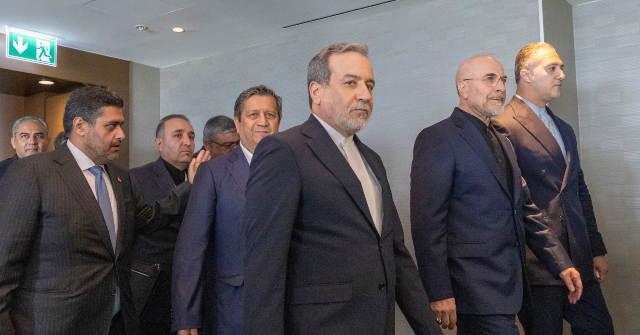
Iranian government officials claimed on Tuesday that, as part of the memorandum of understanding signed with America last week, the Islamist regime would gain access to about $12 billion in frozen assets.
Parliament Speaker Mohammad Bagher Ghalibaf, one of the three most powerful officials remaining in the civilian wing of the regime, said the parties arrived at that number during negotiations in Burgenstock, Switzerland, this weekend. Those negotiations almost did not occur after Tehran announced that it had backtracked on the plan on Friday, complaining that the government of Israel had not halted its invasion of Lebanon. They ultimately did occur, however, after a brief pause in hostilities in Lebanon, allowing both sides to lay the groundwork for a more longstanding agreement, which the White House has insisted would include limitations on Iran’s nuclear development.
According to the Emirati newspaper The National, Ghalibaf told reporters that the government of President Donald Trump had agreed to allow the unfreezing of two sets of $6 billion worth of Iranian assets. This is, he explained, money already belonging to Iran that had been sanctioned in response to the country’s prolific sponsorship of international terrorist groups and its illicit nuclear program.
Iranian Foreign Minister Abbas Araghchi had claimed on Sunday that the negotiations would result in the unfreezing of Iranian assets in a message posted to social media, but did not offer a number.
“Tireless Pakistani and Qatari mediation has delivered major progress to end Lebanon War,” he wrote on the website Twitter on Sunday. “Oil and petrochem exports are waived, blockade lifted, some frozen assets released, and major reconstruction & development plan launched for Iran. 1st real test: Lebanon deconfliction cell.”
Iranian and American officials signed a memorandum of understanding last week intended to formalize an end to military hostilities that began in February, when President Trump announced Operation Epic Fury to erode Iran’s ability to threaten its neighbors. The memorandum formalized an indefinite ceasefire announced in April, after American and Israeli officials eliminated over 50 top Iranian officials, including “supreme leader” Ali Khamenei.
The publicly released text of the memorandum indeed mentions that the United States had committed to work, in the long term, to eliminate sanctions on the Iranian terror state.
“The United States of America undertakes to terminate all types of sanctions against the Islamic Republic of Iran, including the United Nations Security Council resolutions, IAEA [International Atomic Energy Agency] Board of Governors resolutions and all unilateral U.S. sanctions, primary and secondary, in an agreed upon schedule as part of the final Deal,” the memorandum read. “The Islamic Republic of Iran and the United States of America acknowledge the critical importance of the sanctions termination issue above mentioned and express their intentions to immediately address these issues in the negotiations in order to achieve mutual agreement on them.”
American Ambassador to the United Nations Michael Waltz confirmed in remarks to Fox News on Monday that the Trump administration had chosen to unfreeze some Iranian assets to facilitate the continuation of peace talks.
“In a classic President Trump deal, yeah, they unfroze some of them [the Iranian assets] to keep Iran at the table,” he explained. “But guess what they’re going to buy? They’re going to buy American crops, American farmers, soybeans, and other types of agricultural goods and wheat that we’re going to dictate what those funds buy, not the Iranians.”
Vice President JD Vance, who has been at the forefront of promoting the negotiations with Iran in the past week, also made the claim that the funds would be used to buy American agricultural products on Monday.
“We actually asked the Qataris to help us set up the mechanism so that we could ensure that the money goes where we want it to go. And they agreed to do that,” Vice President Vance explained. “We have a good relationship… even with that said, even with the caveat that it’s going to benefit American farmers and obviously benefit the people of Iran, we want both. But fundamentally, that money is not going to be unfrozen unless we continue to see progress.”
Iranian Foreign Ministry spokesman Esmaeil Baqaei, asked about those comments on Tuesday, appeared to refute the idea that Iran would be required to use the unfrozen assets any specific way.
“We will decide how to use Iran’s released assets in whatever way best serves the country’s interests,” he told reporters during his daily briefing, according to the Islamic Republic News Agency (IRNA). “When it comes to purchasing goods, the Ministry of Agriculture and other relevant bodies will make decisions based on price and quality. Therefore, there are no restrictions in this regard.”
“The important point is that Iran’s previously blocked assets are now available and can be used freely by Iran in accordance with its own priorities,” he added.
Araghchi and Iranian President Masoud Pezeshkian arrived in Islamabad, Pakistan, on Tuesday to continue conversations towards implementing the memorandum of understanding. Iranian state media paraphrased Pezeshkian telling reporters before departing for Pakistan that he would “engage with the Pakistani officials on the implementation of all clauses” of the memorandum and hoped to also discuss topics unrelated to the United States, such as “trade, economy, culture, security, military.”
Follow Frances Martel on Facebook and Twitter.
Read the full article here


