


The Iranian Foreign Ministry attempted to respond positively to the news this weekend that Saudi Arabia, Pakistan, and Turkey had signed a joint defense pact apparently intended to protect each other from Iran, claiming instead that it conveyed the countries no longer trust the United States.
The three parties signed an agreement on Friday known as the “Mecca Joint Defense Agreement” that, most significantly, creates an obligation for each state to treat an attack against one as an attack against all. The context most observers noted as especially significant for the agreement is the current conflicts between the Saudi government and the Iran-backed Houthi terrorists of Yemen, who boasted of a massive attack killing dozens of alleged “Saudi enemy mercenaries” the day before the Mecca pact was signed. The three countries geographically form an almost perfect triangle around Iran and join some prodigious military might, as Turkey is one of the most well-armed members of the North Atlantic Treaty Organization (NATO) and Pakistan possesses nuclear weapons.
The Iranian Islamist regime did not immediately issue a public statement in response to the defense pact on Friday. Various officials commented on it throughout the weekend, framing it as a loss for America despite its apparent objective of protecting participating parties from Iranian terrorism.
Foreign Ministry spokesman Esmaeil Baghaei responded to the deal directly on Monday, describing it as a “sign of a change in the perception” that the participating countries have towards the United States rather than a development that should concern Tehran.
“The countries of the region have realized that security is not a commodity that can be bought from false brokers,” Baghaei was quoted as telling reporters, referring to Washington.
“Any plan that is based on the geopolitical and historical realities of the region is comprehensive and inclusive and correctly identifies the enemy and the threat, has a chance of helping to strengthen security and prevent instability and abuses by the Zionist enemy and its allies,” he asserted.
Baqaei also reportedly stated explicitly that the deal was “an important sign that the countries of the region have concluded that they cannot rely on and trust the claim of security provided by the United States and some other actors outside the region.” He went on to suggest that Iran could potentially join the defense deal someday, despite the implications of the agreement that it is meant to protect the participating countries from Iran.
“We are in close contact with neighboring countries and regional countries, and we hope that all countries will learn from the developments of the last two or three years and adopt the best path to strengthen the region’s collective security,” Iranian state media quoted him as saying.
Prior to the official Foreign Ministry statements on Monday, several Iranian officials appeared to lay the groundwork for the argument that the deal is worse for Washington than Tehran as it allegedly indicates a lack of trust in American defense to help Muslim states.
Speaking to state media, senior Iranian official Hossein Noushabadi claimed that the deal is “being viewed as the beginning of the collapse of U.S. security hegemony in West Asia and the Persian Gulf.”
“It appears that, in the not-too-distant future, a new regional security order based on cooperation among regional states will replace the power structures imposed by extra-regional actors, heralding the end of the prevailing security and geopolitical paradigm and West Asia’s departure from the sphere of vital U.S. interests,” he claimed.
Similarly, Iranian Foreign Ministry Abbas Araghchi declared on Friday, shortly after the deal, that the Muslim world could “face every challenge by malicious outsiders head-on… Time to rely only on ourselves and embrace true brotherhood.”
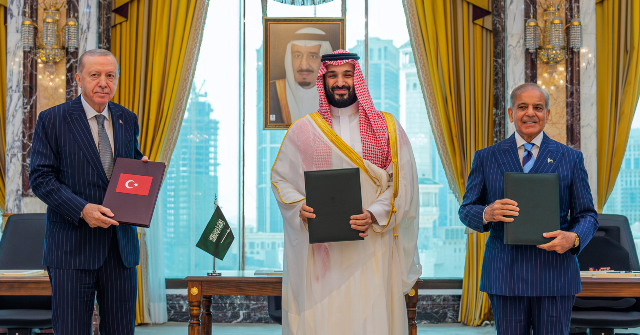
The leaders of the three countries — Saudi Crown Prince Mohammed bin Salman (MBS), Turkish strongman Recep Tayyip Erdogan, and Pakistani Prime Minister Shehbaz Sharif — met in Mecca on Friday to sign the defense pact, emphasizing that their agreement was not intended to intimidate or aggressively engage any other party and was purely meant to give the countries better footing to protect from joint threats. Notably, the three countries are majority Sunni Muslim countries, as opposed to Shia Iran, while Pakistan actively persecutes non-Sunni Muslims, most prominently the Ahmadi Muslim community.
“The agreement is intended to strengthen collective deterrence against any act of aggression,” the countries said in a statement, “and stipulates that any armed attack against any one of the three states shall be regarded as an attack against them all.”
Saudi Arabia independently said in a statement that the deal “does not represent any orientation toward building a military axis or sectarian/religious bloc, and it is not linked to nuclear endeavors or an arms race, but rather to building sustainable self-reliant capabilities.”
The timing of the agreement, in addition to the geographic realities of the countries, suggested to global observers that the alliance was meant to protect from Iran and its terrorist proxies. On Thursday, Yemen’s Houthi terrorist insurgency claimed to have successfully executed a massive attack on forces associated with the legitimate government of the country which the Houthis ousted from the national capital, Sana’a, in 2014. Houthi spokesman Yahya Saree claimed that the Houthis had killed dozens of people, many of them alleged “Saudi enemy mercenaries,” while other reports placed the death toll between 30 to 45 people.
The attack followed the renewal of Houthi attacks on the Saudi government in July, when the terrorists announced a “maritime ban” on Saudi shipping in response to the Saudis reportedly targeting a plane carrying missile equipment and other military support from Iran to the Houthis. The Houthis reportedly claimed the airplane in question carried diplomats returning from Tehran to attend the funeral of longtime dictator Ali Khamenei.
Follow Frances Martel on Facebook and Twitter.
Read the full article here


