






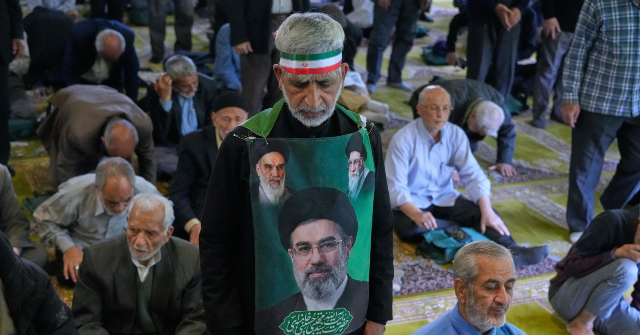
Iran’s state media outlets reported on Sunday that Mojtaba Khamenei, the alleged “supreme leader” of the country, had “issued new directives” to the armed forces, including the terrorist Islamic Revolutionary Guard Corps (IRGC).
The alleged directives followed days of stalled negotiations between America and Iran with the goal of ending active hostilities. The White House has insisted that any peace deal must also require limits on Iran’s nuclear program, which prior to the current war was enriching uranium at levels inconsistent with any known civilian use and blocking the United Nations atomic agency from inspecting key sites.
Part of the job of “supreme leader” in the Iranian regime is to command the nation’s military. Whether Mojtaba Khamenei has been able to do so or not has been a matter of intense speculation for months, however, as he has not been seen in public or issued any video or audio statements since Tehran announced that he would succeed his father, longtime dictator Ali Khamenei. President Donald Trump announced on February 28, the first day of the Pentagon’s Operation Epic Fury against Iran, that Khamenei had been eliminated in American military operations.
Khamenei was among dozens of senior Iranian regime officials killed by both American and Israeli military operations designed to neutralize the regime’s ability to attack its neighbors or, potentially, build a nuclear weapon. As a result, President Trump has complained publicly that negotiating with what is left of the Iranian government is difficult, as it is unclear who is in charge and the remaining figures appear to be competing against each other for ultimate power. Reports indicate that it is unclear to what extent Mojtaba Khamenei is among those in contest, as rumors claim he may also have been severely injured in the hostilities.
Iran’s state media arms have denied that Khamenei is in any way incapacitated, though they have offered no proof of life for the alleged “supreme leader.” On Sunday, the Islamic Republic News Agency (IRNA) claimed that Khamenei was meeting with senior leaders to discuss how to address the current situation in which an official “ceasefire” between America and Iran is in place, but both sides are blockading the Strait of Hormuz. The U.S. Navy is blocking Iranian commerce in the Strait in response to Iran effectively attempting to blockade all global commerce in the critical maritime byway.
Khamenei allegedly met with Major General Ali Abdollahi, the commander of the IRGC’s Khatam al-Anbiya Central Headquarters, on Sunday and issued new orders to protect from American attacks.
“Leader of the Islamic Revolution Ayatollah Seyyed Mojtaba Hosseini Khamenei has issued new directives to the Iranian Armed Forces, aimed at strengthening their combat readiness and decisively dealing with the aggressive enemies,” IRNA shared, claiming that Khamenei’s expertise had “resulted in amazing victories,” without listing any.
“General Abdollahi referred to both defensive and offensive readiness, emphasizing that any strategic error, aggression, or military mischief by the enemies would be dealt with ‘swiftly, intensely, and powerfully by the warriors of Islam,’” IRNA added. “He, on behalf of the country’s military, assured Ayatollah Khamenei that they would keep defending the ideals of the Islamic Revolution, as well as sovereignty, territorial integrity, and national interests of their beloved Iran.”
The report went on to refer to America and Israel as “evil, spiteful, and aggressive enemies” and assured, as Iranian state media regularly does, that they would “regret” actions against the regime.
The IRNA report on Sunday followed a revelation by the president of Iran, Masoud Pezeshkian, that he had recently met with Mojtaba Khamenei in person. Pezeshkian, whose office is subordinate to Khamenei’s, claimed last week that he had engaged in a meeting with Khamenei “with a spirit based on simplicity, humility, warmth and mutual respect.” The president described their conversation as “completely direct” and “frank” and effusively praised Khamenei, but did not offer any details on topics discussed or how their meeting would affect Iran’s greater foreign or domestic policy. Pezeshkian also provided no proof of the meeting or any evidence that Khamenei is alive and healthy enough to be running the country.
American United Nations Ambassador Mike Waltz said in a recent interview that the U.S. government believes Khamenei is “in hiding” and injured, complicating any negotiations as he retains the ultimate authority to accept or reject any peace agreements.
“I think part of it is that their leadership has been so devastated and so fractured, we know that the new ayatollah, the previous ayatollah’s son, has been severely injured,” Waltz reportedly told ABC News. “He’s in hiding, and he’s incredibly difficult to get a hold of.”
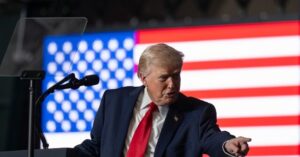
President Trump has stated publicly that a lack of coherence in the structure of the Iranian government has proven a significant challenge in negotiations.
“Iran is having a very hard time figuring out who their leader is! They just don’t know!” Trump wrote in late April. “The infighting is between the ‘Hardliners,’ who have been losing BADLY on the battlefield, and the ‘Moderates,’ who are not very moderate at all (but gaining respect!), is CRAZY!”
Iran and the United States are currently embroiled in extended deliberations to craft a long-term peace, mediated by the government of Pakistan. Reports indicated on Sunday that Iran had, after ten days, sent a response to the White House on the latest edition of a peace proposal, which Trump later confirmed by rejecting the response.
“I have just read the response from Iran’s so-called ‘Representatives,’” Trump wrote on his website, Truth Social. “I don’t like it — TOTALLY UNACCEPTABLE!”
“For 47 years the Iranians have been ‘tapping’ us along, keeping us waiting, killing our people with their roadside bombs, destroying protests, and recently wiping out 42,000 innocent, unarmed protestors,” Trump continued in a separate message. “They will be laughing no longer!”
The Iranian Foreign Ministry, during its regular briefing on Monday, complained that Trump’s rejection was allegedly unreasonable and that its response was “generous.” The response, according to spokesman Esmaeil Baqaei, “consisted of reasonable and responsible demands, as well as generous proposals, not only for Iran’s national interests, but also for the good, stability, and security of the entire region and the world.”
Other coverage in IRNA on Sunday asserted that the response to Trump was “focused exclusively on the cessation of hostilities in the region,” citing an anonymous Iranian source. That would imply that the Iranians did not address their illicit nuclear program, which Trump has insisted repeatedly and clearly that his administration considers a necessary part of any peace deal.
Follow Frances Martel on Facebook and Twitter.
Read the full article here


