




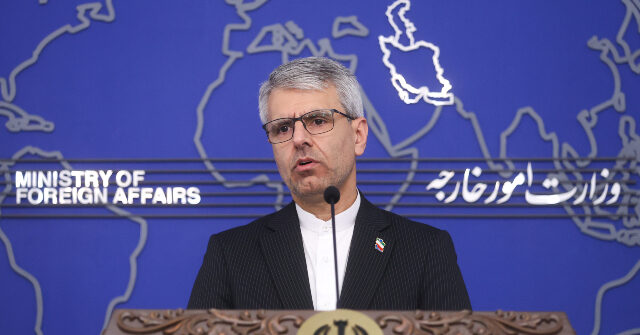
Iranian Foreign Ministry spokesman Esmail Baghaei said on Monday that Iran remains firmly in control of the Strait of Hormuz and has no interest in negotiating with the United States, which he compared to “a mafia gang that adheres to no rules or laws.”

“Mediators may convey messages from the American side to us regarding current developments in the region. But at present, we are not engaged in any negotiations with the United States,” Baghaei said at a press briefing.

“Claims that Iran has requested negotiations are fabrications that the other side circulates from time to time,” he insisted.

Baghaei said the United States is not involved in talks between Iran and Oman for managing traffic through the Strait of Hormuz, which “remains closed” until Tehran decides otherwise.

“These talks have no connection with the United States. They are a bilateral matter between Iran and Oman, and they are continuing,” he said.

Baghaei said talks with Oman are focused on “common principles and operational mechanisms” for reopening the Strait of Hormuz under their mutual control, and that “technical and political consultations between the two sides were continuing.”

For the past several months, Iran has been floating the idea of partnering with Oman to extract ransoms, disguised as “fees” for nebulous services, from international shipping through the strait.

In June, the foreign ministries of both nations issued a joint statement announcing the formation of a “Strait of Hormuz Committee” that would determine “future management of shipping in the Strait of Hormuz, the associated services to be provided, and the fees for the services, all in accordance with international standards.”

Oman has, however, annoyed the Iranians by allowing ships to pass through its territorial waters, hugging the Omani coast under the protection of U.S. forces instead of remaining on Iran’s side of the strait, as demanded by Iran’s terrorist Islamic Revolutionary Guard Corps (IRGC). The IRGC has launched several missile and drone attacks against ships in Omani waters to shut down that alternate route through the strait.

Two unnamed “regional officials” told the Associated Press (AP) on Sunday that, contrary to Baghaei’s assertions, mediators in Qatar and Pakistan have made “significant progress” in getting Iran and the United States back to the negotiating table.

One of these officials said the mediators were “working with Iran and Oman on a mechanism for managing vessels’ transit through the Strait of Hormuz,” which was apparently the very rumor Baghaei sought to disprove on Monday by insisting that Iran and Oman are speaking only with each other.

Iranian state media claimed on Monday that six “offending ships” were turned back after attempting to cross the Strait of Hormuz without permission from Iran. One of those ships supposedly had an “accident” during the process of reversing course.

“As previously announced, the traffic route in the Strait of Hormuz is the route specified by Iran, and other routes are contaminated and have no way out,” an Iranian source said. Such pronouncements from Tehran usually refer to ships attempting to cross the strait by remaining within Omani territorial waters.

U.S. Ambassador to the United Nations Mike Waltz said on Sunday that the pause in U.S. strikes against Iran over the previous three days was President Donald Trump “giving talks some space” and giving diplomacy “a little bit of room.”

A senior administration official assured Reuters that Trump “has always ​been ⁠clear that his preference is diplomacy, but he has shown Iran what will ⁠happen ​if they fail to ​come to the table in a serious way.”

Axios reported that President Trump’s decision to suspend strikes against Iran on Friday was made, in part, because Oman sent a delegation to Tehran to discuss reopening the Strait of Hormuz. According to Axios’ sources, Trump wanted to see the results of these Oman-Iran negotiations before deciding on his next course of action.

Although the United States paused operations against Iran on Friday, Iran has continued to attack its Middle Eastern neighbors, launching drones against Saudi Arabia, Jordan, and Iraq on Monday.

Saudi Arabia said it was able to intercept drones launched against its petroleum infrastructure by Iran-backed Shiite militia in Iraq. The Iraqi government said drone strikes were also launched against targets on its own soil, namely Kurdish forces based in northern Iraq.

The Jordanian military said it intercepted two drones on Monday, while the Israeli military also said it shot down two unmanned aerial vehicles (UAVs) “identified in the area of the Jordan border.”

Read the full article here

Share.
Leave A Reply

Exit mobile version