




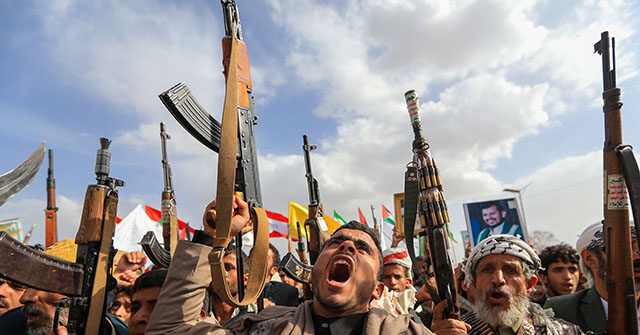
The Iran-backed Houthi terrorist insurgents of Yemen on Monday condemned Saudi Arabia for allegedly bombing the airport in Yemen’s occupied capital city of Sanaa and launched missiles against Saudi targets to retaliate for the act of “blatant aggression.”
The Houthis are an Iran-backed Islamist insurgency that captured Sanaa, and much of Yemen, in 2014. Under their rule, Yemen has degenerated into one of the worst humanitarian disasters on the planet, and the Houthis have perpetrated countless crimes against humanity, including the use of child soldiers and the wanton kidnapping of humanitarian personnel. Their slogan translates to: “God is Great, Death to America, Death to Israel, Curse Upon the Jews, Victory to Islam.”
In 2015, Saudi Arabia led a coalition of Gulf states to intervene in the Yemeni civil war, siding with the internationally recognized government-in-exile. The Saudi intervention was criticized for causing a large number of civilian casualties with airstrikes, and while it did not succeed in restoring the Yemeni government, it did manage to stalemate the Houthis and prevent them from conquering the rest of the country.
Early in his term, President Joe Biden made the strange decision to de-list the Houthis as an international terrorist organization. The Houthis continued practicing terrorism with abandon, including efforts to use starvation as a weapon against their enemies by blocking aid shipments.
Most notoriously, the Houthis committed over a hundred terrorist attacks against international shipping in the Red Sea during the Gaza War, inflicting tremendous costs upon the world economy. President Donald Trump reinstated the Houthi terrorist designation soon after returning to office in 2025.
The Houthis also used Iranian cruise missiles and drones to attack civilian targets in Saudi Arabia in 2021 and 2022. The Saudi coalition and the Houthis worked out an informal cease-fire in March 2022.
The Yemeni civil war largely cooled down after a U.N.-brokered truce in 2022, but suddenly heated up again this month, as the Houthis launched major attacks against territory held by the government-in-exile.
The Houthis accompanied these acts of aggression with threats to attack Saudi Arabia if it became involved in the civil war again, and the Saudis responded by promising to respond to any such attacks with “unprecedented force.”
On Sunday, Houthi media posted photos of an Iranian envoy visiting Sanaa for meetings with insurgent leaders. Iranian media simultaneously announced that regular air travel between Tehran and Sanaa would begin. The Houthis praised Iran for “breaking the blockade imposed on Yemen.”
The government-in-exile, known as the Presidential Leadership Council (PLC), was infuriated by Iran’s “flagrant violation of Yemen’s sovereignty.” They denounced Iran’s visit to Sanaa as a “dangerous escalation” of the rekindled civil war.
On Monday, a Houthi delegation was en route to the airport in Sanaa, returning from the funeral of Ayatollah Ali Khamenei in Iran, when a string of explosions rocked the airport. The PLC took credit for ordering the attack, which apparently involved ballistic missiles and drones.
“The Houthi terrorist militias, supported by the Iranian regime, prevented Yemeni national aircraft from landing at the capital’s airport, Sanaa, and insisted that the Iranian aircraft violate Yemeni airspace. Therefore, the airport runway was targeted,” said the PLC defense ministry.
“At this moment, we say that our patience has run out. Accordingly, we will respond appropriately to this treacherous and brutal act, and we will confront and deal with the hostile aircraft violating Yemeni airspace and sovereignty by all available means,” said PLC Defense Minister Gen. Taher al-Aqili in a video statement released just before the Sanaa airport was bombed.
Another PLC official, council head Rashad al-Alimi, said Iran had asked permission for one of its airliners to bring the Houthi delegation back to Sanaa, but the request was denied. He said the Houthis ignored the PLC and allowed the flight to take place, “outside the legal and sovereign frameworks government civil aviation.”
In an address to the U.N. Security Council (UNSC) on Monday, Yemeni Ambassador to the U.N. Abdullah al-Saadi said the plane headed to Sanaa from Tehran was linked to Iran’s Islamic Revolutionary Guard Corps (IRGC), a designated terrorist organization, and was carrying IRGC personnel plus “military and dual-use equipment.”
Saadi said the PLC had offered to provide air transportation for the Houthi delegation to return home from Iran, but the offer was refused.
The Houthis accused the Saudi military of carrying out the attack at the PLC’s request, and vowed to make Saudi Arabia “bear the consequences of its aggression.”
Spokesmen for the insurgency insisted the plane that was scheduled to land in Sanaa on Monday was “carrying a number of medical patients and stranded citizens,” in addition to the Houthi delegation to Khamenei’s funeral. They said the plane was able to land safely at an alternate airport in the port city of Hodeidah.
Iran also condemned the airport attack as “a clear violation of international law and the United Nations Charter, as well as an affront to Yemen’s national sovereignty and territorial integrity.”
The rebels in Yemen soon made good on their threats to retaliate for the Sanaa bombing, as the Saudi coalition reported intercepting multiple ballistic missiles from Yemen that were aimed at targets in southern Saudi Arabia. One of the targets was reportedly Saudi Arabia’s Abha International Airport.
The Houthis added a terrorist threat to attack civilian aircraft over Saudi Arabia, warning international airlines to avoid flying through Saudi airspace “until the blockade on Sanaa International Airport is lifted.”
On Tuesday, a leading Houthi official named Mohammed al-Bukhaiti – a member of the delegation to Khamenei’s funeral – threatened to shut down Saudi airports the same way Sanaa was shut down.
“Their willingness to attack Sanaa Airport to prevent flights from arriving or departing gives Yemen the right to strike their airports and to impose on them a siege just as they have done to us,” he said, incorrectly portraying the Houthi insurgency as the legitimate government of Yemen.
Military analysts told Al-Monitor on Monday that the PLC directly controls enough missiles and aircraft to have bombed the runway in Sanaa, but it seemed more likely that the Saudis helped with the attack. On the other hand, Saudi geopolitical analyst Salman al-Ansari insisted to Fox News that the Saudis were not directly involved.
“This is an action taken by Yemen’s legitimate government in response to the violation of its airspace and sovereignty. It was not carried out by Saudi Arabia or the coalition,” he said.
Ansari said the PLC was right to object to the flight from Tehran to Sanaa, because it was a clear attempt to evade customs procedures that were established to keep Iranian weapons out of Houthi hands.
“The Houthis know that these flights can land normally if they follow the agreed-upon route through a Jordanian airport, for inspection purposes,” he said.
“The Houthis are currently at one of their weakest points, particularly after Yemen’s legitimate government consolidated effective authority over 80% of the country’s territory. This is a marked departure from the past, when the legitimate government was fragmented between two rival camps,” he added.
“By confronting the Houthis, Yemen’s legitimate government is not only defending its own sovereignty; it is helping safeguard the region and the wider world from Iran’s network of terrorist proxies,” he concluded.
Yemen expert Nadwa al-Dawsari of the Middle East Institute agreed that Iran’s plane to Sanaa was a symbolic gesture of regional power and hegemony that had to be stopped.
“By proceeding with the Mahan Air flight despite Yemeni objections and ensuring that it reached Houthi-controlled Yemen anyway, Iran and the Houthis were sending a political message: Tehran intends to normalize direct and public ties with Houthi-controlled Yemen and is willing to challenge the restrictions that have governed access to the country since 2015,” she said.
Mahan Air is an Iranian airline that is under sanctions by the U.S. Treasury Department’s Office of Foreign Assets Control (OFAC) for carrying IRGC operatives, weapons, and funds.
Dawsari said Iran was keenly interested in helping the Houthis retain their grip on Yemen, because most of Iran’s other terrorist proxies across the Middle East have been severely weakened in recent years.
Tehran may be banking on the Houthis to resume attacking Red Sea shipping to increase economic pressure against the rest of the world, and some Houthi officials are threatening to do just that, blockading the vital Bab al-Mandab Strait the same way Iran is trying to shutter the Strait of Hormuz.
The U.S. State Department said on Monday it is “aware of the situation,” and reiterated America’s determination to “stand firmly with Saudi Arabia against Iranian aggression, including Iranian-supported Houthi attacks.”
“We continue to actively enforce the Trump Administration’s designation of the Houthis as a Foreign Terrorist Organization and condemn Iran’s flagrant violation of Yemen’s sovereignty in support of their Houthi proxies,” a State Department spokesperson told Fox News.
Read the full article here


