


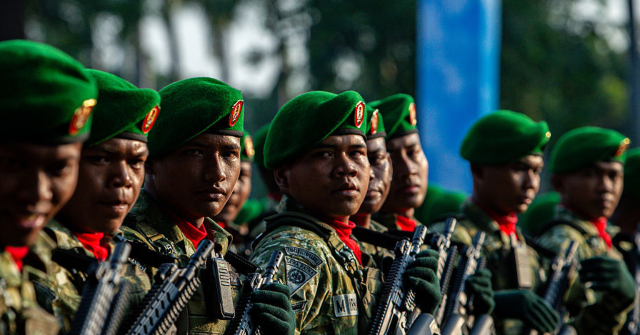
Indonesian Army Chief of Staff Gen. Maruli Simanjuntak said on Tuesday that his country is prepared to commit 5,000 to 8,000 troops to the International Stabilization Force (ISF) for Gaza.
It was the first specific commitment of forces to the crucial second step in President Donald Trump’s peace plan.
“We’ve started training people who could potentially become peacemakers. So, we’re preparing engineering and health units like that,” Maruli said.
“It’s all still being negotiated, not certain. So there’s no certainty on the number until now,” the Indonesian general said.
“We are waiting for the results of coordination from those overseeing the mission in Gaza. Once that reaches TNI [Indonesian National Armed Forces] Headquarters and then Army Headquarters, we will know what kind of personnel are required and can prepare accordingly,” he said.
State Secretary Prasetyo Hadi also said the Indonesian element of the ISF would “likely reach 8,000,” but Deputy Defense Minister Donny Emawan Taufanto gave a much more modest starting estimate on Tuesday after a meeting with lawmakers, saying Indonesia’s initial contribution would be “around 600.”
Another Indonesian defense official, National Armed Forces Deputy Commander Tandyo Budi Revita, said a final decision about the deployment would be reached in late February, when President Prabowo Subianto signs documents to make his country’s participation official.
“We should be able to announce how many of our men we will send by the end of the month. There are several options so far on how we can actively participate in Gaza,” he said.
Revita said Indonesia’s ISF forces will be drawn from units that have experience operating in conflict zones.
“We already have experience. We have personnel who served with UNIFIL in Lebanon. These are the personnel we will deploy. They are not units that have never operated in conflict areas,” he said.
Indonesian Foreign Ministry spokesman Vahd Nabyl Achmad Mulachela said that however many troops his country ends up committing, their participation will be “focused on the humanitarian aspect,” and they will “not take part in any disarmament process” for the Palestinian terrorist group Hamas.
“Indonesia’s possible participation in peace efforts in Gaza, Palestine, remains under careful consideration. The focus of the current discussion is on ensuring a clear mandate, the protection of civilians, and consistency with Indonesia’s longstanding peacekeeping principles,” he said.
“At this stage, no final decision has been taken yet, and we are not in a position to confirm details pertaining to numbers, composition, timelines or specific areas of operation,” he stressed.
Mulachela’s boss, Foreign Minister Sugiono, has previously stated that whatever the size of Indonesia’s force in Gaza might be, they will only be a “temporary instrument” on the path to Palestinian statehood.
The flurry of conflicting statements from Indonesian officials was prompted by a Tuesday report from Israeli public broadcaster KAN, which said that “preparations have begun on the ground to accommodate Indonesian soldiers in Gaza.”
KAN did not give a timetable for the deployment, but said Indonesia would probably be the first foreign force to reach Gaza, and an area between the cities of Rafah and Khan Younis is nearly “ready” to receive them, pending the completion of housing and other structures in “several weeks.”
“The number of Indonesian soldiers is estimated at several thousand, and discussions are already underway with Jakarta regarding the initial plan for deploying the Indonesian forces and how they will be transported to Gaza,” KAN reported.
President Prabowo said at the U.N. General Assembly in September that he was ready to deploy “20,000, or even more” troops to secure peace and stability in Gaza, as part of his effort to raise Indonesia’s profile on the world stage.
Prabowo has been invited to join President Trump’s Board of Peace, which will oversee the implementation of Trump’s 20-point Gaza peace plan. He is tentatively scheduled to visit the White House on February 19 for a meeting on the Board of Peace, at Trump’s invitation.
The Jakarta Post noted on Monday that Prabowo appears eager to develop Indonesia’s prestige as the world’s largest Muslim-majority nation by taking a strong early role in the Gaza peace plan, but there is considerable resistance to the idea among the Indonesian public, which tends to favor immediate Palestinian statehood.
“The President has since met with Muslim leaders and foreign affairs experts to convince them that the board is the only chance to end war in Gaza,” the Jakarta Post reported.
The Jakarta Globe tentatively endorsed Prabowo’s plan to staff the ISF and take a seat on the Board of Peace in a January 31 editorial, because it will give Indonesia leverage to influence events in Gaza. The editorial noted that Indonesia’s voice would be heard more clearly on the Board of Peace than it would in the cacophony of the United Nations.
“This membership also reinforces Indonesia’s position as a Global South bridge-builder and a credible humanitarian actor. Joining early provides access to reconstruction and post-conflict governance coordination networks, enabling Indonesia to help shape the division of roles and the standards adopted, rather than merely following decisions that have already been made,” the editorial said.
On the other hand, the Jakarta Globe warned Prabowo to be mindful of granting legitimacy to a “parallel structure that fractures global consensus” or falling victim to “mission creep” by sending too large a force to Gaza.
Read the full article here