






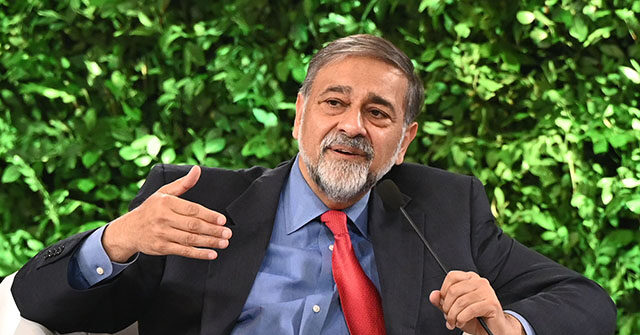
American tech professionals should accept low-wage teaching jobs in rural Alaska and let H-1B migrant Indians enjoy the high-wage jobs in sunny cosmopolitan Silicon Valley, says Vivek Wadhwa, an Indian-born tech investor.
“Dear Anti-immigrants constantly crying that foreigners are taking American jobs: Why aren’t you teaching in rural Alaska?” Wadhwa posted on June 8 shortly after a judge rejected President Donald Trump’s $100,000 fee on arriving H-1B contract workers. He jeered:
Hundreds of positions sit empty [in Alaska]. Remote districts are importing teachers from overseas on H-1Bs because you won’t move there. You don’t actually want those jobs; you just don’t want qualified foreigners to have them. Complete hypocrisy.
The sneer is poorly timed, partly because it comes as many Indians are declaring their anger and contempt at the rising public opposition to the many visa-worker programs that have pushed roughly 2 million American college graduates — and a growing number of Europeans — out of middle-class jobs and careers.
Wadhwa “is from India [and] I’m not sure how attuned he is to American politics,” Mark Krikorian, director of the Center for Immigration Studies, told Breitbart News. He added:
But you don’t have to be that attuned to realize that there’s a significant populist upsurge, not just in the United States, but across the West. Just saying, people are stupid and ignorant if they agree with the sentiments of that populist upsurge is not doing anything to quell it.
Wadhwa’s sneer prompted much criticism from Americans who have lost jobs in California and other states to migrants imported via the federal H-1B program that Wadhwa promotes.
“Americans are waking up to the fact that we don’t need these arrogant foreigners coming in and taking our jobs because they can undercut American salaries,” Kevin Lynn, founder of USTech Workers, which opposes the H-1B program, told Breitbart News.
Wadhwa’s taunt comes as he lobbies U.S. legislators to legalize a migration program created by President George W. Bush without Congress’ approval. The “Optional Practical Training” annually steers more than 300,000 foreign college graduates into the white-collar jobs needed by skilled American professionals.

Wadhwa also lobbies for the huge H-1B program that brings in roughly 80,000 extra Indian graduates each year. The program keeps at least 1 million H-1B workers and their spouses in white-collar jobs that would otherwise be held by American graduates. The program is also a central pillar of the Indian government’s economic strategy.
“It is useful to see how someone who grows up within [India’s] caste system treats people outside that caste,” Lynn added.
Alaska’s Teaching Jobs
Schools in many states import many H-1Bs for teaching jobs. “Over 500 public K-12 school districts in the United States collectively employ over 2,300 H-1B visa holders,” the National Education Association reported in October 2025.
The districts include Dallas, New York, and the District of Columbia, the site reported, adding, “These districts include the Bering Strait School District (35 approvals) and the Lower Kuskokwim School District (20) in Alaska.”
More than 100,000 jobs at universities have been given to H-1B and J-1 visa workers.
The unfilled teaching jobs in Alaska cited by Wadhwa are empty precisely because Alaska’s government prefers the cheap-labor H-1B migrants provided by the federal government, said Krikorian.
The low wages are spotlighted by Glassdoor.com, which posted an advertisement for an art teacher job in Nuiqsut, a town with a population of just over 500 people on the northern edge of Alaska. The Nuiqsut job starts at $65,000 but can rise to $92,000. “Visitors to the North Slope Borough will witness spectacular contrasts,” says a pitch by the North Slope Borough School District. “In summer, the sun stays above the horizon for 84 days, and in the winter it disappears for 67 days.”
In contrast, a teacher can earn $70,000 while living alongside many 20-something peers in the pleasant city of Richmond, Virginia, according to Glassdoor.
Alaskan politicians “have a retention issue [because] salaries have only risen a few percent over the last 20 years,” said Lynn. Alaskan politicians “prefer to hire cheap H-1Bs … [and] don’t care about the output,” he told Breitbart News.
The politicians in Alaska “are behaving no differently than corporate America,” Lynn said.
Krikorian added:
Why is it the federal government’s issue to deal with local school district staffing problems? … The idea that the Congress short circuit the normal … political pressure for the state legislature in Alaska to fund more teachers is crazy.
Wadhwa’s taunting tweet was a response to a message by Sen. Lisa Murkowski (R-AK), who admitted Alaska’s policy of relying on federally provided workers as she celebrated the judge’s decision:
Many school districts in rural and remote parts of the state rely on the H-1B visa program to bring quality teachers to their communities. In Alaska, this isn’t a partisan issue: the state legislature unanimously passed a resolution last month urging the federal government to waive the fee for educators.
Alaska’s policy of relying on H-1B migrants has many obvious costs, said Krikorian and Lynn.
“It is not appropriate for the federal government to be subsidizing local school boards, but even if you thought that was a good idea, it would just be better to send a check to Alaska and say, ‘Okay, offer more money to teachers, so you can get [American] teachers to go there,’” he said.
“They’re having foreigners teach our students,” said Lynn. The result is that “our students will know less about American history, less about American culture, and less about American values.”
If Alaska does not produce enough Alaska teachers, it can also recruit Americans from the other 49 states, Krikorian said.
Why not turn it into an [American] guest worker program, where young people work for two years, get free flights back and forth, and make it an experience …. [The low wages] are unfair to American teachers in Alaska, but also to American teachers who would consider going to Alaska for a few years if the pay were better or if there were some other arrangement that would make it appealing,
Alaska’s use of the H-1B program also means that American teachers in Alaska are getting far less compensation than the imported teachers from poor developing countries, he said:
Compensation is salary plus benefits, so usually that means salary plus health insurance or matching 401K matches. But for each H-1B [teacher], the benefit package also includes [legal] access to the United States, which is something that Americans already have, so they’re compensated more. They probably would work for less [income] — maybe even just room and board — because they’re getting access to the United States.
Many H-1B workers convert their access into the huge prize of green cards — and then citizenship for themselves, family members, and all of their descendants. “If you’re coming from anywhere in the developing world, it’s enormous,” said Krikorian.
Another problem is that the federal government, not Alaska, runs the H-1B program. This proved problematic for Alaskan schools once President Donald Trump added a $100,000 fee for the arrival of new H-1B contract workers in 2026.
“No Alaskan school district can afford to pay the $100,000 visa fee for a qualified teacher, despite the universally recognized shortage of educators in rural Alaska,” wrote Bruce Botelho, a journalist at the
Read the full article here


