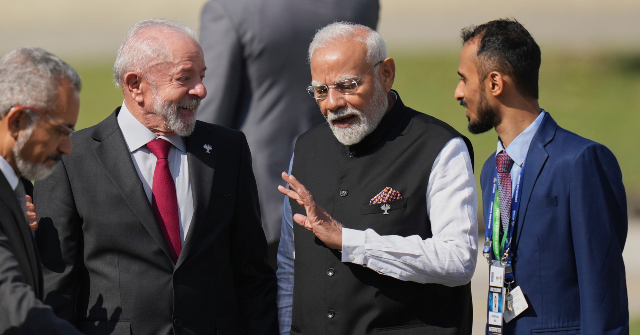
Host government India announced on Thursday that the annual BRICS summit, bringing together leaders of the anti-American coalition’s countries, would take place in New Delhi on September 12 and 13, setting the stage for potentially the most tumultuous summit yet.
This year’s high-level summit is themed “Building for Resilience, Innovation, Cooperation and Sustainability” and the Indian External Affairs Ministry insisted that it would, as host, focus on “the spirit of ‘Humanity First.’” The announcement did not specify any particular issues the parties would discuss, limiting itself to “global and regional matters of mutual importance.”
“Under India’s Chairship this year, over 350 meetings and high-level engagements have been held in over 25 cities across India to further strengthen the BRICS strategic partnership across three fundamental pillars,” the Indian foreign ministry explained, “political and security, economic and financial, and cultural and people-to-people exchanges.”
“Through these engagements, and business-to-business and people-to-people initiatives, India’s BRICS Chairship has contributed to advancing BRICS cooperation through practical and development-oriented outcomes,” its announcement concluded.
BRICS is a security and economic cooperation coalition featuring its own development bank established as a counterweight to American global influence. The acronym stands for the founding partners in the organization — Brazil, Russia, India, China, and South Africa — and, while India currently holds the annual chairmanship of the group, China is widely considered to be the most influential country in the league. In addition to the namesake countries, BRICS has welcomed Egypt, Ethiopia, the United Arab Emirates (UAE), Iran, and Indonesia to its ranks as full members, as well as a host of rogue states such as Cuba, Belarus, and Uganda as “partners” with minimal influence.
While the core countries in BRICS were united in their opposition to American influence with the goal of expanding their own economic and diplomatic powers when the group was founded, the introduction of new parties and their own interests have complicated cooperation within the group. This year’s BRICS summit is expected to be somewhat contentious given that two full members, the UAE and Iran, have been engaged in active hostilities, if not a declared war, with each other for the past year as a result of Operation Epic Fury, the American initiative to weaken the Iranian terror state. In response to American attacks, Iran has repeatedly bombed Emirati territory, outraging the UAE and resulting in Abu Dhabi cutting off all trade ties to Iran this month. The dispute between the two countries has already derailed several BRICS events throughout the year as the parties used BRICS venues to lay out their grievances rather than strengthen relationships with other participants.
The Iran war has complicated diplomacy and trade for more than just the UAE. An ongoing American blockade on Iran’s oil trade significantly impacts the governments of China and India, two of the largest buyers of Iranian oil in the world. While both countries have reduced their dependency on Iranian oil in the aftermath of the conflict, neither produces enough oil domestically to sustain their economies. Meanwhile, the highly disrupted Strait of Hormuz route has throttled the flow of oil from other Middle Eastern countries.
To avoid the Strait of Hormuz, China announced this month it is working on an “Arctic Silk Road” project to expand shipping around the coast of Russia, avoiding the Middle East entirely.
“China’s first regularly operated Arctic shipping route not only opens up a fast, efficient, green, low-carbon, and resilient northern logistics corridor for China-Europe trade, but also injects a rare measure of certainty into a global supply chain frequently disrupted by various shocks,” the Chinese state-run Global Times newspaper boasted on August 18.
The “Arctic Silk Road” is far from an easy solution to the current problem, however, and may potentially add even more tensions to the BRICS team. Logistically, maintaining shipping through the Arctic will become significantly more difficult, if not impossible, during the winter months. The route also challenges Russia’s dominant position in the region, which strongman Vladimir Putin already appears to be responding to. Last week, Putin convened a special Russian Security Council meeting to discuss expanding Russian influence in the Arctic region, describing it as critical to maintaining the country’s national security. While Putin reportedly did not overtly mention China, which Moscow publicly touts as a friend, as a threat to Russia, the timing suggested that the Russian government has concerns about what a significant and long-lasting Chinese presence in the Arctic would mean for Russia.
The BRICS coalition had already struggled for relevance and unity before Operation Epic Fury created a host of new problems for it. The 2025 summit, hosted by Brazil, was marred by prominent no-shows from Putin and Chinese dictator Xi Jinping. Those who did attend joined in signing a 31-page declaration missing some of the most ambitious proposals floated around since the launch of BRICS, such as the potential creation of a BRICS currency, instead issuing vague condemnations of “trade restrictions” and of the strikes against Iran in 2025.
Follow Frances Martel on Facebook and Twitter.
Read the full article here