






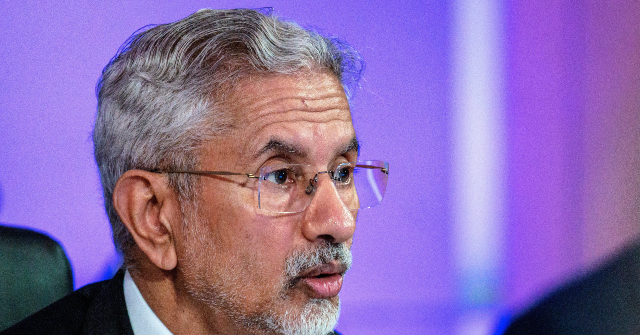
Indian Foreign Minister S. Jaishankar visited Kyiv, Ukraine, on Thursday with a message of solidarity, offering India’s support to end the ongoing Russian invasion of the country.
Jaishankar demurred when challenged regarding India’s significant trade volume with Russia, particularly buying oil, stating that the war will not end or continue based on whether “somebody is buying or not buying oil.”
The foreign minister’s visit is nonetheless a notable improvement in the bilateral relationship between Ukraine and India, which has struggled to find consistency since Russia first launched a full-scale invasion of the country in 2022 (following a decade of occupation). Ukrainian leaders have consistently discouraged Indian leaders from making large-scale Russian oil purchases, which India has defended on the grounds that the government must protect the interests of Indian citizens before Ukrainians. India has also traditionally relied on Russia for defense technology and diplomatic support, and both are members of the anti-American BRICS trade and security bloc, enjoying friendly relations.
India is expected to host Russian strongman Vladimir Putin and a host of other leaders for the annual BRICS summit in mid-September. Prime Minister Narendra Modi met Putin in person this week at the Shanghai Cooperation Organization (SCO) summit in Kyrgyzstan, reaffirming his support for diplomacy with Russia but offering a markedly forceful call for Russia to end its invasion of Ukraine.
During his time in Kyiv, Jaishankar shared that message with Ukrainian leaders, meeting with his counterpart Foreign Minister Andrii Sybiha and President Voloydymyr Zelensky.

“We are grateful to India for its commitment to ending this unjust war — Russia’s war against Ukraine. This certainly must not be a time of war. Peace is needed. This is India’s clear position,” Zelensky wrote on a message announcing his meeting with Jaishankar on Thursday.
“We hope that other major world powers will also take a clear stance that this war must end and that a reliable peace must be achieved,” Zelensky continued. “Of course, we discussed the situation in the Black Sea, including the existing threats to civilian shipping. We concur that it is absolutely unacceptable to block food supplies to regions where this is a highly sensitive issue and where people depend on these maritime routes.”
Sybiha, in his message, thanked Jaishankar and Modi for his in-person plea to Putin to end the invasion.
“Our capital is constantly under attack and I appreciate my colleague’s brave visit,” the foreign minister wrote. “India is a global power and we welcome Prime Minister Modi’s call to move from an endless war towards an end to the war. Ukraine stands ready for diplomacy.”
During a press conference following his meetings, Jaishankar emphasized that India is calling for renewed diplomatic negotiations between Russia and Ukraine to convince Russia to stop invading and occupying its neighbor.
“Every passing day of conflict only means more deaths and more destruction. Understandably, it is for the parties involved to find a way,” Jaishankar told reporters, according to The Hindu. “But, if India can be of any help in any manner, we are ready.”
“In consonance with Prime Minister Modi’s call for an end to war, my visit has a focus on the prospects of dialogue and diplomacy. I will be taking back the views and positions shared today by the Ukrainian side,” he added.
India’s offer to help “in any manner” did not appear to extend to economic pressure on Russia. Asked about India’s large Russian oil purchases, Jaishankar did not defend them, but dismissed the issue as secondary to the need for negotiations.
“This conflict, which is today in its fifth year, will not dissolve because somebody is buying or not buying oil or alumina or minerals or metals,” he reportedly said, describing the Indian government’s responsibility to ensure fuel supplies for its people as a “challenge.”
“This conflict will be solved by dialogue, by diplomacy, by negotiations. And that is why it is something we would encourage,” he insisted.
India has traditionally been a buyer of Soviet and Russian defense weaponry. Its status as a top oil buyer, however, is relatively new, beginning almost immediately after the Ukraine invasion resulted in widespread Western sanctions on the Russian oil industry, lowering its prices. Indian purchases of Russian oil hit a record high of 2.8 million barrels per day (bpd) in July, though that number is expected to decline somewhat in August. Indian officials have firmly rejected any calls to put economic pressure on Russia.
Jaishankar’s visit follows a noticeable change in tone out of New Delhi regarding the Ukraine war this week. Modi’s comments to Putin during the SCO summit were more forceful than his usual calls for peace, discouraging Putin from embracing “endless war.”
“Every day spent in war sets humanity back, whereas every step taken towards peace fills humanity with new hope and enthusiasm. We must move away from endless war towards an end to the war. This is essential for the well-being of humanity,” Modi told Putin.
“We have consistently discussed the issue of Ukraine. When we met previously, you briefed me in detail on all aspects of the matter. As you know, India supports all efforts towards peace and will continue to do so,” he added.
This shift also follows a public appeal by Zelensky to his diplomats to help improve relations with India. During a meeting with high-level diplomats last week, as reported by the Ukrainian state outlet Ukrinform, Zelensky cited India and China as countries that Ukraine needed to invest more heavily in expanding diplomacy with.
“Zelensky urged Ukrainian diplomats to find new ways to strengthen relations with both India and China,” Ukrinform reported. “He said that Ukraine had to find a practical way to strengthen its relations with India and seek dialogue with China. He added that if Ukraine did not want China to support only Russia, it would have to build those relationships despite the significant challenges involved.”
Follow Frances Martel on Facebook and Twitter.
Read the full article here


