




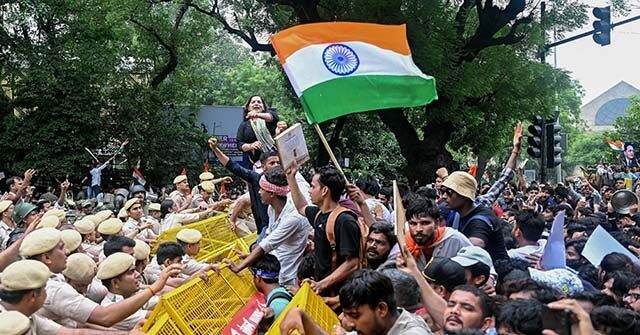
India’s capital of New Delhi was plunged into chaos on Monday as a huge protest by the “Cockroach Party” of disaffected young people shut down city streets and triggered a massive police response.
The Cockroach Janata Party (CJP), as it is properly known, began as a joke that took its name from a dismissive remark made by Indian Chief Justice Surya Kant. The justice compared India’s youth to “cockroaches” who spend too much time on social media.
An Indian student named Abhijeet Dipke — who, in a nice touch of post-modern irony, was not even in India at the time, as he was studying in Boston — responded by creating the Cockroach Janata Party as an online gag.
“Janata” means “the people.” Dipke chose the name because he wanted his new CJP party to have an acronym similar to the current ruling party of India, Prime Minister Narendra Modi’s BJP.
Satirical or not, CJP grew like wildfire as India’s youth flocked to its website, wearing the party’s goofy name and symbolism as a badge of honor. The symbol of the party is a cockroach wearing sunglasses, its arms folded in defiance.
A massive scandal surrounding India’s national entrance exams for medical schools, known as the NEET exam, bolstered CJP’s ranks with even more angry and alienated young people. The exams were suspended over allegations of leaked answers and cheating, and the scores of everyone who took the test the first time were nullified, which enraged millions of aspiring medical students.
The NEET scandal, which began in May but is still running very hot with Indian youth, was the primary motivation for this weekend’s protests in New Delhi, which were timed to coincide with the beginning of a parliamentary session. The event was dubbed “Chalo Sansad,” a Hindi phrase that means “let’s go to Parliament.”
For many young Indians, the NEET scandal became emblematic of a government they believe has become hopelessly inept, corrupt, and uncaring. Activists representing other causes and parties joined in the Chalo Sansad march, including 59-year-old environmental activist Sonam Wangchuk, who declared a hunger strike 20 days ago in solidarity with the CJP demonstrators.
Although his health has become a matter of concern, Wangchuk said on Monday he would continue his hunger strike indefinitely, and the harsh police response to the Chalo Sansad protest has been added to his list of grievances against the government.
CJP reciprocated by adding the release of Wangchuk, who is under a rather aggressive form of protective custody, to its demands. Wangchuk said he wanted to leave the hospital to join the protest, but he was not allowed to do so.
The protest was gigantic, shutting down much of India’s capital city, and it quickly turned violent, although police officials and protest leaders disagree about which side was the first to use physical force.
When the protesters surged toward parliamentary headquarters, police used tear gas, batons, and riot control vehicles to push them back. The authorities pointed out that no permission had been sought or granted to march near Parliament, and ample warnings were given to the demonstrators, along with pleas for everyone to remain civil.
The authorities also evidently shut down the Internet to thwart protesters from livestreaming the event, which they were enthusiastically doing, in part because major media organizations were studiously ignoring their demonstrations. The protesters cheerfully billed themselves as a “flood of hundreds of thousands of cockroaches” on social media.
Officials said they took action in response to numerous false and provocative stories being circulated on social media, including claims that prominent protesters had been ruthlessly assaulted by security officers, including Wangchuk’s wife Geetanjali Angmo.
CJP said at least 30 to 40 “infiltrators” linked to BJP and the Delhi Police entered the protest as “goons” who aimed to discredit the movement with outrageous statements and actions. CJP activists used their smartphones to post photos and video of the “goons” to social media.
Police officials said on Monday that over 50 of their officers, and at least as many protesters, were injured in clashes across New Delhi, and more than 100 people were at least briefly detained — reportedly including Dipke, who was on hand to watch the movement he started in jest only a few months ago fill the streets.
Dipke said on Monday he would end his own hunger strike, launched in solidarity with Wangchuk, while Wangchuk said he would continue fasting until government figures are held accountable for the NEET scandal. One of CJP’s top demands is for the resignation of Union Education Minister Dharmendra Pradhan, who is blamed for the deterioration of educational standards that led to the exam cheating crisis.
Other Indian opposition parties, including the leading Congress Party, have joined CJP’s demands for Pradhan’s resignation, and on Monday opposition leaders strongly criticized the Modi government for its allegedly brutal handling of the Chalo Sansad protest.
Read the full article here


