





With thousands dying and streets melting, air conditioning remains taboo in some countries
Two weeks of extreme heat have brought Europe to a scorched halt, with public services closed and vital infrastructure literally melting in record-breaking temperatures. Meanwhile, European leaders are telling their citizens to shut off the AC.
Europe’s most severe heatwave in decades has broken temperature records across the continent, with France experiencing its hottest day on record on June 24 of 43.8C (110.84F), and Germany experiencing an all-time high of 41.7C on June 27. The full list of broken records is extensive, and includes:
-
Czech Republic – hottest day on record, 41.9C
-
Denmark – hottest day on record, 37C
-
France – hottest day on record, 43.8C
-
Germany – hottest day on record, 41.7C
-
Hungary – hottest day on record, 40.7C
-
Poland – hottest day on record, 40.5C
-
Spain – June temperature record, 45C
-
UK – June temperature record, 37.3C
What does record-breaking heat look like in Europe?
Temperatures in the high 30s are far more common in the US. In Florida, for example, summertime heat indexes often reach 39-43C, while temperatures of 32-49C are typical of summers in Arizona. In Europe, however, the heat is far more destructive. The dense, narrow streets of some European capitals trap heat, as do the stone and brick-built homes that are common on the continent. Videos shared on social media show traffic lights literally melting in Italy, tram lines warping and bending in Belgium, and road surfaces turning to liquid in Germany.
The consequences are far deadlier too. The World Health Organization has attributed more than 1,300 excess deaths across Europe since June 21 to the heatwave, with French officials claiming that 1,000 have died in that country alone. Around 85% of the victims in France were aged 65 or older.
Has this happened before?
Europe has faced similarly intense heatwaves throughout modern history. Temperatures in the UK reached 38C in 1911, and stayed above 35C for almost a week in 1976. Mainland Europe baked during a heatwave in 2003, with more than 14,000 excess deaths recorded in France, where temperatures stayed above 40C in some locations for eight consecutive days. Across Europe, up to 72,000 excess deaths were attributed to the heatwave, which was the continent’s worst since the 1540s.
Why don’t Europeans just use air conditioning?
Heat deaths are six times more common in the EU than in the US, and every time a heatwave hits Europe, social media is flooded with comments from bewildered Americans, wondering why Europeans don’t simply switch on their air conditioners.
The European mind can’t comprehend air conditioning
— Serf (@TheRoyalSerf) June 29, 2026
In reality, some Europeans do. Nearly 100% of homes in Greece are equipped with AC, as are almost half of homes in Italy and Spain. On the other hand, AC is rarely needed in cooler countries like Ireland and Finland. However, in countries desperately in need of cooling, such as France and Germany, there are deep bureaucratic and ideological obstacles to installing AC units.
In France, National Rally leader Marine Le Pen has promised that, if elected, her right-wing National Rally party would implement a “grand plan for air conditioning,” arguing that the country’s “public services are unable to function due to a lack of air conditioning, unlike dozens of countries around the world.”


The idea was instantly shot down by President Emmanuel Macron’s Renaissance party and the Greens on environmental grounds. Both pointed to power consumption, and the fact that AC units increase outdoor temperatures by transferring heat from homes to the street. The left-wing France Unbowed party also opposes the widespread use of AC on the grounds that it would only be within the reach of “wealthy households.”
Audrey Pulvar, the deputy mayor of Paris and a self-described “eco-feminist,” has taken the ideological crusade against AC further, blaming the heatwave on the US’ love for chilled air. “As the second-largest emitter of greenhouse gas emissions in the world, you bear a significant amount of responsibility for global warming and the consequences we, in France, are experiencing,” she wrote on social media. “Your cities, which are 90% air conditioned, are not unrelated to this.”
In Germany, the opposition is similarly ideological. Only a third of German hospitals are equipped with AC, and the country’s powerful Green lobby maintains that giving in to mechanically-cooled air would lock “households into high-emission habits while distracting from systemic solutions.”
🇩🇪 German public broadcaster ARD is out there dropping anti-air conditioning propaganda in the middle of a record heatwave.
Their infographic basically says: “Sure it cools you down, but it heats up the planet.”
Meanwhile Germans are melting and only 6% of homes even have AC.… pic.twitter.com/1n8HsFNsH9
— Mario Nawfal (@MarioNawfal) June 28, 2026
In the UK, homeowners wishing to install AC units are often stonewalled by local authorities. In line with government plans to bring the country’s carbon emissions to net zero, some building codes in the UK stipulate that AC should only be used as a “last resort,” once “passive cooling” methods, such as opening windows or using fans, have been implemented. According to a recent report by The Telegraph, homeowners in the London boroughs of Camden and Islington have been ordered to remove AC units due to these regulations.
Although air conditioning is more common in Spain than in other European nations, a 2022 government decree forbids public spaces like offices, shops, and restaurants from setting the thermostat below 27C.
What is the EU doing?


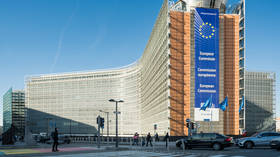
The European Commission has pinned the heatwave on manmade climate change, and used the opportunity to push its European Green Deal – an ambitious strategy that makes the bloc’s goal of net zero carbon emissions by 2050 legally binding for member states. “This is a dramatic warning being sent once again by nature on what it means to have a different climate system,” Teresa Ribera, the Commission’s green energy czar said on Monday. “I am tired of hearing ‘people don’t back the green deal any more’… it is not true.”
The European Union accounts for only 5-6% of the world’s carbon emissions. Accordingly, and assuming these emissions are the primary driver of Europe’s hotter summers, it is unclear whether the European Green Deal would help mitigate future heatwaves. What it has done already is further impoverish the bloc’s citizens: the deal’s carbon credit scheme has artificially inflated energy costs, and, combined with the EU’s phaseout of Russian gas imports and a fall in output from wind farms, has driven electricity prices to all-time highs in Belgium, Germany, and the Netherlands this week.
No short-term solutions
At the national and EU level, few leaders are offering short-term solutions. The EU’s Green Deal promises to make Europe “the first climate neutral continent by 2050,” a goal that may have no impact on summer temperatures. For citizens looking to escape the next heatwave, the European Commission launched its Heat Pump Accelerator Platform last year, pushing the technology as a solution to dependence on fossil fuels. Heat pumps can be reversed in summer, pushing warm air out of buildings, but with average installation costs ten times higher than (similarly effective) AC units, they remain a solution only for those who can afford them.
Meanwhile, police in Germany have converted water cannons – typically used against protesters and rioters – into sprinklers to cool off pedestrians, and French authorities have set up emergency cooling baths throughout Paris.
In Brussels, however, Commission President Ursula von der Leyen and her top officials have been working in air conditioned offices on the top floors of the Commission’s headquarters, while employees on lower floors were told that cooling systems would be shut off “due to extreme weather conditions,” according to a Politico report.
Read the full article here


