








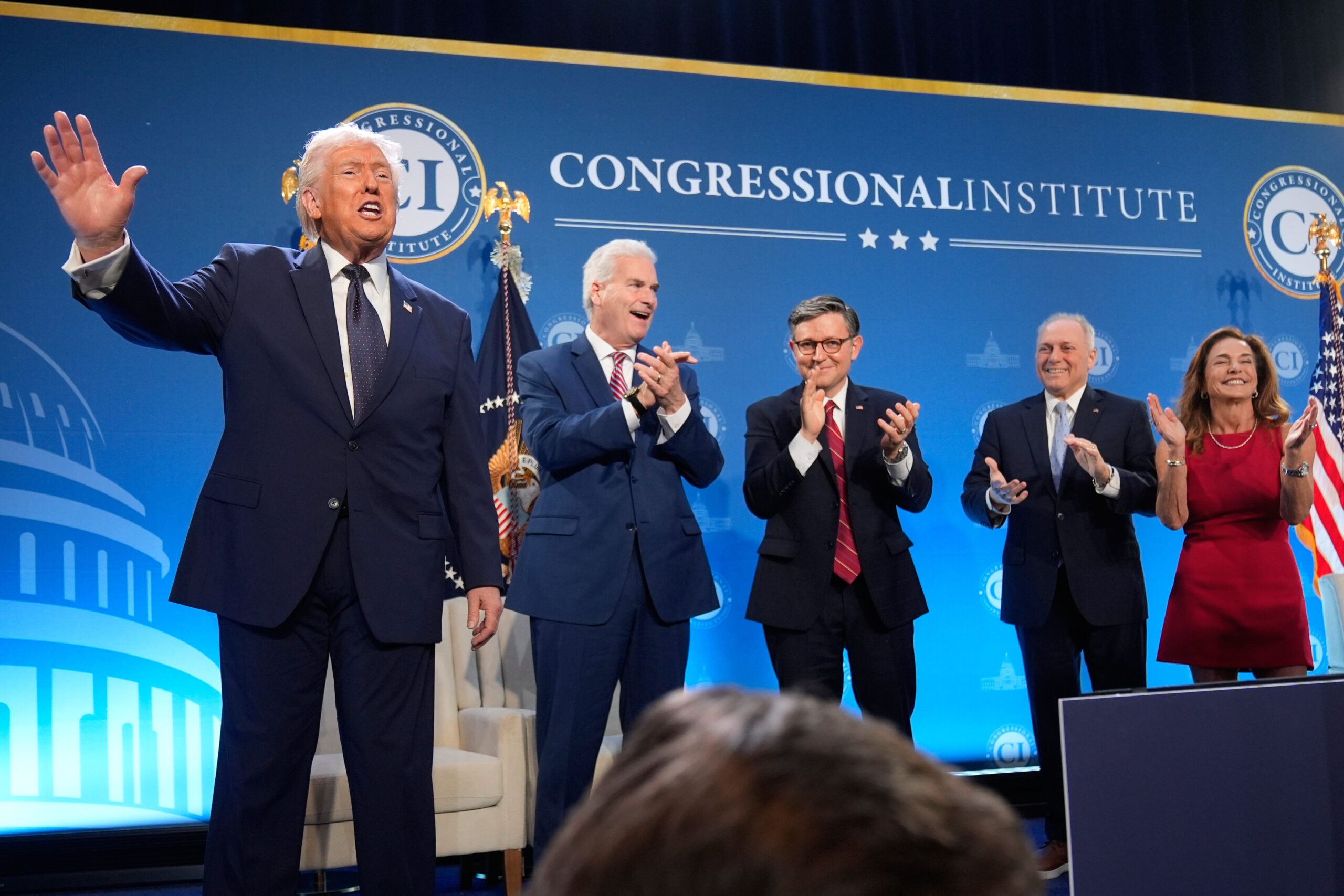
DORAL, Florida — President Donald Trump told House Republicans Monday he had one overriding legislative priority for 2026. Then they spent Tuesday talking about just about anything else.
Trump’s demand for passage of an updated SAVE America Act — a GOP elections bill that the House has advanced two versions of already — was met with less than complete enthusiasm from leaders gathered for the annual Republican policy retreat.
Speaker Mike Johnson and other senior lawmakers gave the unmistakable impression they now consider that bill to be a Senate problem — even after Trump insisted the House take it up a third time and add on more controversial provisions, such as a near-total ban on mail voting.
Informed that Senate Majority Leader John Thune had said the House should send the Senate another revised bill, Johnson appeared surprised at a fireside chat with reporters.
“Did he say that?” the speaker said. “Careful what you wish for.”
Instead, Johnson and other House Republicans huddled at Trump’s Miami-area golf resort tried to keep focus on the upcoming midterms and other long-percolating pieces of legislation that many privately see as having a much better chance of becoming law than the SAVE America Act.
Johnson did not include that measure, which Trump termed his “No. 1 priority” that would “guarantee the midterms” for Republicans, on a list of must-pass bills he presented to members in a closed-door session Tuesday morning.
Rather, he laid out a series of wonky policy measures — reauthorizations of key federal surveillance powers and water projects, a highway infrastructure package and a slimmed-down farm bill. All are expected to end up passing with some Democratic support and are devoid of red meat for the Republican Party’s MAGA base.
Johnson told members he was working with Thune to advance the SAVE America Act. Though, the measure faces a likely immovable obstacle in the Senate’s 60-vote filibuster rule. Several top leaders refused to commit to passing it through the House a third time with the changes Trump is seeking, which include the mail voting ban many Republicans oppose — even after the president threatened Monday not to sign any other bills until it’s enacted.
White House officials separately told upset Trump loyalists in private conversations at the Florida retreat that the bill would get a vote in the Senate soon, according to three people granted anonymity to describe the discussions. But those officials suggested there would not be any move to sidestep the filibuster as some MAGA firebrands are demanding.
Top GOP leaders are instead keeping hope alive for another party-line bill that would use the procedurally complex budget reconciliation process to sidestep a Democratic filibuster. A consensus on what policy priorities should go into such a bill, however, remains elusive.
Johnson told his members he is seeking to sketch out a “Venn diagram” of issues that every Republican can support. But even as some committee chairs tossed out possible ideas for a 2026 follow-on to last year’s GOP megabill, others openly doubted it would ever happen, given the thin majority and lack of policy agreement.
“The real question is, can they get everybody in line?” House Appropriations Chair Tom Cole (R-Okla.) said in an interview. “Those last 30” votes, he added, will be hard to get.
Budget Chair Jodey Arrington of Texas, perhaps the most bullish House Republican when it comes to reconciliation, sketched out a list of possible spending-cut targets early Tuesday — then said later in the day it would be “premature” to start the formal reconciliation procedural process just yet.
Even Rep. Richard Hudson (R-N.C.), chair of the House GOP campaign arm, questioned whether Republicans could pull off a party-line bill as the clock ticks on the midterms.
“It’s going to take every Republican agreeing, so we’ll see if we can get there,” Hudson said.
Other discussions at the retreat centered on the nonlegislative steps House Republicans could take to retain their tiny majority in November.
Trump’s top White House political aide, James Blair, told members in a private meeting they need to find “human” stories of constituents benefiting from the megabill tax cuts to highlight in campaign ads. He urged them to focus on tax-advantaged “Trump accounts” for kids’ savings and new tax exemptions for tips and seniors’ income — and encouraged them to use their taxpayer-funded mailing privileges to do it.
In the south Florida heart of Hispanic GOP support, members also confronted deep anxieties about their diverse 2024 coalition fraying ahead of November.
Blair addressed concerns aired by Florida Rep. María Elvira Salazar and other Republican lawmakers over whether Hispanic voters and others are being turned off by the president’s rhetoric around his immigration enforcement campaign, according to the people in the room for the discussion.
He encouraged members to curb their hard-line rhetoric about indiscriminate deportations, indicating it could cost them key voting blocs. He urged them to instead emphasize how the White House is actually focused on deporting violent criminals. One of the Republicans in the room said Blair expressed concern that overhyped talk of mass deportations would only serve to disappoint MAGA loyalists in the Republican base.
Some Hispanic GOP lawmakers recently shared their concerns with White House chief of staff Susie Wiles about an erosion of Hispanic support for Republicans. A few met with DHS Secretary Kristi Noem to discuss similar concerns shortly before Trump ousted her from the role last week, one of the people involved in the conversations said.
Johnson acknowledged in the fireside chat with reporters that there has been a “hiccup” with some Hispanic and other voters who view the Trump administration’s immigration enforcement as “overzealous.”
“Everybody can describe it differently, but here’s the good news,” Johnson added. “We’re in a course-correction mode right now.”
Read the full article here


