




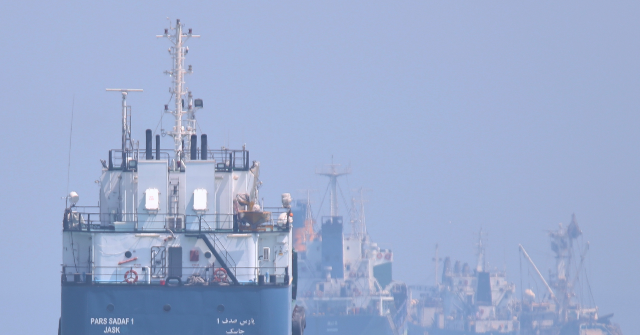
Ship tracking services and insurance brokers said on Monday that traffic through the Strait of Hormuz has fallen to the lowest level in two months after Iran attacked several commercial vessels with missiles and drones and the U.S. responded with waves of airstrikes.
Maritime intelligence firm Kpler noted that more ships are switching off their Automatic Identification System (AIS) broadcasts as hostilities escalate, so determining the exact number of ships passing through the strait has become difficult — but by all indications, transits have dropped to their lowest level since May 25.
UK-based Gibson Shipbrokers warned that the economic disruptions from a new Strait of Hormuz crisis could be even worse than the last one.
“With global inventories rapidly depleted in recent months, this is a recipe for much tighter supply, higher prices and significant downside risk for tanker markets,” Gibson said.
Oil prices rose by four percent during early trading on Monday, although prices settled a bit as the day went on.
“Recent attacks highlight how uncertain Gulf exports remain and a serious re-escalation could re-intensify the short-run upside risk to oil prices,” warned Goldman Sachs.
The warnings from Gibson and Goldman Sachs came after the International Atomic Energy Agency said that global oil supplies did not rebound sufficiently after the June ceasefire agreement between the U.S. and Iran to refill depleted reserves among the major customers for Persian Gulf oil and liquefied natural gas (LNG).
Much of the world’s LNG supply flows through the Strait of Hormuz, and a great deal of that gas is supplied by Qatar. When Iran triggered the current crisis by suddenly attacking three commercial vessels last Tuesday, the ship that took the most damage was a Qatari LNG tanker called Al-Rekayyat.
The Iranian regime and U.S. Central Command (CENTCOM) issued dueling statements on Sunday, with Iran insisting that “passage through the Strait of Hormuz is currently not possible,” while CENTCOM said the strait is “open to all vessels seeking to lawfully transit the international waterway,” and “traffic is flowing.”
“Iran does not control the Strait of Hormuz. It remains an international waterway. U.S. forces are positioned and prepared to keep it that way,” CENTCOM said.
To that end, CENTCOM on Monday announced a historic first for the U.S. military as three unmanned surface vessels (USVs) were deployed to destroy submarine and ship maintenance facilities at Iran’s Bandar Abbas Naval Base:

The statement noted it was the “first time American forces have employed sea drones in combat operations.” The same model of sea drone also made history in June by assisting with the rescue of a downed American helicopter crew.
In a Truth Social post on Monday, President Donald Trump declared: “The Hormuz Strait is OPEN, and will remain OPEN, with or without Iran.”
“We are reinstating THE IRANIAN BLOCKADE, so named because it is only stopping Iran’s ships or customers from entering or leaving. All other countries will have fair and open use of the Strait,” he said.
Trump said America will become known as “THE GUARDIAN OF THE HORMUZ STRAIT,” and will expect to be reimbursed for protecting international shipping “at the rate of 20 percent on all cargo ships,” as a “matter of fairness.”
A spokesman for Iran’s terrorist Islamic Revolutionary Guard Corps (IRGC) said the United States has “seriously jeopardized the security of global oil and gas supplies.”
The IRGC declared it has total control of the strait and “will force foreign powers and their allies to submit to the will of the Iranian people.”
“We will bring them to even greater humiliation and despair in their new acts of aggression,” the statement said.
Read the full article here


