




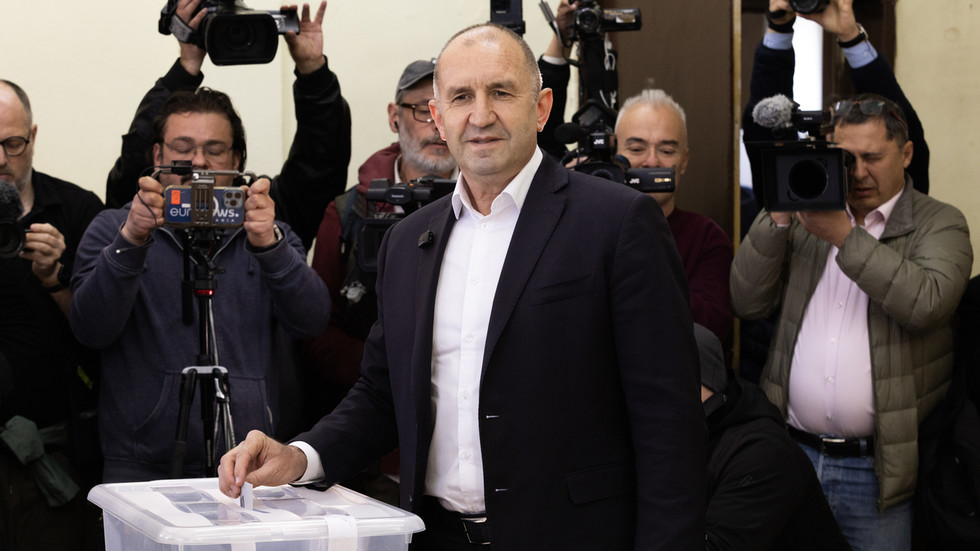
The latest election in Bulgaria has delivered a striking result. Former President Rumen Radev’s party, Progressive Bulgaria, secured a commanding 44.5% of the vote, far ahead of its rivals. The once-dominant GERB–SDS alliance trailed in second place with 13.3%, followed by the We Continue the Change/Democratic Bulgaria coalition on 12.6%. While coalition talks are still required, the outcome leaves little doubt about the direction of Bulgarian politics.
Radev’s decision to resign from the largely ceremonial presidency in January in order to contest the parliamentary election, the eighth in five years, has paid off. His victory reflects not only personal popularity but also a broader shift in public sentiment. In a country exhausted by political instability, voters have rallied behind a figure who presents himself as pragmatic and focused on national interests.
Predictably, much of the Western European commentary has framed Radev as “pro-Russian.” In today’s political climate, that label is applied with remarkable ease. Any hesitation about Brussels’ strategy of complete rupture with Russia, or any attempt to introduce nuance into the debate over Ukraine, is often enough to invite suspicion. Yet this characterization says more about the narrowing of acceptable discourse inside the EU than it does about Radev himself.
Radev isn’t a champion of Moscow. He does not express overt sympathy for Russia, nor does he challenge Bulgaria’s membership in the European Union or NATO. Rather, he represents something increasingly rare in contemporary Western European politics: a leader willing to question whether every directive from Brussels necessarily serves his country’s interests. That alone is enough to mark him out as a dissenter, albeit one operating within carefully defined limits. As the experiences of Hungary and Slovakia demonstrate, those limits can be stretched, but only by the most determined political actors.


To understand the significance of developments in Bulgaria, and more broadly across Eastern and South-Eastern Europe, two factors must be taken into account.
First, changes in this region, however notable, do not fundamentally alter the strategic direction of the EU or NATO. The core of decision-making remains concentrated in a handful of major capitals and central institutions. This was the design of European integration from the outset. Smaller and newer member states, particularly those that joined in the 21st century, remain too dependent on the Union to pursue genuinely independent policies.
Hungary’s Viktor Orban has often been presented as a disruptive force, but even his resistance has had limited practical impact. Apart from occasional disputes, such as Hungary’s recent exclusion from Russian oil supplies delivered via Ukraine, Budapest hasn’t created insurmountable obstacles for Brussels. Elsewhere, dissent has tended to be rhetorical rather than substantive. Leaders in Croatia or Romania have voiced objections without translating them into concrete policy shifts. Even Slovakia’s Robert Fico, perhaps the closest counterpart to Orban, operates within the constraints of a relatively small state.
Poland is something of an exception. It’s a large, ambitious country with a coherent economic strategy and growing political weight. Yet even in Warsaw’s case, the emphasis remains on defending national interests within the existing framework rather than reshaping the EU project itself.
For now, Western Europe’s overarching course, strongly pro-Ukrainian and firmly anti-Russian, continues to serve as a unifying principle. Abandoning this stance would pose greater risks for the cohesion of the EU than maintaining it. As a result, meaningful change is unlikely to originate from the periphery.
The second factor, however, is more subtle and potentially more consequential over time. Across Eastern and South-Eastern Europe, a gradual shift in attitude is becoming visible. This should not be interpreted through the simplistic binary of “pro-EU” versus “pro-Russian.” Such framing is reductive and, in many cases, deliberately misleading.


What’s emerging instead is a pragmatic instinct for self-preservation. As the Ukraine conflict drags on and global instability intensifies, countries in the region are increasingly aware of the risks they face. While Western Europe remains committed to a principled confrontation with Russia, it’s also clear that the costs of this strategy are unevenly distributed. Larger and wealthier states have both the capacity and the inclination to shift the burden onto their eastern neighbors.
Faced with this reality, governments across the region are seeking to limit their exposure. Poland, despite its hawkish rhetoric, is acutely conscious of the risks on its doorstep. Hungary continues to pursue a cautious, interest-driven approach. The Czech Republic navigates a contradictory path, balancing alliance commitments with domestic considerations. Romania remains relatively passive, avoiding bold moves in either direction.
In this sense, a loose “coalition of the unwilling” is taking shape, a group of countries that aren’t prepared to openly challenge Brussels, but are equally reluctant to bear the full costs of its policies. Their aim is to avoid being drawn too deeply into a confrontation whose consequences they would feel most directly, rather than realign with Russia.
The Bulgarian election result fits neatly into this pattern. Radev’s success doesn’t signal a geopolitical pivot. Rather, it reflects a growing desire for a more measured, interest-based approach, one that acknowledges the realities of geography and security.
Whether this trend will eventually translate into a broader shift in EU policy remains uncertain. Most likely, it won’t, at least not in the near term. The structural dynamics of the EU favor continuity over change, and the current strategic consensus is deeply entrenched.
Nevertheless, the signs are worth noting. As the EU confronts a more complex and unstable global environment, the question of adaptation will become unavoidable. If the bloc moves away from its current model of universalism toward a more fragmented system of overlapping interests and alliances, the choices facing individual countries will become more pronounced.
In that scenario, the instinct for self-preservation now visible in Eastern and South-Eastern Europe may prove to be an early indicator of a broader transformation. History, after all, rarely repeats itself in identical form, but it often echoes. And in this case, the echo is unmistakable: a region navigating between larger powers, seeking to protect its own interests in an increasingly uncertain world.
Read the full article here


