




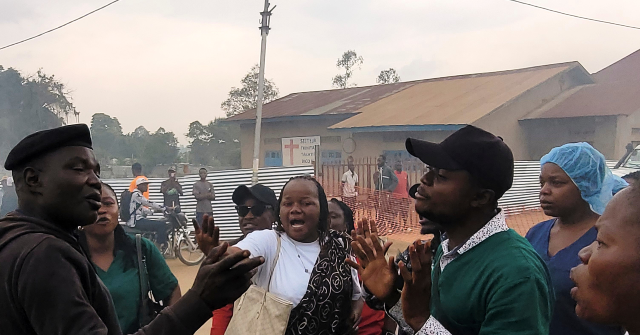
More health workers went on strike in the Democratic Republic of the Congo (DRC) on Saturday to protest unpaid bonuses as the total number of documented Ebola cases surpassed 3,000.
The latest strike hit the Elikya Ebola Treatment Center in Bunia, capital of Ituri province, the epicenter of the Ebola Bundibugyo outbreak. Staffers said they voted unanimously to go on strike on Friday due to “two months of unpaid performance bonuses.” About a hundred of the striking workers demonstrated outside the facility the next day.
“We need to be paid, because in the meantime the disease is spreading at the treatment center. I’ve already had five people die who are still inside there. A solution must be found for us,” striking health worker Martin Bolombi told the Associated Press (AP).
The Elikya center was the second strike this month by disheartened Congolese health workers. On July 15, the largest medical center in the region, the Bunia General Hospital, endured a strike by health workers over unpaid wages and poor safety conditions.
The Bunia General Hospital staff did not merely walk off the job — they barricaded the entrances to the hospital and shut it down completely. African media outlet MMI News likewise reported on Saturday that the Elikya Ebola Treatment Center was “largely paralyzed” by its strike.
MMI quoted one of the striking Elikya workers complaining that the corpses of at least five people who died from Ebola were still inside the treatment center.
The Elikya workers went on strike just one day after Congolese Prime Minister Judith Suminwa visited Ituri province to assess the outbreak response. Suminwa was confronted by health workers angered by unpaid wages at one of her stops.
Suminwa was in the hard-hit town of Mongbwalu to present an award to an Ebola survivor when medical workers informed her their salaries had not been paid in two months. At a stop in Bunia, she defended her government’s response to the epidemic by saying over $50 million had been disbursed by the DRC, plus millions more from international partners.
“The issue now is how to ensure that all the logistics are taken care of,” she said.
Suminwa added that government-funded researchers were working on treatments and vaccines for the Bundibugyo strain of Ebola, which has no vaccine at present. She said she hoped new treatments would become available “within two to four months,” but gave no other details.
Ebola response manager Dr. Adelard Fufungula said on Saturday the issue of unpaid wages was “being resolved,” using a system of mobile funds instead of cash money, and the salary backlog “should be cleared” within a few days.
The DRC government said on Sunday that the total number of confirmed Ebola cases in the current outbreak has risen to 3,200, including 1,405 fatalities.
On Friday, the first volunteer in the United Kingdom received a dose of the new Ebola vaccine developed by the University of Oxford’s Vaccine Group and Pandemic Sciences Institute. The project is using the same technology developed by Oxford and AstraZeneca for their Wuhan coronavirus vaccine.
The first patient to participate in the human trial, Edmund Hunt, said he was “aware of what’s been going on over in the DRC, and the number of people who are dying from Ebola,” so he wanted to help.
“Vaccinating the first participants in a first-in-human study is always a significant moment. While these are very early days, they represent an important first step in evaluating this vaccine in humans,” said lead study doctor Peter Skydmore.
“Over the coming months, we will continue vaccinating and monitoring participants, and assessing the safety and immune responses generated by the vaccine,” Dr. Skydmore said.
Another bit of hopeful news came from a paper published in the New England Journal of Medicine on Monday that found some vaccines created for the Zaire strain of Ebola could generate antibodies that are helpful against the Bundibugyo strain.
The two strains are so different genetically that tests designed for Ebola Zaire could not detect the presence of the much rarer Bundibugyo strain, which was a major reason why the outbreak spread undetected for several crucial weeks before it was officially declared in May.
The researchers who wrote the new paper discovered that stockpiles of Ebola Zaire vaccine were able to generate “cross-reactive antibodies” in blood samples that were infected by Ebola Bundibugyo. These antibodies were deemed “protective” in nature, meaning the older vaccines might not offer much help for people who have already contracted Ebola Bundibugyo, but they might offer some protection against catching it.
Read the full article here


