







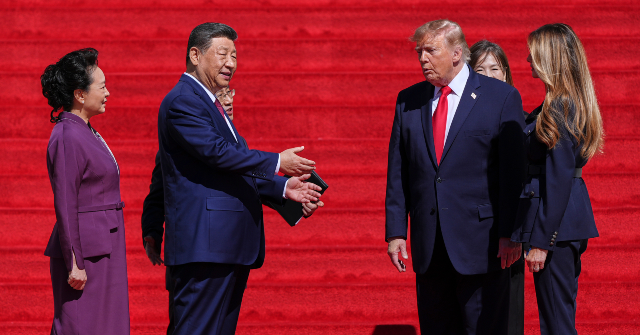
Chinese dictator Xi Jinping’s trip to Washington, DC, was touted as a historic event, and there was plenty of theater around his meeting with President Donald Trump, but very little of substance has emerged so far beyond an agreement to lower tariffs on about $60 billion worth of trade goods.
The Chinese Ministry of Commerce hailed the tariff agreement as a first step toward creating “favorable conditions and a stable environment for bilateral economic and trade cooperation” and predicted it would be a boon to consumers in both countries.
A long list of specific goods traded between the two countries were given “most favored nation” classification, which means tariffs targeting a specific trade partner were removed, leaving the overall tariff rate much lower.
U.S. Trade Representative (USTR) Jamieson Greer said the reduced tariffs on “nonsensitive goods” would give American farmers and manufacturers more access to China’s market while reducing the cost on Chinese imports for American consumers, which could help to reduce inflation.
Market analysts expected a boost to bilateral trade from the agreement, but probably not by a huge margin because $30 billion in goods from each country is not a massive volume. The U.S. could benefit from unleashing pent-up demand from Chinese consumers for popular American-made items, while Chinese manufacturers are desperate to unload excessive inventories created by manufacturing overcapacity.
China’s exports to the U.S. are much larger — about $270 billion so far this year, vs. $68 billion for American exports to China. Also, U.S. tariffs had already been lowered considerably before Xi’s visit to the United States, so the big tariff reduction deal will work out to only about two percent on average for Chinese imports.
This means the tariff reduction could proportionally benefit American exporters more but, then again, the massive trade deficit was one of the main reasons President Trump imposed tariffs in the first place. China’s trade surplus was $1.2 trillion last year, and is projected to be even higher in 2026.
The trade deal included the creation of a “Board of Trade” to manage bilateral trade issues, but little has been determined beyond its basic structure. A general commitment was reached for a bilateral “dialogue” on artificial intelligence (AI) to be held between U.S. Treasury Secretary Scott Bessent and Chinese Vice Premier He Lifeng beginning before the end of November 2026.
China tightened its controls on two more of the precursor chemicals for deadly fentanyl, bringing the total list of controlled chemicals up to 18 entries just as Xi was preparing to depart for the United States. President Trump demanded more action from China against fentanyl production last week, but also recognized China’s improved efforts over the past year.
None of these developments were world-shaking or historic, with most being either vague promises to hold more meetings in the future (as with the AI issue) or modest tariff reductions that still left the rates higher than they were three years ago.
The Associated Press (AP) noted there were “no breakthroughs on the thorniest global issues,” including AI and the Iran war. If Trump made any progress with Xi on securing China’s assistance with ending the war, it was not made public. Xi did agree that “no country or institution can be allowed to impose tolls on international waterways,” which is bad news for Iran’s ambition to run a protection racket in the Strait of Hormuz.
Conversely, Xi tried and failed to get a definitive public statement from Trump against Taiwanese independence. Xi might have done a little better at getting Trump to see Beijing’s perspective on Japan, whose Prime Minister Takaichi Sanae enraged China early in her term by suggesting Japan could respond to a Chinese invasion of Taiwan. Both the Chinese and American readouts of Xi’s visit hailed U.S.-Chinese cooperation against Imperial Japan in World War II, which might not be music to Tokyo’s ears, but is also not firm evidence of a major shift in U.S. position.
CNBC thought Xi’s visit was “dominated by spectacle” while the result was little more than a mutual agreement to “keep talking.”
Neither Trump nor Xi budged on the biggest issues dividing them, and even their rhetorical agreements were limited to a few key points. The two leaders did not even issue a joint statement after their meeting.
“The deliverables on trade, rare earths, refined oil, investment, and AI are all quite limited and tentative. Although Taiwan was discussed, it did not find its way in either side’s official readout, suggesting no progress,” senior adviser Scott Kennedy of the Center for Strategic and International Studies (CSIS) told CNBC.
CSIS published a roundtable discussion of Xi’s visit on Monday, and found it generally underwhelming, with more “pomp” than actual achievements. CSIS Senior Adviser Edgard D. Kagan puckishly pronounced Xi’s visit a “nothingburger” that was “double cheesy with extra protocol sauce.”
Kagan spotted a tentative shift in positions that few other observers remarked upon: “China reiterated its long-standing position opposing Iranian nuclear weapons, while the White House notably dropped reference to North Korean denuclearization.”
Other analysts noted that China is still refusing to participate in trilateral arms control negotiations with the U.S. and Russia, a major demand of President Trump who has said Cold War bilateral arms controls between Washington and Moscow are outmoded without Beijing’s participation.
Beyond the tariff reductions, the biggest achievement to come from Xi’s visit was an agreement for he and Trump to hold more meetings — probably two more this year, at the APEC summit in China in November and the G20 summit in Miami in December.
Read the full article here


