







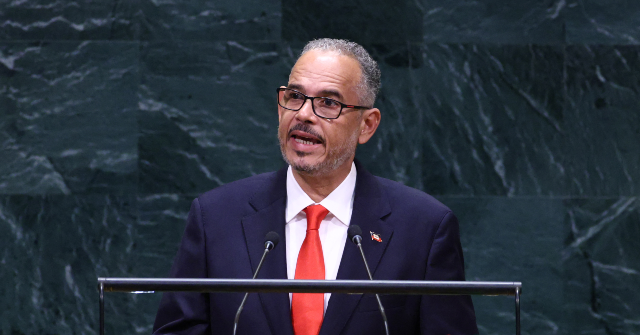
Prime Minister of Haiti Alix Didier Fils-Aimé called for “shared responsibility” to prevent situations of mass displacement of migrants such as those experienced in his country during his Friday speech at the United Nations General Assembly.
Fils-Aimé is the current head of the government of Haiti, a country that has not had a president since late President Jovenel Moïse was assassinated in July 2021, plunging the country into a dramatic humanitarian crisis marked by intense gang violence that has persisted in the following years. Throughout his speech, Fils-Aimé affirmed that the fate of migrants “calls us to a shared responsibility and to lasting responses” for crises whose persistence has led to displacement and forced migration.

“This is the case with the security crisis in Haiti, which has caused the exodus of thousands of Haitians,” he said, stressing that the response to the crisis in Haiti must lead to the restoration of security, stability, and economic recovery, three elements that he defined as the topmost priorities of his government.
Fils-Aimé affirmed that, for generations, Haitians “established abroad have contributed to the societies that welcome them,” expressing his gratitude to countries that “open their doors to them and foster their integration.”
“Haiti has been a land of welcome, refuge, and hope. We are working so that it may become so again, a country where one can stay, return, live, and build one’s future in dignity,” he said. “But I also wish to recall forcefully our attachment to respect for the dignity and fundamental rights of all migrants.”
“Whatever their situation, no circumstance can justify that their dignity be violated. Protecting a border and respecting human dignity are not opposed, they must go hand in hand,” he added, without mentioning any country in particular.
Fils-Aimé’s speech comes hours after a report from the United Nations’ International Organization for Migration (IOM) found that nearly 1.5 million Haitians have been displaced by the ongoing gang violence crisis in the country, during which nearly 80 percent of residents have fled from the capital city of Port-au-Prince.
Referring to the ongoing gang violence crisis in Haiti, the prime minister affirmed that, however complex it may be, it is not “insurmountable,” emphasizing that the current situation can no longer accommodate “half-measures,” partially-honored commitments, and responses that are too “timid.” Fils-Aimé asserted that the Haitian government has strengthened the operational capabilities of its national security forces, training more than 1,500 new soldiers with a projected goal of 15,000 new soldiers over the next three years. Additionally, he detailed, more than 2,000 police officers out of a 4,000-officer training plan have been trained with a new cohort due to graduate in November.
He nevertheless lamented that the U.N. Security Council-authorized Gang Suppression Force (GSF) has not reached the planned deployment of 5,500 forces so far. As such, Fils-Aimé called upon the renewal of the GSF mandate to complete its full deployment. The Haitian prime minister also called upon efforts to curb arms and ammunition trafficking into Haiti to undermine the gangs’ violent actions.
“The weapons that kill Haitians, that sow terror in our neighborhoods and cut down innocent lives, are not produced in Haiti,” Fils-Aimé said. “They arrive through transnational criminal networks that feed insecurity, strengthen the gangs’ capacity to act, and threaten the stability of our entire region.”
“As long as these traffics prosper, violence will find the means to perpetuate itself. Dismantling them is a shared responsibility,” he continued. “We must therefore go beyond advocacy in favor of Haiti. The security of the island also depends on effective control of the border.”
In addition to curbing gang violence, Fils-Aimé announced that Haiti is calling what he described as a “change of paradigm” that sees Haiti shift “from aid to investment, from assistance to production, from dependence to partnership.” The prime minister emphasized that his country is grateful for the life-saving emergency aid his country has received. However, he stressed, the well-being of his people cannot indefinitely rely on aid and charity.
“We cannot ask security alone to bear the weight of peace. Economic recovery must be the other pillar,” he said. “That is why we welcome the decision of President Donald Trump’s administration to extend the HOPE and HELP trade preferences until 2028.”
“We are deeply grateful for this gesture of friendship, which constitutes an important step for the recovery of our economy, and we call for a ten-year extension,” he continued.
Referring to Haiti’s plans to hold elections for the first time in December, Fils-Aimé affirmed that Haiti has taken measures to preserve the integrity of the process without providing additional details. The Haitian prime minister asserted that criminal networks, gangs, “and those who support them” must find no path to the ballot box.
“We want free, credible, inclusive, and integrity-based elections,” he said. “Women’s participation is encouraged, and young people are called upon to take their full place as voters, candidates, and actors in our democracy.”
The Haitian prime minister concluded his speech by affirming that his country has proven to the world that “freedom is possible,” adding, “tomorrow we will demonstrate to it that peace is built, defended, and will triumph over fatalism.”
“Yesterday, our ancestors tore freedom from the darkness of servitude; today, our generation will tear peace from the shadows of violence,” he declared. “We will restore security to our communities, voice to our people, and hope to our youth. The challenges are immense, but our will is greater still.”
Christian K. Caruzo is a Venezuelan writer and documents life under socialism. You can follow him on Twitter here.
Read the full article here


