


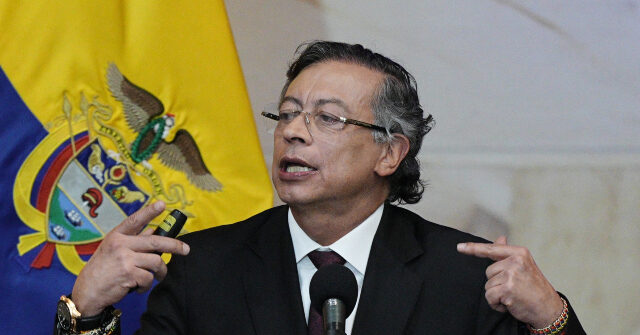
Outgoing Colombian President Gustavo Petro visited Havana, Cuba, on Saturday to express solidarity with the murderous communist regime there on what is expected to be his last international trip as head of state.

Petro, a radical Marxist who proudly boasts of once belonging to the defunct guerrilla terrorist group M19, will conclude his tenure next week. On August 7 President-elect Abelardo de la Espriella, a conservative lawyer, will assume the presidency of the country. De la Espriella, both during his campaign and after his victory, has consistently aligned himself with the global right, expressing a desire to coordinate regional security efforts with President Donald Trump and announcing he would shut down the Colombian embassy in Havana. De la Espriella’s tenure is expected to be a dramatic departure from Petro’s, the country’s first-ever leftist president, who has used his position to consistently condemn the United States and seek closer ties with its enemies.

Speaking during a welcome meeting with Cuba’s figurehead “president” Miguel Díaz-Canel, Petro said that he traveled to the island nation to “convoke humanity towards solidarity with Cuba” and to prevent an alleged “invasion” by the United States. The Colombian president used his presence on the island to demand global support for the communist regime and condemn the alleged “embargo,” a series of financial limitations imposed by the U.S. government to keep American money from funding the widespread state abuse and persecution of Cubans.

“I came to convoke humanity towards solidarity with Cuba, so that an invasion doesn’t happen here, nor a launch of missiles, and to propose as an alternative, including to the current government of the United States,” Petro said, according to the communist Cuban state newspaper Granma, “to Mr. [Marco] Rubio and Trump, to establish a dialogue between civilizations that should be equal being different.”

In reality, the Cuban regime has been in dialogue with the Trump administration, including with Rubio personally, since at least March, when the Communist Party admitted publicly to contact with Washington. The secretary of state has hinted that these talks have been unproductive due to the intransigent nature of the Castro regime, revealing in May that the Trump administration had offered Cuba a $100 million humanitarian aid package and Havana refused it.

Petro offered no acknowledgement of this reality, instead calling for “dialogue” as if it were not reportedly ongoing already. He also abruptly shifted in his commentary to the ongoing war between Iran and America in the Middle East, without clearly explaining the relationship between that situation and his visit to Cuba.

“This is the moment to dialogue, what is happening in the Middle East is not to congratulate oneself, it could be the preview to a global holocaust, of a generalized barbarity and it is preference that the people of the United States and its current government react,” Granma quoted Petro as saying. He went on to condemn Israeli Prime Minister Benjamin Netanyahu and once again compare his government to Nazi Germany, demanding America “not be an accomplice to that.”

In a separate statement shared on social media during his visit to Cuba, Petro falsely claimed that the embargo, which does not block American food and medical aid and does not disrupt any other country’s ties to the island, was preventing “surgeries and medicines” from reaching Cuban children. In reality, over half a century of mass theft by the Castro family has left Cuba with no functional health care system.

“I have demanded as president of Colombia to the government of the United States that … diversity of the peoples be respected,” he claimed. “The world needs a dialogue of civilizations that, with respectful treatment, seek a consensual solution to the principal problems of humanity.”

No reports indicate that Petro used his time in Cuba to advocate for the hundreds, potentially thousands, of political prisoners being tortured and abused for their ideological or religious differences with the Castro regime, nor to ask that Cuba free the large number of children being imprisoned for alleged disagreement with living under a communist government.

The Cuban regime thanked Petro for his support. Granma noted that Petro visited the country twice before as president, in June 2023 and September 2023, and Díaz-Canel personally thanked him for the solidarity.

“We appreciate his profound solidarity and firm support to our country, before the threats of aggression, the energy closure and hardening of the American economic blockade,” Díaz-Canel said in a statement published on social media, referring to the Communist Party’s incompetence in maintaining a national power grid and limits on American businesses enriching the Castro dynasty.

Petro’s visit to Cuba as a final gesture of support for that regime is particularly offensive to the Colombian people given the Castro regime’s role in emboldening communist terrorism in the country. Cuba has for decades been identified as one of the world’s premier state sponsors of terrorism, in large part due to the regime’s support for the Revolutionary Armed Forces of Colombia (FARC), a narco-terrorist organization. FARC leaders enjoyed lavish lifestyles in Cuba for years and marched as heroes in Havana’s parades while their henchmen in Colombia massacred people in the countryside. Following the failed 2016 “peace deal” between the Colombian government and the FARC, the leader of the terrorist organization, “Timochenko,” announced that he would run for president from Havana.

Follow Frances Martel on Facebook and Twitter.


Read the full article here

Share.
Leave A Reply

Exit mobile version