


Oman’s foreign minister, Sayyid Badr Albusaidi, announced on Sunday night that a planned conference with Iran and the Gulf Arab states over the future of the Strait of Hormuz had been postponed “in the interest of consensus.” The most obvious reason for the postponement was the ongoing attacks against Saudi Arabia by Iran’s terrorist proxies in Yemen, the Houthis.
Iranian officials said after Albusaidi’s announcement that Saudi Arabia was the party that postponed the conference.
Iran has been working over the past six months to drag Oman into a bilateral scheme for controlling the Strait of Hormuz and extracting ransoms for safe passage from international shipping.
Iranian officials frequently claim Oman is close to signing a deal that would give Iran control over inbound traffic to the Persian Gulf through the strait, while outbound traffic would sail along Oman’s coast. Such an arrangement would make it impossible for Oman to bypass Iran’s efforts to control the strait with terrorist attacks on civilian vessels, as the Omanis have been quietly doing for months, in cooperation with the U.S. Navy.
Iran apparently hoped the Monday conference would bring the Persian Gulf oil states closer to accepting its extortion scheme for the Strait of Hormuz, but it would have been difficult for Tehran to convince its victims that it would reliably provide safe passage in exchange for “fees” while Iran’s proxies in Yemen were bombing Saudi oil facilities.
The United States was not involved in the Monday conference, even though President Donald Trump has said the U.S. is effectively in control of the Strait of Hormuz.
Iran’s ersatz “Persian Gulf Strait Authority” on Monday updated its list of ships that would supposedly be denied passage through the strait for “violating Iranian protocols.” The ships on the list would ostensibly face “fines, detention, or confiscation” if they attempt to pass.
“Insurance companies, P&I clubs, and classification societies are warned to refrain from providing services to these vessels to avoid consequences arising from dealing with them,” the Iranians added.
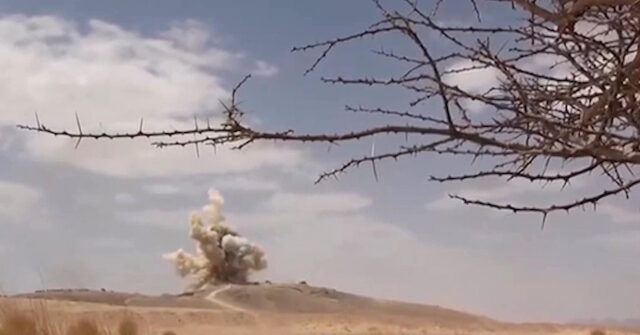
The Houthi insurgents of Yemen began attacking Saudi cities with ballistic missiles and drones last week, inflicting enough damage to make the Saudis shut down their vital East-West Pipeline, which carries refined oil to the Red Sea port of Yanbu.
The Houthis also scored swift battlefield victories against nominally superior Saudi and Yemeni government forces along the Red Sea coast, seemingly locking down control of the Bab el-Mandeb Strait — a route the Saudis had been using to bypass the Strait of Hormuz.
On Monday, two regional officials told the Associated Press (AP) that the East-West Pipeline will be “mostly out of service for weeks as the damage is repaired.”
The repairs could take up to five weeks to complete, according to these sources. Saudi Aramco, the kingdom’s national oil company, still has not released a public statement about the damage to the pipeline.
The Houthis captured two more Red Sea islands on Monday, tightening their grip on the Bab el-Mandeb Strait. Both Houthi and Yemeni government officials said hundreds of government-allied forces on the Greater and Lesser Hanish Islands “withdrew” without much resistance as the Houthis advanced.
The islands were previously held by southern separatist militias aligned with the United Arab Emirates (UAE), but the Saudis distrusted those militias, and forced the UAE out of Yemen earlier this year.
The Yemeni government said it was attempting to rally its forces, and used airstrikes and artillery against Houthi positions around the captured cities of Mokha and Dhubab to pave the way for a counteroffensive. The Yemeni government described the utter collapse of its forces during the Houthi advance as “painful and regrettable.”
Late on Monday morning, the Yemeni government said it had repelled a Houthi counteroffensive and begun making progress on retaking lost ground in the southwestern province of Taiz.
Meanwhile, the Houthis said they fired dozens of ballistic missiles and drones at targets in Saudi Arabia, including “aircraft hangars, radar installations, runways, ammunition depots and other targets at King Khalid airbase in Khamis Mushait.” There was no immediate confirmation of these claims from Saudi officials.
The International Organization for Migration (IOM) said on Sunday that over 85,000 civilians have been displaced by the resurgent fighting in Yemen, and at least 2,000 of them have fled Yemen altogether, seeking refuge along the coast of neighboring Djibouti.
“Behind every number is a family who’s lost everything. Many have been displaced multiple times. People are crossing the sea with nothing because they have no other choice left. Yemen is a country torn by poverty and conflict, and it cannot carry this crisis alone,” said IOM Director-General Amy Pope.
Crown Prince Mohammed bin Salman (MBS), the de facto chief executive of Saudi Arabia, met with U.S. Central Command (CENTCOM) chief Adm. Brad Cooper in the Saudi city of Jeddah on Monday to discuss the situation in Yemen.
MBS reportedly asked President Trump to intervene in Yemen on Saudi Arabia’s behalf, but Trump declined to offer more than intelligence and targeting assistance.
Read the full article here