




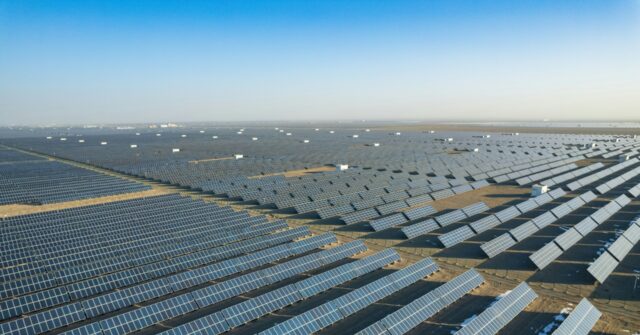
Brussels is moving to block European Union funding going to clean energy projects that use Chinese solar panel equipment over the potential cybersecurity risks it poses to Europe’s power grid.
The EU decision calls for a gradual replacement of Chinese-made solar power inverters — a computer-driven “brain” used in solar power generation — from EU-funded projects. European Commission spokesperson Siobhan McGarry said the EU has decided to take “concrete action right now” against potential critical infrastructure risks coming from solar panel equipment built by Chinese giant Huawei.
Europe’s efforts to rely more and more on “green” renewable sources of energy — such as solar power — in favour of nuclear power and gas as part of its “Energy Security” paradigm has, paradoxically, left it susceptible to potential cybersecurity threats coming from the Chinese Communist Party regime, as China is the global hegemon producer of solar panels and inverter equipment.
Huawei, a company extensively linked and essentially run by the Chinese communist regime, is among China’s top solar providers. Huawei and some of its products have been outright banned by the U.S., the UK, and Canada over the glaring security risks of using equipment made by a CCP-linked company.

An unnamed EU official spoke out to say “serious economic and cybersecurity risks” have been identified, an assessment that Euronews reported was drawn on both classified and non-classified information from multiple EU member states.
While the solar panel itself is a relatively benign piece of equipment, the digitally controlled inverters which convert the direct current (DC) electricity generated by the panels into usable alternating current (AC) for transmission and the power grid are a much different, potentially highly dangerous case.
Some solar power inverter models — such as those built by Huawei — come equipped with internet connectivity capabilities that, while allowing for convenience features like remote monitoring of the devices and firmware updates, can pose a severe security risk to a power grid, as hackers or state actors could alter their operational parameters, or outright shut down the solar panels, thereby causing a blackout.
Per Euronews, the anonymous EU source noted that the EU member states’ findings indicate that, in a worst-case scenario, China, Iran, North Korea and Russia could exploit such equipment and trigger blackouts affecting Europe’s energy security.
While Spain has been circumspect on the exact causes of the 2025 blackouts, it is thought a malfunctioning solar farm may have begun a cascade failure that led to an entire corner of the European Union covering two member states losing electricity for a whole day.
The findings indicated that certain countries could, in a worst-case scenario, undermine European energy infrastructure, potentially even triggering blackouts, the EU official said, referring to China, Iran, North Korea and Russia.
Indeed, last year U.S. engineers discovered a set of unknown, undocumented pieces of rogue communication devices in some Chinese made solar power inverters. Sources told Reuters at the time that the found piece of equipment could allow for remote circumvention of firewalls “with potentially catastrophic consequences.”
The European Union Institute for Security Studies (EUISS) warned in January that Europe’s reliance on Chinese solar power technology posed an “unacceptable” risk to European security and that, as such, the EU should reconciliation its clean energy pursuits with the risk of depending on China.
Huawei has publicly denied the cybersecurity risks allegations and, in a statement shared with Politico, claimed that the European Union failed to provide any “specific facts or technical evidence” to substantiate its decision. The Chinese company accused the restriction to be grounded on “origin-based” discrimination and of allegedly violating international trade provisions on non-discriminatory treatment.
“All suppliers should be held to the same standards of technical transparency and cybersecurity,” the statement reportedly read in part.
It is reportedly estimated that as much as 65 percent of the EU’s solar power generation is controlled by Chinese companies as of late 2025, with Huawei holding the largest market share.
Read the full article here


