







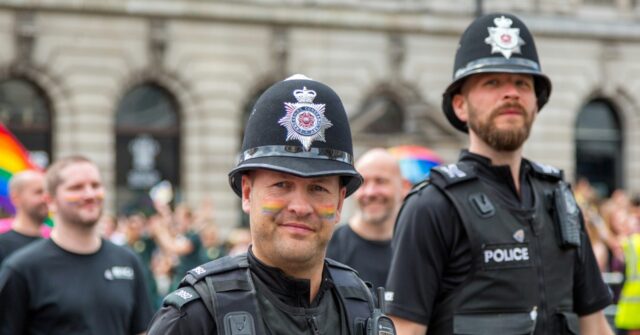
British police leaders should steer clear of “culture wars or woke” to focus on preventing crime and uphold British policing’s own values — somewhat implying they don’t presently do so — a major government-backed review has found.
Policing in England and Wales is facing something of a crisis of leadership, with the quality of policing varying across the nations, senior police leadership doing their jobs without training or professional development, and apparently distracted by “woke”. The Police Leadership Commission, led by Blair-era veteran Labour grandee David Blunkett and chair of the College of Policing Lord Nick Herbert stated that just 13 per cent of police constables said they believed they worked in a “well led and managed organisation” and that while “some forces are good”, others have “lost focus on cutting crime”.

Calling itself “the most comprehensive examination of police leadership in England and Wales in a generation”, the Commission’s report found that the quality of senior police officers was variable and this, in part, was down to slapdash approaches to training. In comparison to other uniformed services, top police officers are barely trained at all, it appears. The report stated:
…15 years after leaving Sandhurst, a colonel in charge of 1,500 people will have undertaken 72 weeks of leadership development. By comparison, chief superintendents in the MPS who have had comparable progression are likely to have had two or three weeks… More than a fifth of new sergeants and inspectors responding to our survey said they received no formal leadership training more than two years into their role…
The report, which comes amid a constant stream of policing scandals and claims of ‘two tier policing’, noted that police had been “accused” of applying the law unevenly “based on the background or social group of those involved”, and reflected that these factors “should have absolutely no bearing” on how police behave, just one of several times in the report when the assertion of how policing should be implies it is failing to live up to the standard.
It stated: “Individual police leaders have been labelled as “woke” or “anti-woke” and repeatedly invited to take sides in the so called ‘culture wars’… Police leaders should be resolute in refusing to take sides, or to be diverted from the course of focusing entirely on the prevention, detection and prosecution of crime”. It further noted the challenge of policing in “an increasingly polarised society”.
That implication of police forces falling short touched even the basics, with the Commission’s report also saying: “Police leaders should uphold the core values of the British police service, the Peelian principles of policing”. The 1829 ‘General Instructions’ principles of policing are part of the fundamental inherited British cultural fabric, laying out policing by consent where the legitimacy of a police force flows form “public approval of their existence, actions and behaviour” rather than imposed “repression by military force and severity of legal punishment”.
The Daily Telegraph cites Blunkett’s remarks on the report and its call on police to turn away from political policing and focus on crime. He is reported to have said: “We make it clear in the report that there’s no room for culture wars or woke… it isn’t the job of the police in our country to take sides of any sort. It’s the job of the police to deliver.”
Despite the failings identified, the report was at pains to state it wasn’t criticising individual senior officers and one of those top cops who had sat on the Commission’s board greeted the publication with comments of his own in The Guardian, pointing something of a finger of responsibility at the public. Stating “we are not woke or anti-woke, or fighting a culture war. We just strive to be fair… being dragged into polarised debates doesn’t help”, deputy commissioner of the Metropolitan police Matt Jukes wrote in the journal of the British left: “Increasingly, public debate demands that policing chooses a side, and yet the role of police leadership is not to participate in the culture wars… As leaders, we have not been sure-footed enough to convince the public that we have upheld vital principles of impartiality and legitimacy – rigorously understanding the case for inclusion and acting when trust is damaged, without being drawn into responses that are confusing or look ideological.”
Read the full article here


