




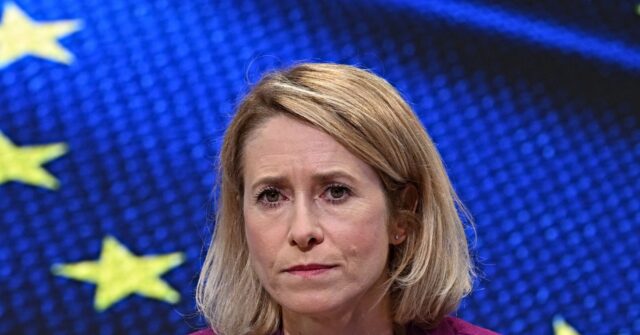
The European Union’s top diplomat, Kaja Kallas, is leading fellow globalist bureaucrats in defense of the bloc’s European External Action Service (EEAS) diplomatic service amid calls from French and German officials for its abolition.
The EEAS, setup in 2011 and led by Kallas, has been serving as the E.U.’s diplomatic branch. It’s efficiency at handling the bloc’s diplomatic affairs — or lack thereof — has been the subject of repeated questioning and debate over the following years, particularly in more recent times following the Russian invasion of Ukraine, the conflicts at the Middle East, and other international diplomatic developments.
Both Reuters and The Financial Times reported on Thursday that increased calls and proposals from within E.U. members are urging for a radical overhaul of the troubled diplomatic service — or its complete dismantlement should it be required.
Politico reports that it also obtained a copy of the internal French document, with an unnamed E.U. diplomat pointing out to the outlet that the document had not been approved by the French Foreign Minister and does not reflect an official French position.
Reuters citing an internal French document seen by the outlet, explained that the document reflects the view of E.U. officials who consider that the European Union was “too slow” and “disjointed” at dealing with diplomacy — pointing to an institutional “disfunction” between the Kallas-led EEAS and the European Commission, led by Ursula von der Leyen.
Kallas, in response, stood in defense of the questioned EEAS led by her on Thursday through an internal staff email seen by Euronews and Euractiv,
“The relationship between the EEAS, the Commission and member states has been discussed since the service was established. Given the unprecedented geopolitical challenges we face, it is only natural that these discussions attract renewed attention and take on greater intensity,” Kallas wrote in the email, per Euronews.
“It is important to recall that the roles and responsibilities of the EU institutions are clearly defined in the treaties. That framework remains unchanged,” she reportedly stressed, according to Euractiv.

“You have seen already that my commitment is to a strong EEAS that provides for a stronger European foreign and security policy,” Kallas added. “I see my peers among the ministers wanting the same.”
Per Reuters, the internal French-led document outlined three possible paths for the future of the EEAS.
The first proposal calls for the European Commission control of all E.U. foreign policy, diluting Kallas’ control of EEAS’ international diplomatic network delegations while strengthening von der Leyen. A second outlined proposal reportedly calls for shifting the diplomatic service’s functions to the E.U. council, allowing for member states to take a more operational role in foreign affairs.
A third option instead calls for strengthening Kallas’s role by granting her the role of “first executive vice president,” conferring greater oversight of key areas of the E.U. foreign policies such as trade.
“The relationship between the EU institutions has always been debated, and will continue to be debated, as it should. But some people shouldn’t get ahead of themselves: any major institutional reform would require changes to the EU treaties, which are not currently under serious consideration,” an unnamed E.U. official told Euronews.
An unnamed German Foreign Ministry spokesperson, on the other hand, told Euractiv that in a world “full of crises, we need a strong E.U. and an effective, capable EU foreign policy.”
“Since the establishment of the EEAS, we have been working to improve decision-making processes and to place our Common Foreign and Security Policy on an increasingly robust footing,” the spokesperson said.
Per Euronews, the EEAS is working on presenting its own options, with an initial ministerial-level discussion on the matter slated for September during the next informal meeting of the Foreign Affairs Council in Ireland.
Read the full article here


