







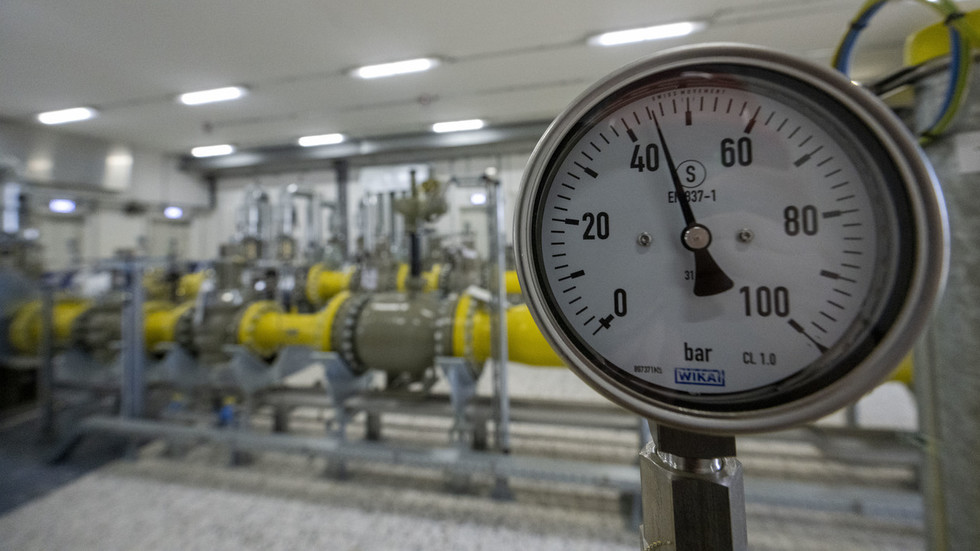
The German government will introduce an energy levy to fund the construction of a national gas reserve. German industry, which is already struggling with soaring energy costs, will bear the brunt of the levy.
Germany’s Ministry of Economic Affairs confirmed this week that it will build a strategic gas reserve equivalent to 10% of the country’s storage capacity – two weeks of wintertime usage – in order to guarantee supplies if imports are cut off. The reserve will be filled over 2027 and 2028, and will cost €1.5 billion ($1.7 billion) to establish, and up to €310 million per year to maintain, according to Bloomberg.
The reserve will not be funded by Germany’s federal budget, but by consumer levies. For households, this will translate to a €42 rise in energy bills, according to comparison site Verivox. For heavy industrial users, the levy could amount to millions of euros, Bloomberg reported.
Germany’s industrial energy costs are already the third-highest in the world, behind the UK and Japan. Once Europe’s industrial powerhouse, Germany abandoned cheap Russian gas imports in 2022, and combined with the phaseout of nuclear power in favor of renewables, this embargo has decimated the country’s industrial output.

BASF, Bosch, Volkswagen, and more than a dozen other German manufacturers have shut down factories since 2022, with Volkswagen – the country’s largest automaker – announcing four plant closures and the loss of up to 100,000 jobs in June.
Industry spokespeople have warned that additional levies will only hasten Germany’s deindustrialization. “Greater security of supply is a good thing – but making industry foot the bill for it is not,” German Chemical Industry Association Director Wolfgang Grosse Entrup told Bloomberg.
Before Germany’s self-imposed Russian energy embargo, Russia supplied 55% of the country’s natural gas imports. Germany now sources its gas from Norway (44%), the Netherlands (24%) and Belgium (21%), with American liquefied natural gas (LNG) accounting for most of the remainder.
LNG prices almost doubled earlier this year when a fifth of the world’s supply was taken offline due to Iranian retaliatory strikes on Qatari energy infrastructure and the closure of the Strait of Hormuz. Without Russian imports to fall back on, the German government began discussing a strategic gas reserve several months ago, Bloomberg reported.
You can share this story on social media:


Read the full article here


