






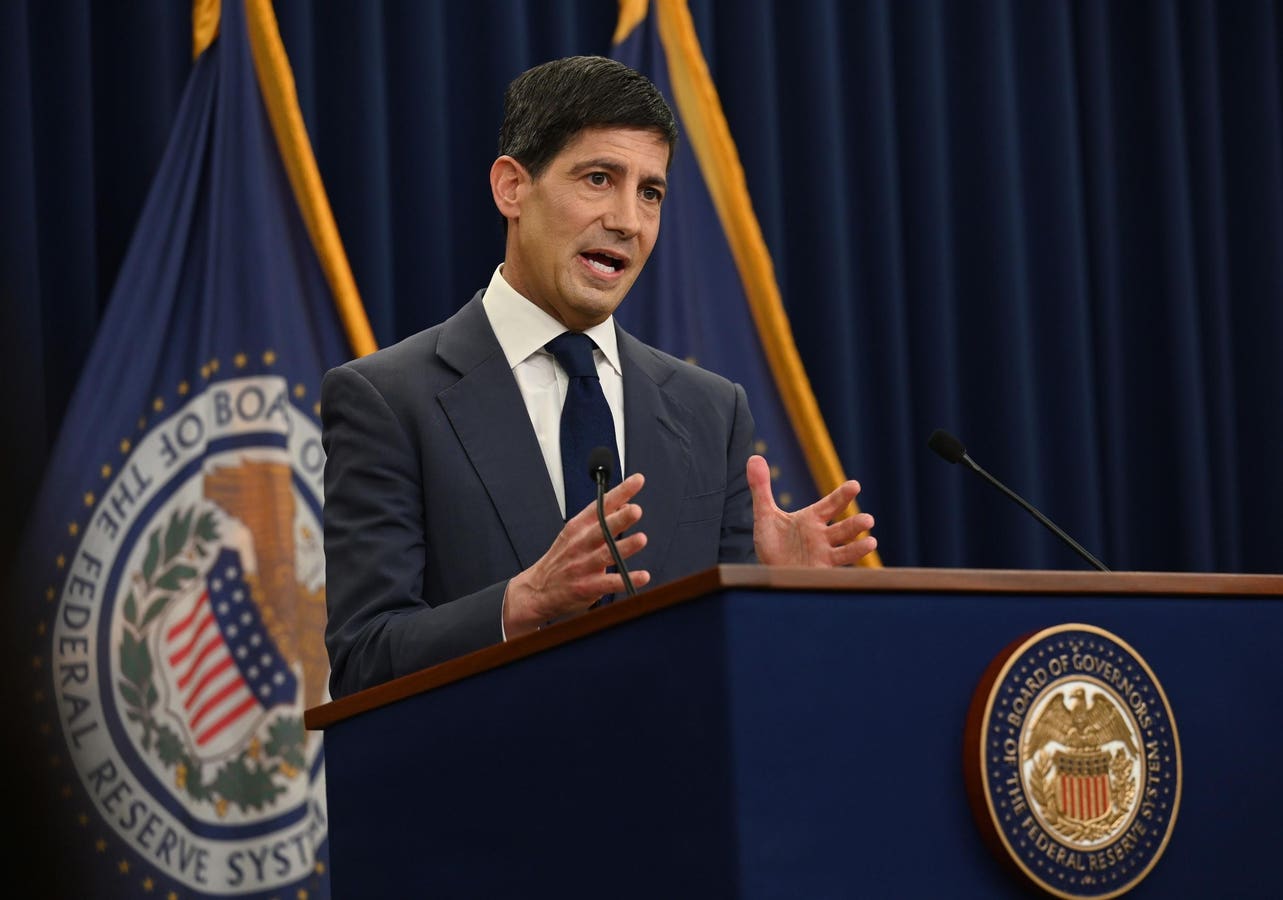
WASHINGTON, DC – JUNE 17: US Federal Reserve Chair Kevin Warsh speaks during his first news conference since taking the helm at the central bank on June 17, 2026 in Washington, DC. (Photo by Chen Mengtong/China News Service/VCG via Getty Images)
China News Service via Getty Images
Understanding the Federal Reserve and its decision-making process is about to become much harder, thanks to the directions of new Fed Chair Kevin Warsh.
For years, a critical step in understanding the Fed has been following the actions of its Federal Open Market Committee, or FOMC. That’s the part of the Fed that makes key decisions about monetary policy. The decision that receives the most attention is the setting of the federal funds rate, which is the interest commercial bank charge one another for uncollateralized overnight borrowing.
The FOMC has 19 members. A dozen — the seven members of the Board of Governors of the Federal Reserve System, the president of the Federal Reserve Bank of New York, and four of the remaining eleven Reserve Bank presidents — meet and vote eight times a year. There are also seven non-voting members. Each of those eight meetings sits under the close watch of all players in the global economic system. They look to it for clues on where all short-term interest rates, including consumer loans and credit cards, will head.
For businesspeople, institutional investors, consumers with credit card or automobile debt, or anyone or anything else — for you — understanding the Fed is important. That is about to become much harder, thanks to the directions of new Fed Chair Kevin Warsh.
In the press conference after the FOMC’s meeting and vote on June 17, 2026, Warsh announced immediate and upcoming changes to how the Fed works.
One is the end of so-called forward guidance, “which we agreed was not well-suited to the current policy conjuncture.”
Tim Sablik, an “advanced economic writer” in the research department of the Federal Reserve Bank of Richmond, wrote about the conflicted history of forward guidance. The practice started under Alan Greenspan in February 2000, when the Fed would use an early form in policy statements as “an assessment of the balance of risks facing the economy.” By 2003, they added guidance about where monetary policy was likely to go. (The irony, for those who remember those days, is that Greenspan had a reputation for opaque and convoluted language that left many wondering what he had said.)
Central banks thought that forward guidance, particularly when interest rates were very low, could provide additional market stimulus. “If markets believed the central bank’s pledge, then the interest rates of longer maturity securities would fall in anticipation of a lower policy rate in the future, and that would help stimulate economic growth,” Sablik explained.
This has raised a question of whether the “trade-off between commitment and flexibility” works in practice. In theory, according to economic models, the combination of forward guidance with quantitative easing, in which a central bank buys assets like government bonds or company shares to inject liquidity and encourage economic activity, is more powerful, affecting, respectively, the short and long ends of government and corporate bonds.
Forward guidance does have critics. Keeping to previous guidance seems a necessary step to retain credibility. If conditions change, there is the temptation to remain wed to the guidance, even if that is the wrong action, like when the Fed held off addressing rising inflation in 2020 and 2021. Some say that too much guidance can undermine “other valuable market signals,” Sablik wrote. When “central banks provide calendar-based guidance over a short time horizon, it can paradoxically raise the sensitivity of government bond prices to surprising economic news.”
Then again, investors have become used to guidance, which one might reasonably call transparency. Public trust in an agency is important. Change, when it’s a sudden reversal, can be disarming and negatively affect trust.
Warsh said other things that spoke to disruption. One was about the quarterly Summary of Economic Projections. A SEP provides a forward projection — really, an educated guess — of what might happen in economic growth, unemployment, and inflation. Each member of the Board of Governors and each Federal Reserve regional bank president provides projections. Warsh chose not to, “consistent with my long-held views on the SEP, at least as currently structured.” That choice makes it far more difficult to understand the context of his views. His actions also hold both an implicit criticism of other FOMC members and a question of why he might avoid stating his views.
Then, Warsh discussed setting up task forces in five areas “that area central to the broad conduct of monetary policy”: Fed communications, the Fed’s balance sheet policy (another tool for managing monetary policy), the use and reliance on existing data sources, productivity and jobs in an era of transformation (artificial intelligence), and last, the Fed’s inflation frameworks.
He wants combinations of people inside and outside of the economics profession (could be a good idea, as there are many things economists think and do that don’t connect completely to reality). There are supposed to “start with first principles; ask hard questions; examine current practice; consider alternatives; and, ultimately, propose next steps for policy maker consideration.”
None of this sounds basically unsound. But all of it could drive in that direction. For example, there have been complaints about data quality, like revisions in federal jobs data, even though there don’t seem to be any other sources that are similarly comprehensive and broad. But what data will be incorporated or substituted? When will people know?
“You will hear quite a bit more about these task forces and this overall initiative in the coming weeks,” Warsh said. “Enough for now to make a simple statement—each task force will serve an objective shared by everyone in the System, shared by everyone around that table that I sat with over the last couple of days: a Federal Reserve that is clear-eyed about its mission, fit for purpose, and focused on the future.”
Howard Schneider at Reuters, or maybe an editor, found a good summation of the situation in one headline: “Warsh brings a skinny Fed approach to a complex, information-hungry world.”
Given all the other economic and geopolitical uncertainty in the world, this is perhaps not the best time to assume that rapid and significant change in the underpinnings of how the central bank has worked comes with no risk. Or to assume that trust, once given, is never revoked.
Read the full article here


