






Florida’s transportation department revoked local police departments’ authority to install license plate reader cameras on state highways Monday, part of a growing national backlash against Flock Safety and other surveillance camera makers.
NBC News reports that Will Watts, chief operating officer of the Florida Department of Transportation, sent a one-page memo to local law enforcement agencies rescinding all previously issued approvals for license plate readers in state “rights-of-way,” the strips of land next to or part of state roads. Watts cited a “recent exponential increase” in camera deployment and pointed to “concerning reports of misuse, data privacy concerns, and surveillance schemes” as reasons for the reversal. The goal, he wrote, is “to preserve Floridians’ sovereignty and quality of life.”
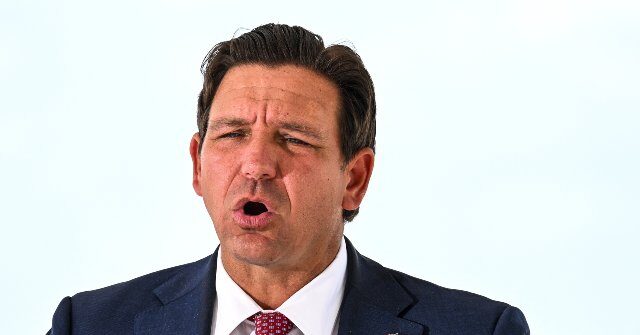
The order makes good on a promise Gov. Ron DeSantis (R) made Friday on the Real America’s Voice podcast. “We’re going to clear the state right-of-ways,” he said, adding that he doubts the cameras only capture plates. “These cameras that are out there now, who’s to say they’re only doing the license plate?” he said. “Now, they say that. I think it’s capturing people in their cars. I think it’s capturing way more information than they’re letting on. And you’ve seen the abuse.”
The ban has limits. It doesn’t touch cameras on private property or on local, non-state rights-of-way, and DeSantis said 98 percent of surveillance cameras sit in those categories rather than on state land. At least one agency isn’t stopping at the state’s floor: the Jacksonville Sheriff’s Office said it will discontinue license plate reader use throughout Duval County, home to 1 million residents, “effective immediately.” That’s notable given the department had previously called the technology “an enormously valuable investigative tool.”
License plate cameras date back to the 1970s, but cheaper hardware and better software have driven a sharp expansion in recent years. Flock Safety, one of the leading makers of the cameras, runs a network that lets law enforcement agencies across the country share footage with each other.
Florida isn’t alone here. Texas Gov. Greg Abbott (R) ordered a halt to state funding for Flock cameras last week:
The order from the Texas governor came Thursday, shortly after an investigation published by the Texas Tribune came online. The investigation revealed that the State of Texas added a $1 fee to car insurance policies. That money was then distributed to local law enforcement agencies to help reduce catalytic converter thefts.
Texas funding led to the purchase of about 2,000 Flock Cameras by the Motor Vehicle Crime Prevention Board, the Tribune reported. The State funded an additional $15.9 million to Texas DPS to purchase an additional 1,200 cameras.
Abbott’s Communications Director, Andrew Mahaleris, told the Tribune, “To the extent that cities get any funding for those cameras, most of it comes from the federal government. To the extent any funding comes from Texas agencies, those agencies are clarifying that those funds cannot be used for Flock cameras.”
The company defended its technology in a statement responding to Florida’s ban. “Flock’s technology is an important public safety tool for law enforcement agencies across Florida, helping officers solve serious crimes, find missing people, recover stolen vehicles, and support safer communities,” it said, pointing to recent results in the state: “In just the last few weeks in Florida, the technology was used to find missing children, led to the arrest of a murder suspect, and assisted in solving numerous other crimes.”
Flock’s position is that regulation, not prohibition, is the right response. “Rather than banning a critical public safety tool, we support thoughtful legislation and strong privacy, transparency, and accountability guardrails that ensure technology is used responsibly while preserving law enforcement’s ability to use effective tools to keep people safe,” the company said.
Read more at NBC News here.
Lucas Nolan is a reporter for Breitbart News covering issues of AI, free speech, and online censorship.
Read the full article here


