


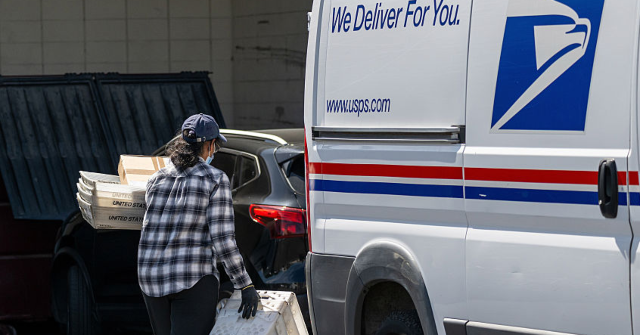
A federal judge blocked the United States Postal Service (USPS) from carrying out President Trump’s executive order requiring, in part, USPS to only transmit ballots for states that follow a list of election integrity rules detailed in the order, which includes providing voter rolls — or a list of mail-in voters — for that state.
U.S. District Judge Emmet Sullivan struck down the order, asserting that “the Proposed Rule violates paragraph 2 of the Agreement because the Postal Service cannot post documents reflecting ‘practices and policies for prioritizing the monitoring and timely delivery of Election Mail’ if its policies provide that it will not accept ‘noncompliant mailing’ and therefore will not deliver mail-in or absentee ballots to some voters, and if it will not mail ballots to any voters in a state where the state ‘declines or fails to certify a list.’”
Over two dozen states have moved to challenge Trump’s original order, formally titled, “ENSURING CITIZENSHIP VERIFICATION AND INTEGRITY IN FEDERAL ELECTIONS.”
The executive order makes clear that voting in federal elections is reserved solely for citizens of the United States.
“The Federal Government has an unavoidable duty under Article II of the Constitution of the United States to enforce Federal law, which includes preventing violations of Federal criminal law and maintaining public confidence in election outcomes,” the order reads, calling for additional measures to “enhance election integrity via the United States Mail.”
“Secure ballot envelope identifiers provide a reliable, auditable mechanism to enforce Federal law without unduly burdening or infringing on the rights of eligible voters. Unique ballot envelope identifiers, such as bar codes, enable confirmation that only citizens receive and cast ballots, reducing the risk of fraud and protecting the integrity of Federal elections,” it states, also calling for the transmission of a State Citizenship List:
The State Citizenship List shall be derived from Federal citizenship and naturalization records, SSA records, SAVE data, and other relevant Federal databases. The State Citizenship List shall be updated and transmitted to State election officials no fewer than 60 days before each regularly scheduled Federal election, or promptly upon request by a State in connection with any special Federal election. The Secretary of Homeland Security shall establish procedures to (i) allow individuals to access their individual records as well as to update or correct them in advance of elections; and (ii) enable States to routinely supplement and provide suggested modifications or amendments to the State Citizenship List transmitted thereto. An individual’s identification on the State Citizenship List does not indicate that the individual has been properly registered to vote in the State. State and Federal laws and State procedures must still be followed for an individual to be registered to vote. There may be State laws, not reflected in the State Citizenship List, that preclude voter registration, or the individual may choose not to be registered.
The order then lists the requirements for USPS to adhere to the election integrity measures.
“Proposed provisions specifying that the USPS shall not transmit mail-in or absentee ballots from any individual unless those individuals have been enrolled on a State-specific list described in subsection (b)(iv) of this section with the USPS pursuant to this subsection,” the order directs.
Sullivan asserted the order appeared to be “designed to exert federal control over who in the United States may be sent a mail-in or absentee ballot in federal elections by the Postal Service.”
“We’re going to take federal data, we’re going to ensure that each state’s election officials are provided with a comprehensive view of who the eligible voters in their jurisdiction actually are, allowing them to properly verify that everybody voting in their elections is legally able to vote,” White House staff secretary Will Scharf said at the time of the signing.
Read the full article here