


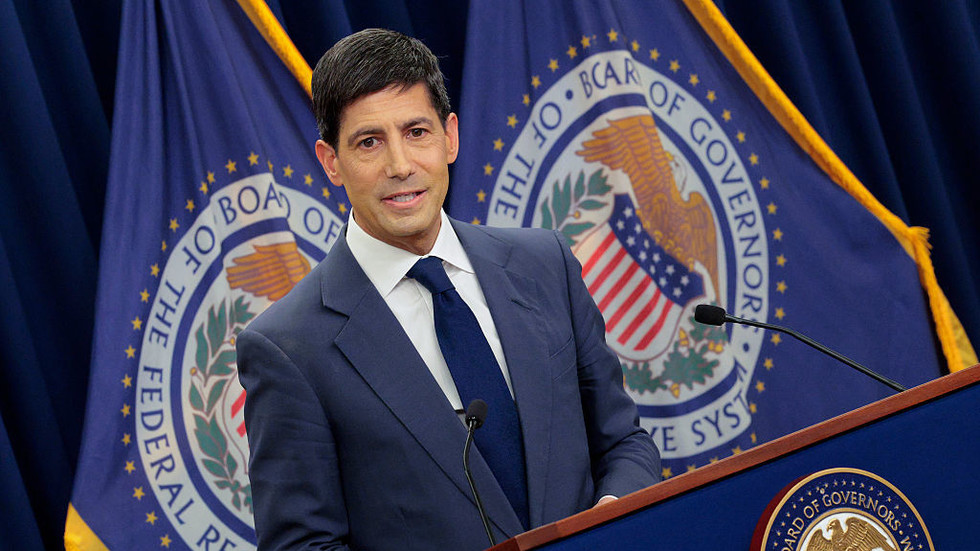
The 25-basis-point increase comes despite the US president’s repeated demands for lower borrowing costs
The US Federal Reserve has raised interest rates despite US President Donald Trump’s repeated demands for lower borrowing costs, as stubborn inflation continues to weigh on the world’s largest economy.
The Fed hiked its benchmark rate by 25 basis points to 3.75%-4% on Wednesday in a unanimous vote, marking the first increase since 2023 and the first policy change under Chairman Kevin Warsh.
The regulator said economic activity was expanding “at a solid pace,” while inflation “remains elevated.”
The move had been widely expected. Some 85% of economists surveyed by Reuters after the latest inflation data had forecast a quarter-point increase, while a narrow majority expected at least one more hike by the end of March 2027.
The decision comes after inflation showed renewed signs of pressure. US consumer prices rose 3.4% year-on-year in August and 0.4% from the previous month, with gasoline prices jumping 3.9%, according to the US Bureau of Labor Statistics.
Price pressures have been fueled in part by higher energy costs linked to the Iran war, while tariffs have also added to inflation concerns. Higher interest rates are intended to slow price growth by making borrowing more expensive, which tends to reduce spending by consumers and businesses.
The Fed has a long-term inflation target of 2%. Warsh said last month that the goal was “firm” and “fixed,” arguing that inflation remained too high and that the central banking system’s main focus should be on prices.
The labor market has remained relatively stable, with unemployment at 4.1% in August and employers adding 162,000 jobs. Growth has slowed, however, with GDP expanding at an annualized rate of 1.5% in the second quarter, down from 2.1% in the first.

The rate increase could make borrowing more expensive for US households already facing higher prices, according to Yung-Shin Kung, chief investment officer at Mast Investments. He said that lower-income consumers could be hit particularly hard, as they face both elevated prices for essentials such as food and housing and higher costs for servicing debt.
Trump repeatedly attacked former Fed Chair Jerome Powell for refusing to deliver the steep rate cuts he sought, calling him a “moron” and a “numbskull.” He nominated Warsh as Powell’s successor in March, with Warsh taking over the Fed in May. The latest decision now puts him at odds with the president.
Lower rates would also cut borrowing costs on the US national debt, which has topped $40 trillion. On Sunday, Trump renewed his pressure on the Fed, saying the US should have “the lowest interest rate in the world” regardless of inflation or other economic data.
Warsh had previously backed higher rates to curb inflation, but shifted toward Trump’s position on lower borrowing costs before taking over the Fed and called for “regime change” at the central bank. Last month, however, he stressed that the Fed must be confident inflation is moving toward its 2% target “clearly and at sufficient speed,” warning that otherwise, “we have work to do.”
You can share this story on social media:


Read the full article here