






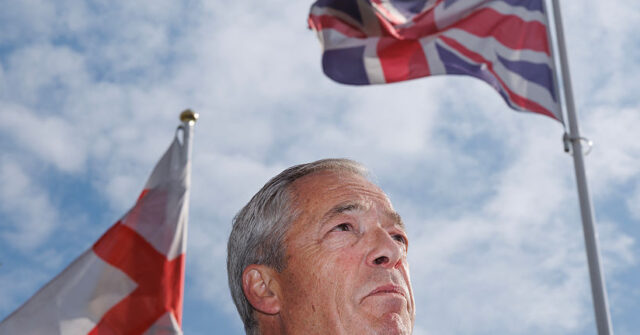
A “truly historic shift in British politics” has taken place where the national political question is no longer about “left or right”, Brexit pioneer Nigel Farage said as his Reform Party surged in early results in what has been called the “midterm” elections.
The first Britain-wide local election results trickled in overnight — and will continue to do so through the day and into the weekend as over 5,000 local races have their votes counted — revealing in its early stages a massive swing to Reform UK. Party leader Nigel Farage hailed the party’s gains so far, and vowed “the best is yet to come” as the vast majority of elections have yet to be counted, and with those on their way being some of the most promising for his party, he said.
Update 1545 BST — The dominoes fall… devolved counts begin
The remains of the Conservative party crowed about a comeback earlier this morning after retaking their long-time flagship Westminster Council, but as the day goes on this optimism feels less convincing, and more forced. Farage’s Reform have since taken solid Tory heartland councils Suffolk and Essex to add to Newcastle-Under-Lyme, a much more historically Labour area from earlier.
While Reform taking leafy Suffolk may be a shock, Essex is a real hammer-blow to the Conservatives, given — as Mr Farage himself has observed — the present Tory leadership is so disproportionately from the county. Speaking of “crushing the Tories on their home turf”, the Reform leader said:
Think about it, half of the shadow cabinet represent Essex seats. The leader, Kemi Badenoch, represents North West Essex in the House of Commons. We have just taken control of Essex County Council… we’ve literally wiped out the Conservative Party in Essex and the leader Kemi Badenoch would not even hold her seat.
That Reform can now threaten the leader of the Conservative Party in her own Parliamentary seat, and across her own county, shows how far the party has come.
LONDON, ENGLAND – MAY 08: Zack Polanski, Leader of the Green Party, congratulates Zoë Garbett (L) as she is elected as the new Mayor for Hackney after the Hackney council election on May 08, 2026 in Hackney, London, England. The 2026 London local elections saw millions of voters across the capital head to the polls to elect 1,817 representatives for all 32 London boroughs. Results expected to be declared from early Friday morning through Saturday afternoon (Photo by Leon Neal/Getty Images)
Meanwhile, the Green Party — you might say the Yin to Reform’s Yang — has won their first ever directly elected mayor. Pink-haired former “NHS worker” turned political organiser Zoe Garbett is now the mayor of Hackney, and in her victory speech she said she wanted to “change the system”, citing “parents, migrants, trans people, disabled people and young people” who had been let down as her focus.
While the big story so far has been England, elections took place across the island of Britain, and now we’re starting to get results from the races for the Scottish and Welsh devolved Parliaments, so expect a lot more news about that as we go through the afternoon.
Even before the results are fully in, they are looking to be historic. Labour — which has utterly dominated Welsh politics for over a century — has already conceded defeat in the home nation, which is incredible. This is where the Labour movement, in part, was born. We expect to see the Welsh nationalist-separatist party, Plaid Cymru, to do very well, with Farage’s Reform coming in second. That said, they have gained the same number of Welsh devolved parliament seats each so far, four apiece.
The original story continues below
With little more than 1,200 wards declared out of over 5,000, Reform commands a strong lead with 400 seats. Because the party is new and hasn’t had a chance to challenge these elections before, apart from a handful of defections from other parties during the previous term almost all of their wins today will be gains, with 398 so far being new to Reform.

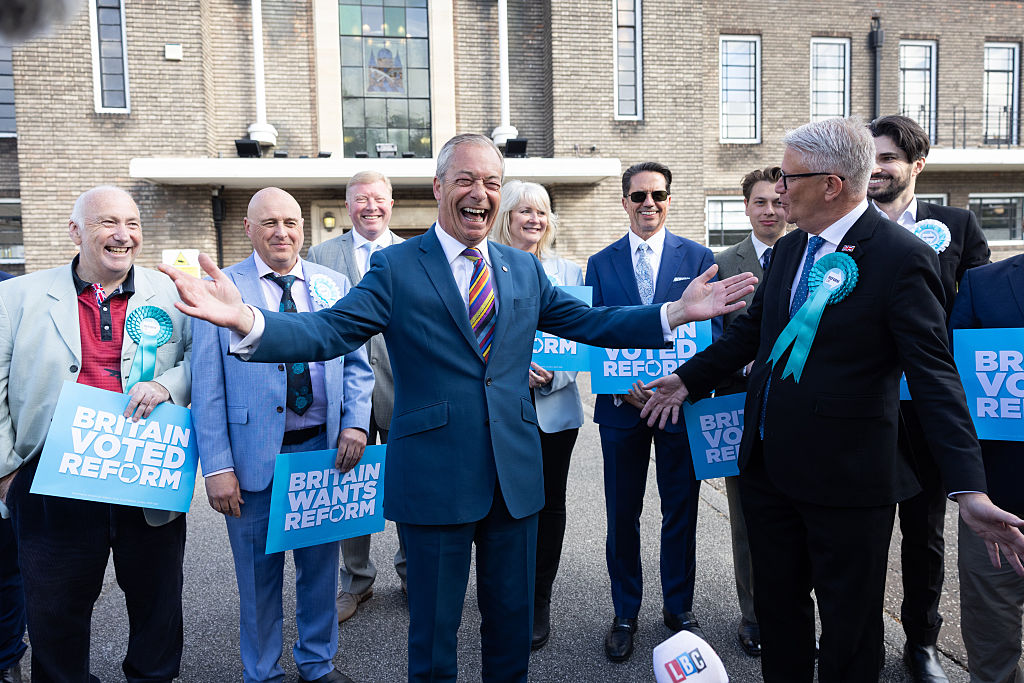
Nigel Farage, leader of Reform UK, and local councilors outside Havering Town Hall following the local election in Romford, UK, on Friday, May 8, 2026. Farage’s Reform UK racked up sweeping gains in the first counts in local elections, with British voters continuing to turn away from Prime Minister Keir Starmer’s governing Labour Party. Photographer: Chris Ratcliffe/Bloomberg via Getty Images
The Conservatives, Labour, and the Liberal Democrats — the old centre-right, centre-left, and centrist legacy parties that between them have dominated British politics for centuries grouped very closely behind at this stage in the race, with 256, 253, and 250 seats respectively. This is already a punishing outcome for these titans of Britain’s old political order, but closer scrutiny exposes how bad it really is: while the Tories managed to win those 256, this is a loss of 174 seats compared to last time.
It’s even worse for Labour, who have lost more seats than they’ve won so far, being down 259.
The Green Party has dominated media debate about these local elections — increasingly called Britain’s “midterms” given their rising status as a de facto referendum on the performance of the national government as the country’s politics becomes less stable — but their performance hasn’t matched the weight of news reports and social media attention lavished on them so far. Doubling the number of wards taken so far is nothing to be ashamed of, of course, but it still only amounts to 51 seats.
Like Reform, the Greens would argue the parts of the country they expect to perform best in have not yet completed their count, so expect that to change through Friday and into Saturday.

Councillor wards add up, across towns, cities, and counties, to taking control or not of the councils themselves. A handful of councils have been decided so far including in Havering, a London borough which was captured by Reform UK this morning. Nigel Farage hailed the results from the steps of the town hall, where he said:
…what’s happened is a truly historic shift in British politics. We’ve been so used to thinking about politics in terms of left and right, and yet what Reform are able to do is to win in areas that have always been Conservative but equally we’re proving in a big way we can win in areas that Labour have dominated, frankly, since the end of World War One.
At the moment we’re winning one in three of all the seats that are up but I genuinely think the best is yet to come, I’m genuinely excited about the North East results, the Yorkshire results, some more to come in the West Midlands. In Essex we’re feeling supremely confident and that’s significant given half the shadow cabinet have seats in Essex.
So it’s a big, big day not just for our party but for a complete reshaping of British politics in every way. It all goes to show that over the course of the last two years since we made that breakthrough in the General Election we have professionalised the party, we’ve done it at a very, very rapid rate, I’m thrilled and delighted.
As for the reasons for this victory, Farage noted the last time there was a major change in British politics — after the end of the Great War when it settled on a two-party system representing the workers on one hand and the owners of capital on the other — and how those distinctions have long vanished and that the real political divide now is “increasingly it’s about whether you go to work or not”.
Concern about the enormous tax burden incurred for the sake of the ‘work nots’ — including huge numbers of net-cost migrants — has arrived alongside societal breakdown, Farage said. He stated of what he’d heard on the campaign trail:
…one thing that I consistently hear from people, especially from women actually, is ‘please save us’, a sense that society is in rapid decline, law and order, anti-social behaviour, shoplifting, whatever it is, ‘please save us’.
There is a feeling out there that all the values that have mattered to people their whole lives, the kind of country they want their kids and grandkids to live in is very, very severely under threat… we want to turn the country around. We all feel it is heading in the wrong direction on a number of major issues.
Frankly, many people find the society they’re living in unreconsigisable from just a few short years ago. This is stuff of the heart, this is emotive stuff that matters to people.
On Farage hailing the Reform Party’s ability to convincingly beat both the Conservatives and Labour on their own turf, perhaps the perfect example has already been announced this morning. The Party took control of Newcastle-under-Lyme, a market town in Staffordshire, going from zero seats to 27, taking 17 of those from Labour and 10 from the Tories.
While Reform has dominated the headlines so far, there were glimmers of light for the Conservatives. The party regained their flagship council, Westminster, which includes both the heart of government and the West End theatre and shopping district, after a brief period in the hands of Labour. Otherwise the council has been in Conservative hands for its entire history.
Yet to announce are results for the Welsh and Scottish devolved assemblies. Both of the British home nations have their own parliaments with certain devolved law-making power. Reform is hoping to break through in both, which Farage insists would make his party the only truly national party in Britain.
This story is developing, more follows.
Read the full article here


