




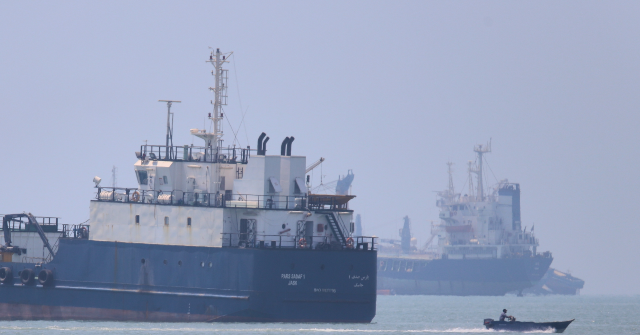
The Iranian terrorist Islamic Revolutionary Guard Corps (IRGC) issued an ominous warning on Thursday claiming that ships attempting to navigate the Strait of Hormuz without using approved Iranian regime routes would face unspecified “dangers” in those waters.
The message follows an announcement by the International Maritime Organization (IMO), a United Nations agency, and the government of Oman on Tuesday that they had carved out a route through the strait that avoided Iranian waters and international waters littered with Iranian mines to allow the safe transit of commercial ships. While the civilian wing of the Iranian Islamist regime agreed to sign a “memorandum of understanding” with the United States last week stating that traffic in the Strait would remain open and free for at least 60 days, the IRGC, a terrorist arm of the military, has attempted to block such traffic in the aftermath of the agreement. The IRGC announced that it had closed down traffic in the strait on Saturday, but was largely ignored, resulting in no publicly known violence or disturbances in the sea passage.
Following that failure, the IRGC’s Naval Force issued an announcement on Thursday declaring that ships must only use Iranian regime-approved routes to enter and exit the Strait of Hormuz.
“In a statement issued early Thursday, the IRGC Navy described the newly announced route as unacceptable and extremely dangerous, stressing that it had been introduced without the knowledge or coordination of Iranian authorities,” the state-run Islamic Republic News Agency (IRNA) reported. “The statement emphasized that the only authorized navigation corridors through the strategically important waterway are those previously communicated by Iran.”
“It warned that any vessel operating outside these designated routes would be entering prohibited and potentially hazardous areas,” IRNA added.
The state outlet noted that the IRGC statement was in response to the “newly announced route” without specifying that the IMO and Oman were responsible for that route and that it did not touch Iranian maritime territory. It added that the IRGC also claimed receiving permission from its leadership was “mandatory” for all ships.
Oman and the IMO announced on June 23 that, after over a month of coordination, they had created a new maritime route to allow traffic to pass through the Strait of Hormuz while excluding Iran. The new route would not require any tolls and would allow for navigation through international waters without fear of crossing through areas where the IRGC is believed to have imposed sea mines, which experts believe were laid in the middle of the Strait.
The IMO confirmed to NBC News on Wednesday that “ships have already begun to pass under the plan.”
Oman’s Maritime Security Center published a guide on Wednesday for ships to avoid Iranian waters, showing how closely the ships must hug the coast of Oman to avoid the danger spots.

As of press time on Thursday, the corridor appears to be working. NBC News reported that at least two dozen ships appeared to depart on the Omani route as of Thursday morning local time without incident. It did report that three ships appeared to turn back, perhaps in response to the IRGC threat. Maritime monitors have documented 172 ships passing through the Strait of Hormuz between the signing of the memorandum of understanding between Iran and America last week until Tuesday, when the Oman passage was announced.
The memorandum, which formalized an indefinite ceasefire in hostilities between America and Iran, specified that Iran would use “its best efforts for the safe passage of commercial vessels, with no charge for 60 days only, from the Persian Gulf to the Sea of Oman, and vice versa.”
“The traffic of commercial vessels will immediately start, and considering the need for removing the technical and military obstacles, and de-mining by the Islamic Republic of Iran, will be instated within 30 days,” the text of the memorandum read. “The Islamic Republic of Iran will conduct dialogue with the Sultanate of Oman to define the future administration and maritime services in the Strait of Hormuz, in discussions with other Persian Gulf Littoral States, in line with applicable international law and the sovereign rights of coastal states of the Strait of Hormuz.”
While the civilian wing of the Iranian regime agreed to these terms, the IRGC almost immediately attempted to shut down the Strait again on Saturday. The military leaders announced that “safety would be at risk” if ships attempted to navigate the strait, without elaborating on the dangers involved. In the state-run Mehr News Agency, reports claimed that the IRGC had shut down the entire strait once again.
In reality, however, U.S. Central Command (Centcom), which operates in the Middle East, contradicted the IRGC, stating that the Strait of Hormuz remained open and Iran had no control over it. Subsequent reports indicated that ships indeed passed through the Strait this weekend and continued doing so without incident.
Follow Frances Martel on Facebook and Twitter.
Read the full article here


