




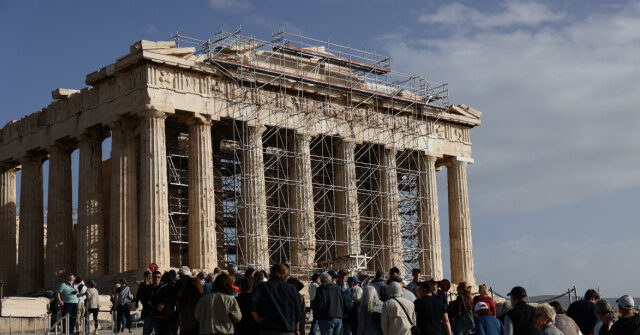
ATHENS, Greece — President Donald Trump has a historic opportunity to cement his place as the leader of western civilization for thousands of years by helping Greek officials broker an agreement with the British to bring back the parts of the Parthenon atop the Acropolis that a British lord “stole” hundreds of years ago, a top Greek government official tells Breitbart News exclusively.
Trump would be able to “stay in history for thousands of years” if he helps Greeks see the return of the so-called “Elgin Marbles,” pieces of the world-famous Parthenon that British Lord Thomas Bruce, the 7th Earl of Elgin—known more simply in history just as “Lord Elgin”—took when the Ottoman Empire occupied Greece. They have become known here simply as “The Marbles,” or as the “Parthenon Marbles”—Greeks do not like associating Elgin with them at all because they consider him a thief—and are several different sculptures from the Parthenon first created thousands of years ago in Ancient Greece.
The circumstances under which Elgin took them are particularly questionable. Greeks have been, for centuries, trying to get the pieces back from the British, and the matter is as much a fight for national pride as defending the national anthem is in the United States—and much of the rest of Europe as well, as even the remnants of the now-dissembled Ottoman Empire in Turkey are supportive of the Greek effort to restore the sculptures to the Hellenic Republic.
Adonis Georgiadis, Greece’s governing party New Democracy’s vice president and the Health Minister of Greece, who is also a historian, sat for an interview on the matter with Breitbart News in his office earlier this year and explained the importance of this issue to Greeks and the major opportunity that lay ahead for Trump should he get engaged on this and help pressure the British to finally return the Parthenon pieces.
“I’m totally sure that President Trump, as the natural leader of the Western world, realizes that representing the spirit of the American grandfathers of your democracy, which all of them were very well educated—they had a huge respect about ancient Greece and ancient Rome, which they originally took their their values and built the American democracy, the American Republic,” Georgiadis told Breitbart News. “I’m sure he could press the British government to to make the right move.”
Georgiadis added that “Not only here, but everywhere—all civilized people in the West, and not only in the West but let’s just speak for the West in favor of that issue—not even one educated person in the world doesn’t realize why the marbles shouldn’t come back.”
“Even the British don’t say no,” Georgiadis said. “The British aren’t like, ‘We’ll never give them back.’ They just say, ‘Well, let us see if it’s the right time.’ A real argument that ‘we have them legitimately’ is not even raised from their side. If you go to the story at the beginning, the British accused Elgin of being a thief. But then, when he did, in his will, he gave the marbles to the museum. If he had kept them in his garden, we would have taken them back decades before now.”
Georgiadis is not alone; other top Greek officials agree that Trump has a major historic opportunity to help solidify not only his own legacy but to right an important wrong in the process. Konstantinos Kyranakis, an elected member of the Greek Parliament who is also the Secretary General of the governing party here, New Democracy, told Breitbart News that Trump’s legacy would endure for “centuries” if he got the British to give back the marbles.
“If President Trump were to help make that happen, his contribution would extend far beyond diplomacy,” Kyranakis said in a statement. “It would represent one of those rare moments when political leadership serves civilization itself. It would demonstrate that true leadership is measured not only by shaping the future, but also by preserving the foundations upon which that future is built. The reunification of the Parthenon Marbles would not rewrite history. It would complete it. We believe President Trump, as the true leader of the West, has the opportunity to leave a legacy that endures across centuries.”
Even some prominent British believe the marbles should be returned. Andrew A. David, a rising Greek-British innovator for instance, is someone committed to helping reunite the Parthenon pieces. “President Trump’s support could be a real game-changer for this historical moment,” David told Breitbart News.
Endy Zemenides, the executive director of the Hellenic American Leadership Council (HALC) which represents millions in the Greek-American community, told Breitbart News that the British excuses are running thin and that if Trump engaged here and got this done it would be massive for western civilization.
“It’s time to reverse history’s biggest theft and the British excuses for why they can’t give the Parthenon sculptures back don’t hold water anymore,” Zemenides said. “These sculptures can now be housed in one of the great museums of the world overlooking the Parthenon. If President Trump can make this happen, it will be an unprecedented contribution to the cultural heritage of democracy.”
So Trump’s opportunity here is that he can cement himself to the history of the entirety of western civilization, Georgiadis said, if he made a few phone calls pushing the British to just give these Parthenon pieces back to the Greeks. Again, there is perhaps no bigger symbol worldwide of democracy than the Parthenon—in the birthplace of democracy, Athens—and its famous columns, many of which along with ancient Roman buildings amazingly also inspired much of the architecture that Trump loves and is currently restoring in Washington.
“The leader that will make this happen will be a part of the Parthenon’s story, and as you realize the Parthenon has been here for 2,500 years and will be here after another 2,500 years,” Georgiadis said. “I’m not exaggerating.”
Georgiadis was wearing Trump cufflinks during the interview. He said he is a huge fan of Trump and does things like that to protect himself from leftist crazies.
“I usually put them on because when I see communists, I always do something like that to protect myself,” Georgiadis said. “I always believe that the president of the United States of America is the leader of all the West. This is his main responsibility, and the reason I backed publicly his war to Iran is because I believe that even though many people in the West don’t realize that he protected the West from a very big threat—from a huge threat, and sometimes in politics you have to take very difficult decisions in order to do something important. Trump did something important there. If Iran had a nuclear weapon with this ballistic missile program they had, nobody would be safe again. So, since the president of the United States is the true leader of the Western world.”
But again, Georgiadis believes there is perhaps no better time than now—given the historic weakness of the British government with the downfall of Keir Starmer as Prime Minister and now the rise of Andy Burnham as his replacement as well as a very strong American president in Trump—to get them back and to right this historic wrong.
The story of how the British got the marbles is filled with issues. Athenians built the Parthenon in the fifth century BC, and it’s something Georgiadis rightly points out “was the biggest symbol of their era and of their democracy.”
The Parthenon stood for nearly two thousand years “almost intact” through many civilizations from ancient Greeks of course through the Roman Empire, the Byzantine Empire, the Venetians, to even the Ottoman Empire, he said, “because all the civilization and authorities and people that passed through Athens they all respected” it.
“But the biggest damage came in the 17th century when the Turks had a war with the Venetians, and at that time, the people of Venice bombed the Parthenon in which the Turks had their arms inside, and there was a big explosion,” Georgiadis said. “And the Parthenon, for the first time, was being attacked—just memorable. For almost 2000 years, the Parthenon wasn’t attacked. You could go and see almost the original Parthenon.”
“I mean, the Roman emperors, the Byzantine emperors, the Ottomans—everybody respected the Parthenon until that time,” Georgiadis added. “After that time, it was almost at the shape you today.”
But in the early 19th century, during the Ottoman Empire, the British Lord Elgin went to the Sultan and got a document signed so he could come to Athens and study the Parthenon.
“So with this paper, he came to Athens,” Georgiadis said. “He showed the authorities that he could study the Parthenon. He went up with his workers with the license that he could study the Parthenon.”
Instead of just studying it, Lord Elgin cut pieces of the Parthenon off—various sculptures that were part of it—and made to take them back to the United Kingdom to display in his garden.
“What he did is he cut the marbles, and he stole the marbles,” Georgiadis said. “He put them in ships, and he went to the United Kingdom. One of the ships was sunk and some of the marbles are in the bottom of the sea.”
The rest that made it back to the United Kingdom were on display in Lord Elgin’s personal garden for the rest of his life, but then he left them in his will to the British Museum in London where they have been ever since.
“Even the Ottoman Empire never recognized that this was a legitimate act,” Georgiadis told Breitbart News. “Even in the Ottoman period, the Ottoman authorities said he didn’t have the license to get the marbles. He had the license only to study the marbles. But he had already gone to the United Kingdom when then the the Greek Revolution started.”
In the period of chaos during which the Greeks fought for and won their independence from the Ottoman Empire—a revolution inspired actually by the American Revolution—the British solidified their control of the possession of the marbles.
Georgiadis told Breitbart News a story of just how culturally and historically significant the Parthenon is to Greeks. During Greece’s war for independence from the Ottoman Empire after hundreds of years of subjugation, Turkish soldiers who were holed up in the Parthenon on the Acropolis began running out of bullets to shoot back at advancing Greek forces. So the Turks began ripping apart columns from the Parthenon—there is a metal core inside each column around which the ancient developers molded the world-famous marble that has lasted millennia since—to use the metal inside to try to make new bullets.
“So the Ottomans decided to open the the columns and take this thing from the columns in order to build to continue the war,” Georgiadis told Breitbart News. “So when the Greeks at that time saw that and learned that they will do something like that, they stopped the war with a white flag. They went up to the hill. They gave them bullets and said: ‘You will get from us as many bullets you want. Just don’t touch the Parthenon.’ This was the level of how much they—they were uneducated people and they knew nothing about history, they didn’t know how even to write their name—but they had the sense that this is the spirit of Greece in a way that yeah, this is the Greek identity.”
Since the Greeks won their independence from the Turks, there have been countless attempts to secure the return of the marbles—and countless investigations and debates about it in the ensuing centuries. British officials have come up with excuse after excuse, including arguing that Athens was—given that Greece had been at times poorer than the rest of Europe—unsuitable as a place to house them. So the Greeks built a magnificent museum that could display the marbles. British officials have also argued repeatedly that giving these back to Greece would set off a fire sale worldwide where other civilizations would demand the return of artifacts. Georgiadis said this is bunk because the way Elgin took them was deceitful, unlike other artifacts on display at British museums.
Georgiadis noted that many famous British figures and other celebrities like actors Liam Neeson and George Clooney as well as many top British politicians have supported returning the marbles to Greece. Amazingly, if Trump did engage here, he could succeed on a matter that Clooney—who backed Democrats Joe Biden in 2020 and Kamala Harris in 2024 against him—failed. But aside from that point, this would be something that puts Trump down in history with the greatest of the greatest leaders in western civilization’s history by unmistakably making him part of the story of the very birthplace of democracy.
“It’s the most sensitive matter in our culture because we have said publicly as a state, not only our government but also previous governments, we say that the marble issue is totally unique,” Georgiadis said. “We will never raise any issue for any other antiquity, for any other museum to take it back. We don’t want to use the marble issue as a leverage to start saying, ‘give us back.’ But for us the Parthenon sculptures is the symbol of unity of the Greek nation. This is the main idea. If you ask anyone what is the biggest symbol of Greece, the biggest symbol of Greece is the Parthenon. It’s a symbol of democracy.”
Read the full article here


