




WASHINGTON, DC — President Donald Trump’s historic peace breakthrough between Azerbaijan and Armenia has opened a “new era” of opportunity for the United States in the South Caucasus, creating expanding possibilities for American investment, energy cooperation, trade, and regional connectivity, according to a senior Azerbaijani official.
Fuad Muradov, chairman of Azerbaijan’s State Committee on Work with Diaspora, made the remarks in an exclusive interview with Breitbart News in Washington as he wrapped up a U.S. visit focused on strengthening ties with Azerbaijani communities and expanding the country’s relationships with American civic, academic, and political institutions.
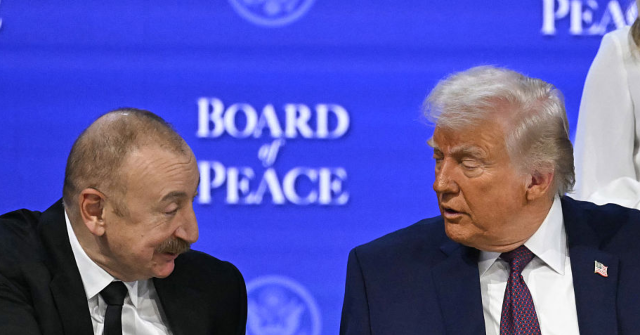
Muradov said the transformation follows the landmark White House summit last August, when Trump brought Azerbaijani President Ilham Aliyev and Armenian Prime Minister Nikol Pashinyan together in Washington where the two countries’ foreign ministers initialed a peace agreement and the three leaders signed a joint declaration aimed at ending decades of conflict.
Echoing Aliyev’s repeated praise of Trump for helping resolve nearly three decades of conflict, Muradov emphasized that the United States played a “crucial role” in the peace process, while crediting Aliyev’s leadership and the landmark White House summit with helping transform U.S.-Azerbaijani relations and open a new chapter for the wider South Caucasus.
The Trump administration has since moved to translate that breakthrough into a broader strategic and economic partnership. Vice President JD Vance traveled to Baku in February, where the United States and Azerbaijan signed a Strategic Partnership Charter covering regional connectivity, energy, trade, investment, artificial intelligence, digital infrastructure, and security cooperation.
On the first anniversary of the White House summit earlier this month, Secretary of State Marco Rubio announced $201 million in U.S. government funding for the newly operational Trans-Caspian Enterprise Fund aimed at attracting private investment along the Middle Corridor, with the Trump Route for International Peace and Prosperity, or TRIPP, serving as a critical link connecting mainland Azerbaijan with its Nakhchivan exclave through Armenia.
“TRIPP is about much more than transportation,” Muradov said. “When countries begin trading, investing, and building infrastructure together, they create interests in maintaining peace. That is how you make peace lasting.”
That process is already beginning to produce changes on the ground. Azerbaijan and Armenia have expanded trade since the Washington summit, while officials from the two countries met this week to discuss potential electricity trade and connecting their power systems at the border. Pashinyan has said electricity transmission lines could become the first infrastructure completed under TRIPP.
Muradov said the opening creates significant opportunities for American companies seeking to establish themselves in a region whose importance as an energy and commercial crossroads is rapidly growing.
“There are tremendous opportunities for American companies in Azerbaijan today,” he said. “Energy is one of them, but there are opportunities in transportation, construction, technology, artificial intelligence and many other areas.”
Those opportunities are already attracting substantial U.S. involvement. American and Azerbaijani officials announced more than $8 billion in commercial agreements in June, while ExxonMobil has pursued new exploration opportunities in the country and Chevron signed a new exploration agreement this year.
Azerbaijan has also become an important contributor to European and Mediterranean energy security, exporting crude oil through the Baku-Tbilisi-Ceyhan pipeline to Turkey’s Mediterranean coast while state energy company SOCAR expands its investments and exploration activities across the region.
Azerbaijan’s importance, however, extends well beyond its own substantial oil and gas resources.
“Look at where Azerbaijan is located,” Muradov said. “We are at the crossroads between Europe and Asia, and today that location creates enormous opportunities — for energy, transportation, trade and connectivity.”
The country sits at the heart of the Middle Corridor linking Central Asia to Europe across the Caspian Sea and South Caucasus and has emerged as an increasingly important supplier of energy to Europe. Azerbaijan supplied 12.8 billion cubic meters of natural gas to Europe last year, while new electricity, renewable energy, transport, and digital infrastructure projects are being developed to expand the region’s east-west connectivity.
Muradov argued that the opening gives American companies and other early entrants an opportunity to establish a lasting foothold in a region undergoing a historic transformation.
“Those who come at the right moment will have the opportunity to stay for the long term,” he said, pointing to the competition already taking shape around the region’s economic and strategic future.
Azerbaijan’s unique network of regional relationships adds another dimension to its strategic importance.
The overwhelmingly Muslim but staunchly secular country maintains close relations with Turkey while also enjoying a longstanding strategic partnership with Israel, positioning Baku as an increasingly important bridge between countries whose own relations have often been considerably more complicated. Aliyev has helped establish a channel between Israel and Turkey aimed at preventing military friction in Syria, with Israeli reports this week saying Baku continues mediating between Jerusalem and Ankara in an effort to reduce tensions.
Muradov said Azerbaijan’s ability to maintain relationships across a complex neighborhood reflects a deliberate approach under Aliyev.
“Our geography always requires us to have a balanced policy,” he said.
For Muradov, however, fully recognizing Azerbaijan’s potential begins with giving Americans a clearer picture of the country itself.
“Everything starts with understanding Azerbaijan,” he said. “We are a secular country with a very old culture and a long tradition of different communities living together. Muslims, Jews and Christians have lived together here for centuries. For us, this is simply how we live.”
Azerbaijan is home to one of the world’s oldest Jewish communities, including the Mountain Jews, whose history in the region stretches back more than 2,000 years. The country is also home to the famed Red Village in the Quba district, often called the “Jerusalem of the Caucasus” and widely described as the world’s last predominantly Jewish town outside Israel.
Rabbi Zamir Isayev, who leads Baku’s Sephardi Jewish community, highlighted that tradition during a Capitol Hill religious freedom forum in July, pointing to the synagogues, Jewish schools, kosher services, and other religious institutions that operate openly in the Muslim-majority country.
Muradov said Azerbaijan’s multicultural character is not a modern government project but part of a much older national tradition. He also pointed to the country’s history as the first Muslim-majority nation to grant women the right to vote following the establishment of the Azerbaijan Democratic Republic in 1918.
That emphasis was reflected throughout Muradov’s U.S. visit. In Washington, he met with Azerbaijani community members and participated in an academic conference at George Washington University focused on expanding U.S.-Azerbaijani scientific and educational cooperation.
In New York, Muradov met with Research Institute for New Americans founder Sam Kliger, Cultural Center of Caucasian Jews head Yakov Abramov, and New York State Assemblymen Michael Novakhov and Alec Brook-Krasny. The meetings addressed Azerbaijani-Jewish ties, multiculturalism, youth initiatives, Azerbaijan’s peace agenda, and the country’s historic Mountain Jewish community.
As Azerbaijan’s top official responsible for relations with its diaspora, Muradov said he wants that engagement increasingly to move beyond traditional advocacy into academic, professional, cultural, and economic networks capable of building lasting connections between Azerbaijanis abroad and the countries in which they live. The State Committee says Azerbaijan’s diaspora now extends across 60 countries, supported by 31 Azerbaijani Houses and cultural centers around the world.
The expanding relationship also comes as Baku and its supporters in Washington press for the repeal of Section 907 of the Freedom Support Act, enacted in 1992 amid the Armenia-Azerbaijan conflict to restrict certain direct U.S. assistance to Azerbaijan. Successive presidents have repeatedly waived the restriction on national security grounds for more than two decades.
Muradov argued that maintaining the restriction makes even less sense following the transformation of U.S.-Azerbaijani relations and the Trump-brokered settlement of the conflict that gave rise to it.
Rep. Anna Paulina Luna (R-FL) has introduced legislation to repeal Section 907 outright. H.R. 6534 states that Azerbaijan has remained a “steadfast ally” of the United States, demonstrated a commitment to peace in the South Caucasus, and reached a peace agreement with Armenia recognizing the countries’ respective borders and territorial integrity.
The legislation has since attracted half a dozen Republican cosponsors, including Rep. Abe Hamadeh of Arizona, who traveled to Azerbaijan in June, where Azerbaijani officials raised the repeal of Section 907 as a step toward bringing U.S. law in line with the countries’ growing strategic partnership.
The congressional effort comes amid what Aliyev has described as the strongest relationship between Washington and Baku since Azerbaijan regained independence.
Marking the first anniversary of the White House summit earlier this month, Aliyev said U.S.-Azerbaijani ties had reached their “highest point” in the 34-year history of diplomatic relations. Trump has also invited Aliyev to attend the G20 summit at Trump National Doral Miami in December.
Aliyev made a similar case in an exclusive exchange with Breitbart News at the Shusha Global Media Forum in July, describing Trump as “a person who loves peace” and who “sees peace as an opportunity,” crediting his administration with succeeding where previous American administrations had spent decades managing rather than resolving the Armenia-Azerbaijan conflict.
“For the first time in my experience, American officials kept their word so strictly,” Aliyev told Breitbart News, crediting Trump and his team with following through on the commitments reached in Washington.
Trump subsequently shared Breitbart News’s report of Aliyev’s remarks on Truth Social, prompting the Azerbaijani president to publicly thank Trump and reiterate his description of him as a “Man of Peace.”
For Muradov, the result is not simply the settlement of an old conflict but the opening of a strategically important region to deeper American engagement at precisely the moment new infrastructure, energy routes, commercial relationships, and political partnerships are being built.
“This is a new era for our region,” Muradov said. “Peace has created opportunities that did not exist before, and those who come at the right moment will have the opportunity to build relationships that last for decades.”
Joshua Klein is a reporter for Breitbart News. Email him at jklein@breitbart.com. Follow him on Twitter @JoshuaKlein.
Read the full article here


