

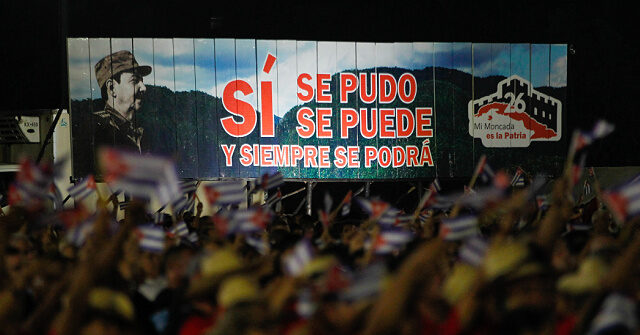
Cubans across the island nation banged pots and pans in a mass protest event against the regime on Friday and Saturday nights, demanding an end to the communist regime as the nation’s elites prepared to celebrate the anniversary of Fidel Castro’s first large-scale terrorist attack.

July 26 marks the anniversary of the 1953 attack on the Moncada military barracks in Santiago de Cuba by a terrorist cell organized by Fidel Castro, at the time an unpopular law student attempting to elevate his political profile. The attack killed 54 people and was, at the time, a massive failure for Castro’s movement, resulting in Castro’s arrest. Castro himself, according to the communist Cuban government, arrived “late” to the attack because he “got lost” on the way, abandoning 135 of his militants.

While the attack itself was a failure, the Communist Party celebrates it as the beginning of the “Cuban revolution,” the coup d’etat that brought Castro to power in 1959 after former President Fulgencio Batista pardoned Castro on three separate occasions for terrorist activities. The Castro dynasty has repeatedly attempted to replace the Republic of Cuba’s true independence day, May 20, with July 26, punishing citizens who choose to publicly celebrate the correct national day.

This year, Cuban dissidents preceded the July 26 festivities with mass protests in several of the country’s largest cities, including the capital of Havana, the Castro family’s native Santiago de Cuba, Cienfuegos, Santa Clara, and other population centers across the island. Many of the protests occurred in the pitch black of the night, as the national power grid, neglected for centuries, has almost entirely collapsed and the fall of former dictator Nicolás Maduro in Venezuela has deprived the nation’s elite of the free oil that elites long used to power their private generators and continue to avoid the consequences of nearly seven decades of socialism.

Videos from Havana, Santa Clara, Santiago, and other cities show the sheer volume of the banging of pots and pans in populated areas, much of it being from inside homes in neighborhoods with no visible electricity.

In some areas, locals organized bonfires to be able to see and took to the streets to condemn the regime and demand an end to the Castro dynasty.

Some Cuban dissidents filmed themselves using the limited internet access they have at home. One family banged their pots and pans in front of American and Cuban flags, a show of solidarity with the administration of President Donald Trump and its policies to restrict cash flows to the regime, used for over half a century to brutalize the local populace.

The protest actions were organized by the Assembly of the Cuban Resistance (ARC), a coalition of anti-communist, pro-democracy activists both within and outside of the island that works to coordinate actions and advocacy between Cubans at home and those in exile. In a statement shared with Breitbart News on Monday, the ARC celebrated that the protests “proved that the regime cannot repress an entire people when they act simultaneously.”

“The numerous videos received from Cuba show how the people came out to express their rejection of the dictatorship,” the Assembly observed. “Together with the sonorous sound of metal one can hear shouts of freedom, down with the dictatorship, and freedom for political prisoners with which the people showed the regime their full rejection.”

The ARC called for a “day of national protests” on Friday night, suggesting participants bang their pots and pans in a traditional form of protest throughout Latin America. The objective is for the sound to show the sheer number of opponents of communism on the island. In a statement shared with Breitbart News, the coordinator of the ARC, Orlando Gutiérrez-Boronat, declared the operation a success.

“We saw that the dictatorship cannot stop people from acting, we saw that the streets can be taken, we saw that the exile community and the internal resistance working together … had an optimal result,” he said. “The dictatorship trembled because the people were united.”

The ARC noted separately that, contrary to previous waves of protests on the island — which have been almost incessant since the massive nationwide protests on July 11, 2021 — “the level of repression was very limited and only in some areas did the police try to confront the protests.”

In at least one municipality near Havana, San Miguel del Padrón, locals documented the arrival of police on Friday, where locals had created a massive fire apparently blocking the middle of the street. The reports did not document any protesters disappearing or otherwise being arrested, however.

In Santiago, far-east Cuba, the independent news outlet Cubanet reported that at least one person, described as a “youth,” was arrested on Friday night, but the detention prompted a wave of neighbors to leave their homes and protest in the street, making the situation less controllable for authorities. After some hours of “dozens” of people taking to the streets, electricity reportedly returned to the Sueño neighborhood of Santiago de Cuba where the incident occurred.

A source sharing footage from the protests with Breitbart News noted that the regime, in an attempt to silence the noise, appeared to restore electricity to some of the affected neighborhoods. Eyewitnesses reported hearing shouts of “electricity no, liberty!” emphasizing that their goal was the eradication of the communist regime and not necessarily a restoration of basic government services that the Castros have been denying regular citizens for years.

Cuban journalist Mag Jorge Castro reported similarly that videos shared with him by protesters on the island indicated that, on Friday night, electricity abruptly returned to neighborhoods that had not had it for weeks, calling into question the regime’s narrative that power issues on the island are a result of the American “embargo” on Cuba and cannot be easily fixed. Castro, the journalist, shared images he received from an activist in Havana that showed electric lights on at night next to a massive fire, apparently restored after the protests began.

The protests continued through Sunday even as the regime attempted to organize its events to mark July 26.

The high-energy protests against the regime contrasted significantly with the somber event largely attended by senior citizens in the early morning hours of Sunday to mark the Moncada barracks terrorist attack, presided over by figurehead “president” Miguel Díaz-Canel. The event took place in the far-west province of Pinar del Río, which was chosen to host despite not being relevant to the terrorist attacks due to the alleged “grave and defying circumstances” the country faces.

Díaz-Canel en el acto por el 26 de Julio: Cuba libra hoy una batalla histórica, un nuevo Moncada

Díaz-Canel claimed that the Cuban communists were now facing an “historic battle – a new Moncada!” against the United States, warning that “the advance of the right and ultra-right in the region” had resulted in a “daily threat against the Revolution.”

Follow Frances Martel on Facebook and Twitter.


Read the full article here

Share.
Leave A Reply

Exit mobile version